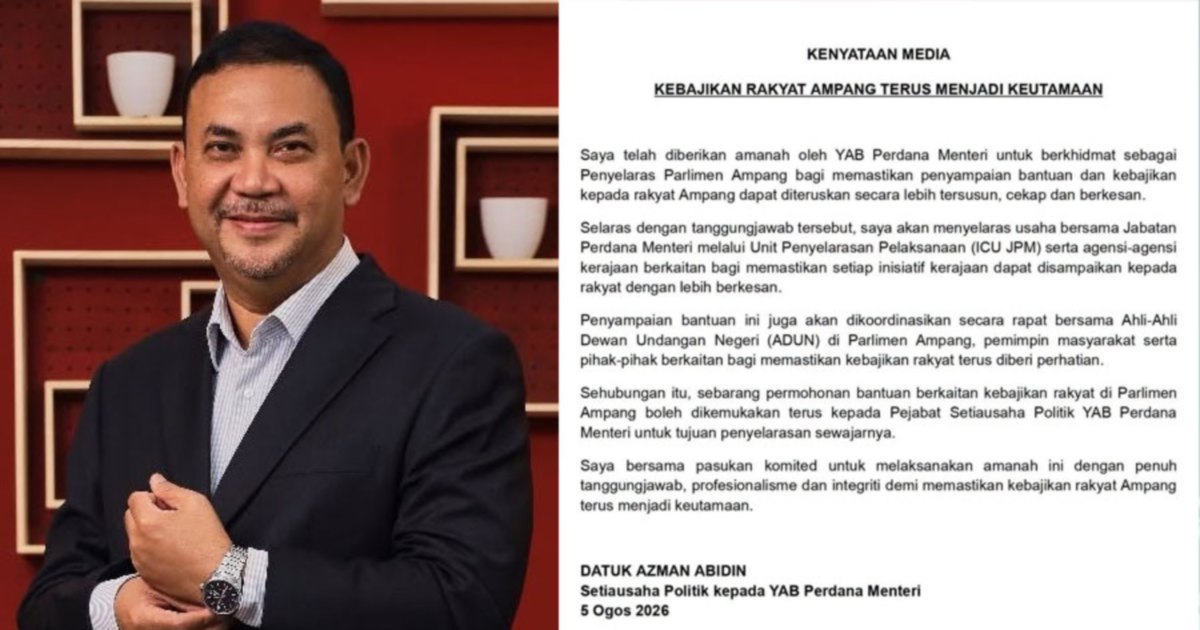
The Prime Minister's office has shifted control over parliamentary coordination in the Ampang constituency to one of Datuk Seri Anwar Ibrahim's senior political secretaries, a move triggered by the recent suspension of PKR lawmaker Rodziah Ismail's access to crucial constituent allocation mechanisms. This development marks an escalation in the internal party tensions within the People's Justice Party and signals growing intervention by the PM's office in constituency-level management, reflecting broader struggles over resource distribution and political influence within the ruling coalition.
Rodziah Ismail, who represents the Ampang parliamentary seat, has been effectively cut off from the MyKhas system—the federal government's online portal designed to facilitate disbursement of constituency development allocations to elected representatives. The suspension of her access to these funds represents a significant constraint on her ability to fulfil promised development projects and respond to constituent requests, a core function of Malaysian MPs seeking to maintain political legitimacy at the grassroots level.
The appointment of Anwar's aide to coordinate parliamentary activities in Ampang suggests that decisions affecting the constituency will now flow through the Prime Minister's office rather than through normal party channels. This centralisation of authority over local political operations raises questions about the autonomy of individual MPs within PKR and the wider PKR-led Pakatan Harapan government structure. Such arrangements are not unprecedented in Malaysian politics, yet they typically emerge during periods of factional conflict or when party leadership seeks to sideline particular members perceived as disloyal or problematic.
The MyKhas system itself has become increasingly significant in Malaysian electoral politics since its rollout across federal constituencies. By controlling access to development allocations, political leadership gains considerable leverage over individual MPs' ability to deliver tangible benefits to voters. Suspension of MyKhas privileges therefore functions as both a financial restriction and a public signal of diminished standing within party hierarchies, potentially undermining an MP's electoral prospects in future contests.
For Ampang residents and businesses seeking government support for local infrastructure, community programmes, or emergency assistance, this administrative change creates uncertainty about processes and timelines. Parliamentary coordinators typically manage the interface between constituents and their elected representative, handling inquiries, coordinating with federal agencies, and facilitating applications for development grants. The involvement of a PM's political secretary in these routine functions suggests that partisan considerations may increasingly influence how constituent services are administered.
Within PKR, this development reflects ongoing friction over party discipline and resource allocation. The party has experienced periodic internal disputes over the distribution of development funds and the selection of parliamentary candidates, particularly in competitive urban constituencies like Ampang. Such tensions often surface when particular MPs are seen as insufficiently supportive of party leadership or when factional groups compete for influence within the party's structure. The targeting of Rodziah Ismail's MyKhas access therefore warrants examination of her recent voting patterns, public statements, and alignment with or against particular PKR factions.
The appointment also carries implications for Anwar's centralising approach to government management. Since assuming the premiership, Anwar has expanded the influence of his personal political apparatus over various state institutions and party functions. Inserting his political secretaries into constituency coordination roles demonstrates a preference for direct oversight rather than delegated authority, a governance style that concentrates decision-making but can strain relationships with party members who feel bypassed or distrusted.
For the broader Malaysian political landscape, this situation illustrates how resource control mechanisms are weaponised in intra-party disputes. The MyKhas system, intended to streamline government spending, has become a tool for enforcing party discipline and managing internal factions. As opposition parties continue to challenge the government's legitimacy and performance, such internal divisions weaken the unity required to maintain voter confidence and counteract political competition.
The suspension of Rodziah Ismail's MyKhas access and the appointment of a PM's aide as Ampang parliamentary coordinator will likely intensify speculation about the MP's future within PKR. She may face formal investigation, be required to demonstrate renewed loyalty, or potentially be targeted for deselection in future elections. Her constituents meanwhile face a period of uncertainty about how development requests will be processed and whether they will receive the same level of attention and advocacy under new coordination arrangements.
Regionally, Malaysia's experience with resource-based political management reflects broader Southeast Asian patterns where executive branches concentrate authority and personalise governance structures. Such tendencies, while sometimes presented as efficiency measures, often undermine institutional stability and meritocratic advancement within political parties, instead reinforcing patronage networks and personalised power bases.
The incident underscores the continued fluidity of Malaysian coalition politics, where party discipline mechanisms interact with government resource distribution in complex ways. As Pakatan Harapan navigates its third year in government following the 2022 elections, these internal management questions will increasingly define how effectively the coalition can deliver on policy commitments and maintain political stability ahead of potential future electoral contests.

