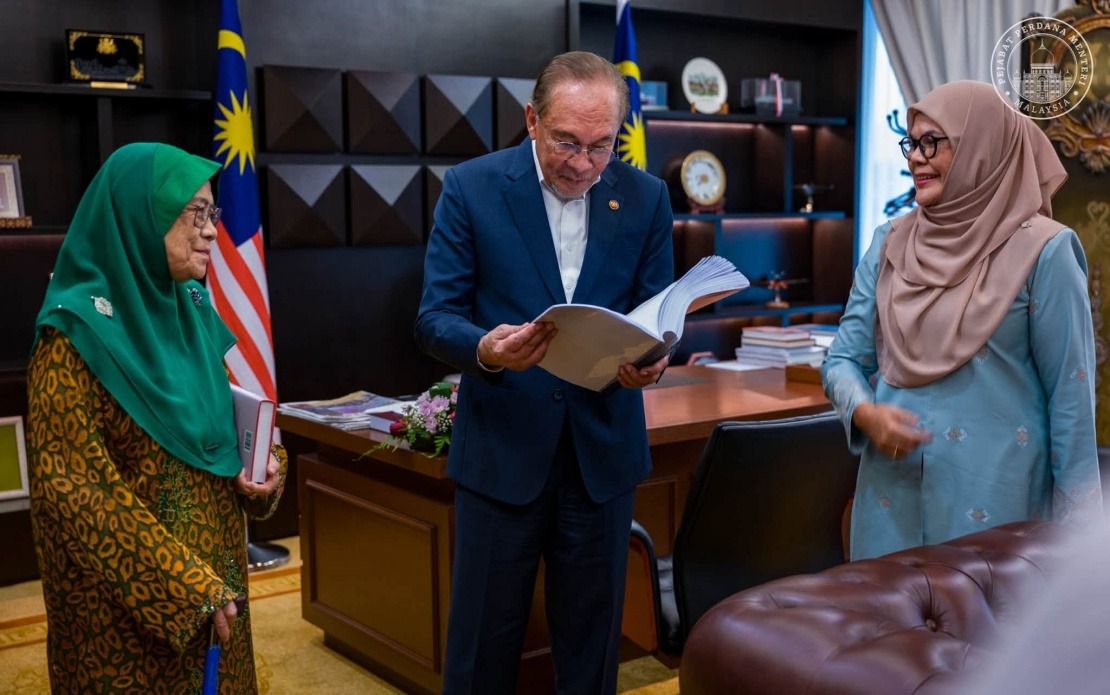
Prime Minister Datuk Seri Anwar Ibrahim has expressed optimism that a newly published book chronicling his intellectual journey and political philosophy will become a lasting resource for future policymakers and leaders grappling with questions of national development and governance.
In remarks shared on social media on July 1, Anwar indicated that he had actively participated in shaping the manuscript, offering detailed feedback and insights to ensure accuracy and depth. The book was authored by Professor Dr Salinah Ja'afar, a lecturer and linguist at the Academy of Malay Studies at Universiti Malaya, whose expertise in language and communication helped translate Anwar's ideas into coherent written form. This collaborative approach reflects an effort to move beyond political rhetoric and create an intellectual record of contemporary Malaysian leadership.
The Prime Minister also acknowledged the scholarly contribution of Professor Emeritus Datuk Dr Nik Safiah Abdul Karim, an internationally recognised linguist who served as the book's academic adviser. Her involvement signals an attempt to elevate the publication beyond mere political memoir, positioning it instead as a serious intellectual work worthy of academic scrutiny and analysis. Such credentials matter in a Southeast Asian context where many political publications lack rigorous editorial oversight or scholarly framework.
Anwar participated in exclusive interviews with both scholars to ensure comprehensive coverage of his worldview. These sessions appear designed to capture not merely his policy positions but the underlying philosophy informing his approach to governance—a distinction that could prove valuable for students, administrators, and future political figures seeking to understand how a sitting prime minister navigates complex national challenges.
The Prime Minister framed the publication as a testament to his commitment to documenting ideas shaped by decades of political experience, intellectual reading, and personal reflection. His emphasis on the book's potential educational utility suggests recognition that political leadership extends beyond managing immediate crises; it involves articulating enduring principles and values that can guide institutions long after current officeholders have left power. For Malaysian governance, where institutional memory can be fragmented across competing political narratives, such documentation carries particular weight.
Anwar's stated aspiration for the book to serve future generations positions it within a broader discourse about Malaysian nation-building. Rather than focusing narrowly on his tenure, the framing emphasises universal principles regarding character development, institutional ethics, and national direction. This approach resonates with concerns among Southeast Asian leaders about preserving institutional knowledge and preventing institutional amnesia when governments change.
The emphasis on personal values development reflects contemporary conversations about leadership quality in the region. Many Southeast Asian nations grapple with questions about how to cultivate ethical governance standards across bureaucratic hierarchies. By encoding his thinking on this theme in published form, Anwar appears to be creating a touchstone for future administrators to reference when facing ethical ambiguities or governance dilemmas.
The publication also carries symbolic weight regarding how Malaysia's political leadership engages with academia and intellectual discourse. The involvement of established scholars lends credibility while suggesting that serious political thought remains possible within the Malaysian system. This contrasts with dismissals of political autobiography as merely self-serving propaganda, instead positioning the book as a contribution to Malaysia's intellectual commons.
For Southeast Asian observers, the project illustrates how contemporary leaders attempt to shape historical legacy through published work. Unlike memoirs that typically appear after political careers conclude, this book emerges during Anwar's tenure as Prime Minister, suggesting confidence in both the relevance of his ideas and the likelihood that they will remain pertinent beyond his current role. The timing allows for active engagement with the work while Anwar remains in office, potentially influencing how his leadership is immediately interpreted and implemented.
The book's focus on nation-building philosophy rather than partisan politics could influence how future Malaysian policymakers approach development challenges. Given Southeast Asia's ongoing debates about balancing economic growth, social cohesion, and institutional integrity, having documented frameworks from current leaders may prove instructive for successor administrations navigating similar terrain.
This publication initiative also reflects broader regional trends in which prominent figures attempt to codify their leadership philosophy in accessible form. As Malaysia continues evolving its political system and wrestling with questions of governance legitimacy, such intellectual scaffolding may help institutions maintain continuity of purpose even as specific administrations change. The hope that future generations will reference this work underscores Anwar's apparent belief that leadership wisdom transcends electoral cycles and partisan loyalties, instead residing in enduring principles that institutions should perpetuate regardless of which coalition holds power at any given moment.

