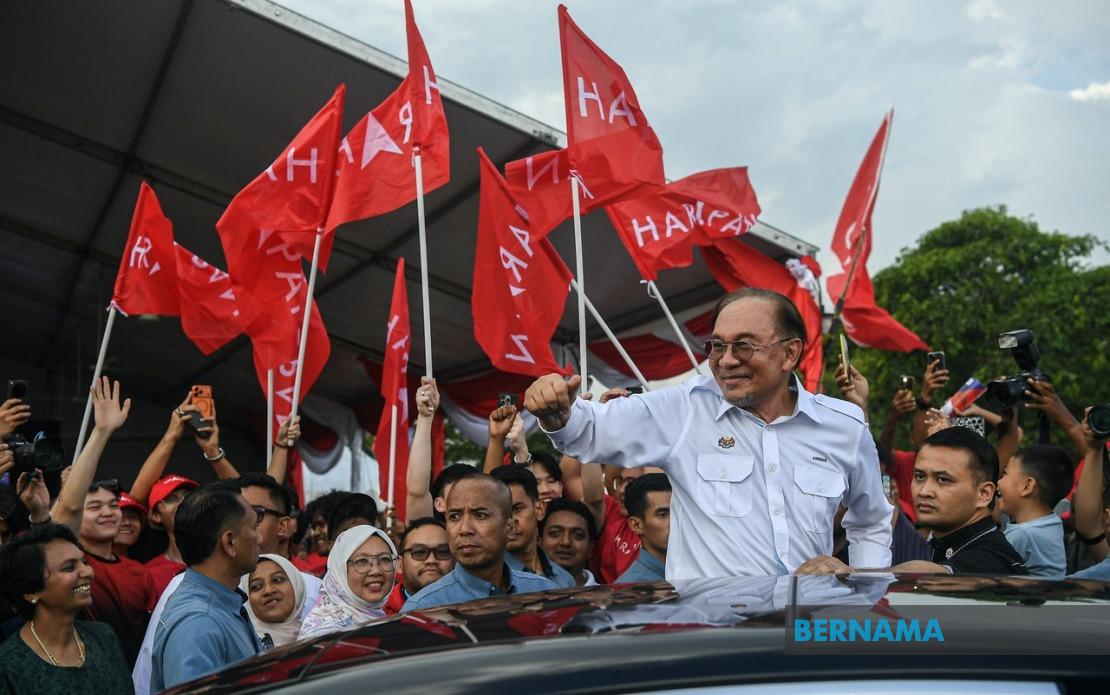
Prime Minister Anwar Ibrahim's energetic campaign blitz across Johor has injected renewed momentum into the Pakatan Harapan coalition's push in the 16th state election, with senior party officials crediting his direct engagement with voters for lifting the campaign's trajectory. Communications Minister Datuk Fahmi Fadzil characterised the reception encountered during the Premier's appearances as "extraordinary and encouraging," citing vivid examples of spontaneous public enthusiasm that extended far beyond typical political handshakes and rhetoric.
Fahmi, who accompanied Anwar during recent campaign stops in the Batu Pahat district including the constituencies of Senggarang and Semerah, recounted instances of genuine community interest that underscored the personal connection the Prime Minister continues to command at the grassroots level. Most memorably, he described an elderly resident who transported his spouse by trishaw specifically to encounter Anwar during a campaign event—a detail that encapsulates the depth of engagement PH strategists believe extends beyond casual curiosity into substantive political backing.
As the Communications director for the coalition and spokesperson for the PKR party machinery, Fahmi's assessment carries weight within party circles as a measure of campaign health. His observations, shared during a visit to the Malaysian National News Agency's operations centre in Johor Bahru ahead of early voting, suggest that PH's decision to deploy Anwar intensively across the state has yielded tangible dividends in terms of public turnout and receptiveness at campaign venues. The visible enthusiasm he witnessed indicates that voters, particularly those in traditionally significant constituencies, remain attentive to the ruling coalition's message during this critical electoral juncture.
The coalition's comprehensive campaign strategy deployed the Prime Minister across an ambitious schedule during the critical final weekend before polling commenced. Between Saturday July 4 and Sunday July 5, Anwar undertook 15 separate campaign engagements spanning the breadth of Johor, demonstrating both the importance PH attaches to retaining state control and the party's confidence in leveraging the Premier's political capital to energise its candidate slate and grassroots machinery. Such intensive deployment typically signals either vulnerability in specific constituencies or determination to expand the party's margin of victory where incumbency advantages exist.
Pakatan Harapan's commitment to fielding a complete slate across all 56 State Legislative Assembly seats reflects the coalition's intention to contest every corner of Johor rather than ceding territory to opposition challengers. This blanket coverage strategy requires substantial organisational capacity and sustained elite engagement, making the Prime Minister's visible participation a critical component of demonstrating party seriousness and resource commitment throughout the electorate. The presence of senior federal leadership serves multiple tactical functions: it reinforces local candidates' standing, projects an image of party unity and momentum, and provides grassroots activists with tangible morale support.
Johor's political significance extends beyond its own 56 seats. As Malaysia's second-largest state by population and a traditional power base for various political movements, outcomes here often forecast broader regional shifts. A strong PH performance would suggest the coalition maintains sufficient public confidence to defend existing state administrations, while conversely, losses would indicate waning support that could presage difficulties in other state contests or the next federal election. Anwar's personal campaign investment thus carries implications that ripple beyond Johor's boundaries.
The electoral contest itself witnessed substantial competition, with 172 candidates vying across the 56 constituencies—indicating a moderately contested race where multiple opposition parties fielded serious challenges across many seats. Early voting, which commenced on July 7, proceeded ahead of the main polling day scheduled for Saturday July 11, allowing voters unable to cast ballots on election day to participate in advance. This phased voting schedule has become standard practice in Malaysian elections and typically accommodates essential workers, those with mobility challenges, and others unable to appear on the designated polling day.
Fahmi's framing of public response merits deeper examination. His assertion that witnessed enthusiasm reflects genuine "interest and acceptance" toward PH's campaign messaging suggests the coalition perceives a receptive audience for its policy platform and governance record. However, distinguishing between passing curiosity aroused by a Prime Minister's visit and durable electoral commitment remains perpetually challenging for political analysts. The anecdote of the elderly couple's trishaw journey is emotionally resonant but represents a single data point rather than systematic evidence of broad-based support shifts across the electorate.
The Communications Minister emphasised that elevated public engagement, whether converting into direct electoral support or merely heightened attentiveness to state election developments, serves PH's strategic interests during a campaign period. Mobilising voters psychologically to perceive an election as consequential and worthy of serious consideration effectively elevates turnout environments—a factor that typically favours incumbent coalitions with established organisational networks. If the enthusiasm Fahmi observed translates into comparable turnout increases on polling day, PH would benefit from the expanded voter participation among demographics predisposed toward the coalition's candidates.
For Malaysian observers tracking political developments, Johor's state election functions as a significant bellwether. The state has alternated control between different political movements across recent electoral cycles, and its composition within the broader national parliament remains strategically important. Anwar's intensive personal campaign presence signalled both his confidence that PH could maintain or expand its position and his willingness to expend presidential-level political capital on state-level contests—a choice reflecting the magnitude PH leadership attributes to these contests.
The logistics of Anwar's campaign schedule—15 events across two days spanning a geographically dispersed state—underscored the Premier's stamina and the party's determination to maintain visible momentum through the final weekend before voters rendered their verdict. Such compressed schedules necessarily involve considerable travel, repeat messaging, and sustained engagement across diverse audiences. The quality of such intensive campaigning often depends on underlying organisational capacity: venues must be secured, crowds assembled, security arranged, and local media coordinated with efficiency.
As the Johor election proceeded toward its conclusion, the intensity of the campaign's final phase and the apparent resonance of PH's message among voters encountered by the Prime Minister suggested a contest where both the ruling coalition and opposition challengers perceived realistic prospects for influencing outcomes. The state's voters would ultimately determine whether the grassroots enthusiasm Fahmi documented would crystallise into the electoral verdict that validates PH's continued governance of Malaysia's second-largest state.

