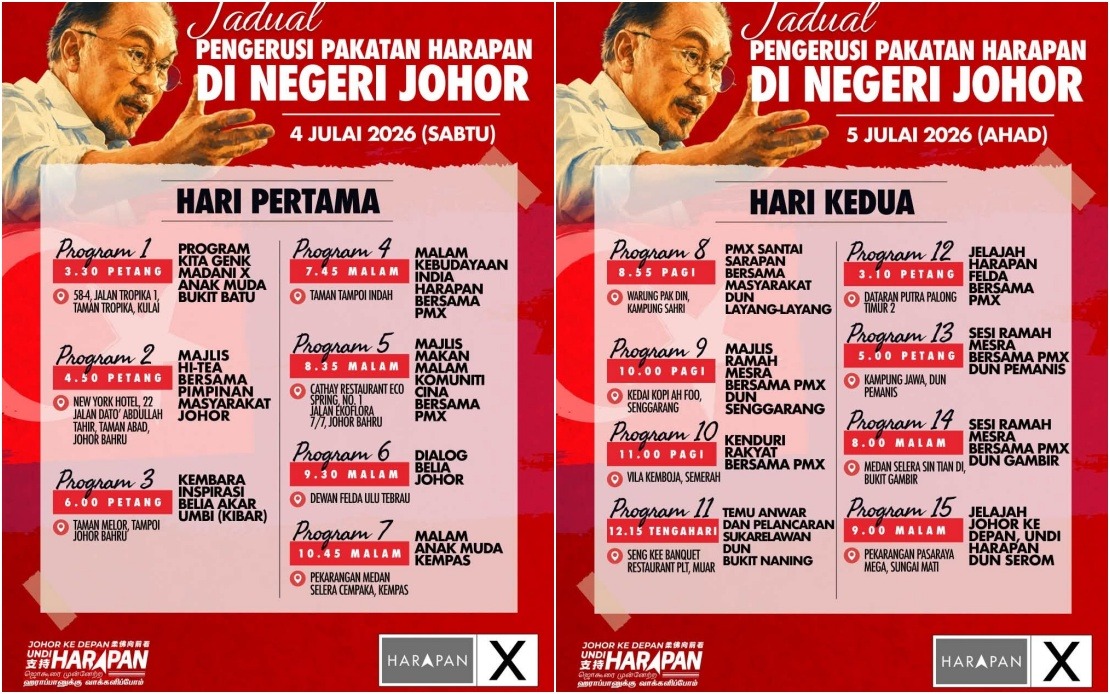
Datuk Seri Anwar Ibrahim, the Pakatan Harapan chairman, is preparing for an unusually intensive political campaign schedule across Johor over the coming weekend, with plans to attend 15 distinct programmes in support of 56 PH candidates competing in the 16th Johor state election. The flurry of campaign activity underscores the significance Anwar and his coalition place on the peninsula's southern powerhouse, where control of the state government remains fiercely contested among rival coalitions. His highly publicized itinerary, shared via social media platforms, represents a concentrated push to mobilize grassroots support and demonstrate coalition unity just eight days before voters head to the polls on July 11.
The scope of Anwar's weekend agenda reveals the strategically calculated nature of modern Malaysian political campaigning, with events carefully sequenced to reach diverse constituencies and demographic groups across multiple districts. Rather than focusing on a single geographic cluster, the campaign route zigzags across the state, suggesting deliberate attempts to maximize visibility in marginal seats and reinforce support in traditional strongholds. The scheduling pattern—beginning Friday afternoon and extending through Sunday evening—demonstrates the commitment required from party leadership to maintain momentum in what promises to be a closely contested electoral contest. This compressed timeframe also highlights the resource-intensive nature of coordinating multiple simultaneous campaign tracks, reflective of how contemporary Malaysian politics demands constant presence and engagement from top-tier party figures.
Friday's schedule begins with a youth-focused programme in Kulai at mid-afternoon, followed immediately by community engagement initiatives in Tampoi and surrounding areas. These early slots appear deliberately positioned to capture working voters and younger constituents before evening household activities begin. The later Friday evening agenda shifts focus toward demographic-specific engagement, with separate Indian cultural programming, Chinese community dining, and youth dialogue forums scheduled across consecutive hours. This segmented approach to community outreach—rather than holding unified rallies—reflects a more sophisticated understanding of voter fragmentation and the importance of tailored messaging for distinct communal groups. The timing also suggests PH strategists believe Friday evening provides optimal opportunity for capturing attention in an increasingly crowded media environment.
Sunday's itinerary expands the geographical reach, beginning early with breakfast engagements in Layang-Layang and progressing through village-level meetups and volunteer activation programmes. The explicit mention of "Kembara Inspirasi" (inspiration journeys) and grassroots dialogue sessions indicates PH's emphasis on direct voter contact rather than top-down broadcasting. The inclusion of volunteer launch events and constituent breakfast sessions suggests attention to building organizational infrastructure that extends beyond election day itself. These smaller, more intimate gatherings typically allow politicians to address specific local concerns while generating the social media content and word-of-mouth momentum that increasingly drives electoral outcomes in Malaysia's mixed urban-rural electorate.
The diversity of venues and event formats reflects strategic recognition that different voter segments respond to different campaign stimuli. Educational sessions appeal to younger voters concerned with policy substance; cultural nights activate community leaders and diaspora voters; dialogue forums create spaces for grievance airing and relationship building. This multifaceted approach contrasts with older campaign models that relied primarily on large public rallies and mass media reach. Instead, Anwar's itinerary prioritizes what political scientists term "retail politics"—personalized, community-level engagement that creates perception of accessibility and responsiveness. For Johor voters, particularly in semi-urban and rural constituencies, such direct access to the coalition chairman carries disproportionate significance in decision-making.
The 56 candidates Anwar is mobilizing behind represent PH's full slate in Johor, suggesting the coalition sees this state election as essential to its national political trajectory. Control of Johor's state assembly holds symbolic and practical importance beyond the state itself, as electoral performance here influences morale, funding availability, and momentum for subsequent national-level contests. A strong showing in Johor could energize PH's base nationwide, while disappointing results might embolden competing coalitions and complicate Anwar's leadership position within his own party structure. The concentration of high-level party attention on this single state election therefore signals broader strategic calculations about coalition viability and competitive positioning across the broader Malaysian political landscape.
Early voting on July 7 provides a secondary mobilization opportunity, allowing campaigns to push committed supporters toward advance polling even as undecided voters remain targets for persuasion efforts. The four-day gap between early voting and election day July 11 creates pressure for campaign managers to maintain momentum and address emerging issues or negative narratives that might surface during final days. Anwar's weekend blitz essentially functions as the opening salvo in this final sprint, establishing PH's presence in voters' consciousness before the actual voting window opens. The intensity of his personal involvement sends signals both to party grassroots organizers—validating their efforts with visible leadership commitment—and to voters—suggesting PH leadership takes Johor seriously enough to warrant senior figures' time investment.
For Malaysian political observers, this campaign approach illustrates evolving dynamics in how modern coalition politics operates in Malaysia. The fractured state of national politics, with multiple competing coalitions scrambling for relevance and position, has intensified competition for state-level control. Individual state elections now function increasingly as proxy contests for broader coalition viability rather than purely local affairs. Anwar's personal campaign investment in Johor reflects this reality, where state election outcomes immediately influence coalition stability, parliamentary mathematics for future federal governments, and organizational morale. The weekend campaign represents both practical electoral strategy and symbolic statement about PH's continued investment in maintaining competitive presence across Malaysian geography.
The explicit social media invitation to "all Johor voters" to join the programmes reflects contemporary campaign tactics emphasizing open-access, democratized political participation rather than closed party-member-only events. This messaging appeals particularly to younger, urban voters accustomed to digital communication and skeptical of traditional political gatekeeping. By framing events as open community gatherings rather than exclusive party functions, Anwar's campaign attempts to transcend traditional party-member boundaries and position PH as coalition open to broad-based support. This rhetorical framing matters substantially in Malaysian electoral contexts, where swing voter persuasion often hinges on perception of which coalition appears more inclusive and less captured by factional interests.
Geographically, the weekend route emphasizes constituencies around Johor Bahru metropolitan area and surrounding Kulai-Tampoi-Senggarang corridors, suggesting PH strategists identify these semi-urban zones as critical battlegrounds. These areas typically feature mixed demographics—established Chinese business communities, growing Indian professional classes, younger Malay urban voters, and transitional agricultural-to-residential populations. Winning these constituencies decisively while holding ground in established urban strongholds and making inroads in rural Felda settlements would likely deliver PH control of the state assembly. The campaign schedule's emphasis on these areas indicates sophisticated analytical assessment of where votes genuinely remain contestable and where party efforts can generate return on investment.
The intensity of Anwar's personal involvement also carries implications for his standing within Pakatan Harapan and broader national politics. By committing to this exhausting campaign schedule and personally campaigning across multiple constituencies, Anwar demonstrates continued physical stamina and political engagement despite his advancing age—concerns periodically raised in Malaysian political commentary. His visible presence across different event types and community settings allows demonstration of coalition unity and party discipline, countering narratives about internal PH divisions that periodically emerge in Malaysian media. The weekend campaign functions simultaneously as electoral strategy, intra-party signal, and broader political communication to the Malaysian electorate about coalition readiness to govern.
As voting approaches, the outcome in Johor carries ramifications well beyond state boundaries. A successful election result would validate Anwar's leadership strategy and strengthen his position heading into potential federal elections. Conversely, disappointing results might trigger internal coalition tensions and embolden competing political formations. This high-stakes context explains why Anwar personally commits to 15 programme venues across two days—the Johor state election represents far more than a local contest. It functions as crucial data point about whether Pakatan Harapan's current coalition formula, leadership structure, and policy messaging resonates with Malaysian voters across diverse geographic and demographic contexts. The weekend campaign blitz thus represents both practical electoral tactic and strategic gamble on Anwar's continued political viability as coalition leader navigating Malaysia's increasingly complex and fragmented electoral landscape.

