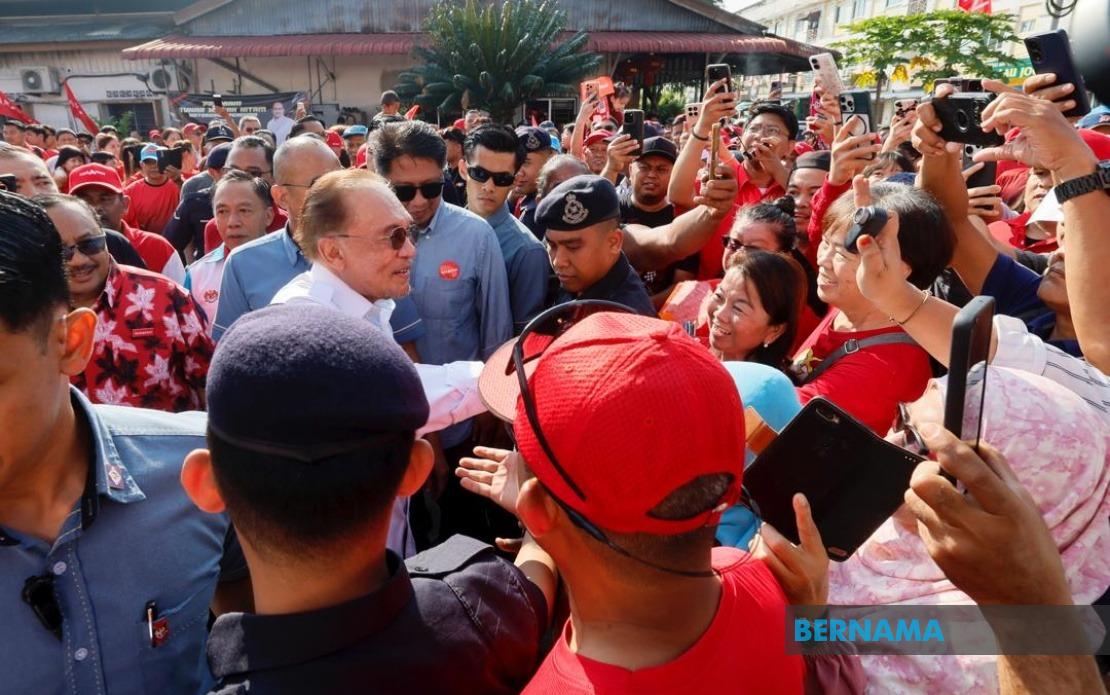
Prime Minister Datuk Seri Anwar Ibrahim's on-the-ground campaign effort in Johor has delivered a significant psychological lift to Pakatan Harapan's election machinery, with grassroots operatives and candidates pointing to his personal engagement as a catalyst for deeper community outreach efforts. The visit, occurring on the ninth day of the state election campaign cycle, concentrated on the constituencies of Machap and Layang-Layang within the broader Simpang Renggam parliamentary zone, where PH fielded its challenge to capture ground in the increasingly competitive southern state.
The informal breakfast gathering format employed by the campaign apparatus—styled as 'PMX Santai Sarapan Bersama Masyarakat'—drew participation from over a thousand residents in Simpang Renggam, creating the visual and organisational momentum that opposition parties require when competing in state-level contests. The deliberate choice of casualness in the Prime Minister's engagement appears designed to convey accessibility rather than the hierarchical distance that can sometimes characterise political leadership in Malaysia's electoral environment.
Nur Hafiz Roslan, contesting the Machap state seat under the PH banner, articulated the significance of the visit through the lens of campaign morale and messaging discipline. He framed the Prime Minister's presence as reinforcing the ideological underpinnings that PH believes should anchor its campaign—namely, that electoral success should translate into substantive service delivery for constituents rather than factional gain or communal division. The emphasis on 'amal soleh,' or righteous conduct in public service, attempts to tether the campaign narrative to religious and ethical principles rather than partisan advantage alone.
Anwar's direct messaging to candidates emphasised the imperative of diligent execution and community-centred engagement throughout the campaign period. By personally reminding candidates that their presence in these constituencies should be defined by service rather than antagonism, the Prime Minister sought to establish a standard of conduct that could inoculate PH against accusations of divisive tactics—a persistent vulnerability for opposition-turned-governing coalitions in Malaysia's polarised political landscape. The reinforcement of this message at multiple campaign stops signals that Putrajaya views it as sufficiently important to warrant the Prime Minister's personal time investment during a contested election cycle.
Guna Balakrishnan, standing as the PH candidate in Layang-Layang, similarly invoked the motivational impact of the Prime Minister's visit while simultaneously insisting that grassroots mobilisation efforts require continuous intensification rather than complacency born from apparent incumbent advantage. His comments reflected an understanding that perceived support among local residents, while encouraging, does not automatically translate into polling-day turnout or ballot-box gains. The strategic instruction that Balakrishnan attributed to Anwar—that electoral victory must be followed by genuine development outcomes for the locality—addresses a chronic credibility challenge facing Malaysian political coalitions that have made unfulfilled promises in the past.
The demographic snapshot provided by attending residents offers insight into the messaging's reach across age cohorts and community segments. Chuan Chee Mei, a 48-year-old Simpang Renggam resident, articulated that witnessing the Prime Minister's visible commitment to supporting candidates at grassroots level strengthened her family's intention to vote PH. This observation highlights how Malaysian voters, particularly at the state level, assess coalition viability through the personal engagement and presence of senior leadership rather than solely through policy platforms or organisational structures.
Another attendee, Noor Takiyudin Salleh, aged 38, emphasised the atmospheric qualities of the campaign engagement—its informality, accessibility, and apparent scale of public participation. The fact that the crowd numbered exceeding a thousand people provided visual testimony to PH's campaign momentum in this particular zone, reinforcing perceptions among voters that the coalition possessed organisational capacity and community responsiveness. In Malaysian state elections, such visible demonstrations of grassroots energy frequently correlate with polling performance, as they generate social proof effects that encourage marginal voters to perceive momentum as shifting toward particular contenders.
The Johor state election represents a significant political contest within Malaysia's federal context, with 172 candidates competing across 56 state assembly seats. Scheduled polling on July 11 follows early voting on July 7, creating a compressed campaign window in which visible leadership engagement and intensive ground mobilisation become proportionately more consequential. For PH, which faced substantial setbacks in recent Johor electoral cycles, demonstrating organisational coherence and renewed engagement represents both necessity and strategic priority.
The timing of Anwar's campaign intervention—occurring neither at the election's outset nor in its final days—suggests a calibrated approach to leadership visibility in state-level contests. The Prime Minister's presence at mid-campaign junctures allows for consolidation of support among persuadable constituencies while maintaining sufficient temporal distance that subsequent campaign developments can build upon any momentum generated. For Machap and Layang-Layang specifically, the visit represents an opportunity to elevate candidates beyond their individual profiles and associate them with federal-level governance experience and credibility.
The religious and ethical framing employed by campaign messaging, emphasising service and righteous conduct rather than partisan combat, aligns with broader PH positioning in Malaysian electoral politics since its 2018 federal victory and subsequent coalitional evolution. Such messaging particularly resonates in Johor, where Malay-Muslim voters constitute substantial electoral constituencies and where perceptions of ethical governance and community responsiveness carry demonstrable influence on voting behaviour. By anchoring campaign discourse to these values, PH attempts to contest for support among Johor's Malay-Muslim populations rather than ceding such constituencies entirely to established competitors.
The engagement mechanism employed—informal breakfast gatherings that prioritise direct voter interaction over stagecraft and distance—represents a deliberate departure from traditional rally-format politics that characterises much Malaysian campaign activity. Such intimate, community-level interactions create personal testimonial content that translates effectively across social media platforms and informal community networks, amplifying reach beyond immediate physical attendance. For voters aged under 50, such organic engagement frequently carries greater persuasive weight than conventional advertising or party statements.
Moving forward toward the July 11 polling date, the campaign implications of the Prime Minister's intervention will become evident through voter behaviour at the ballot box. PH's performance in Johor carries significance beyond the state itself, affecting perceptions of federal coalition stability and the government's capacity to maintain political momentum during a period when economic challenges and internal coalition management present competing demands on Anwar Ibrahim's political capital and attention.

