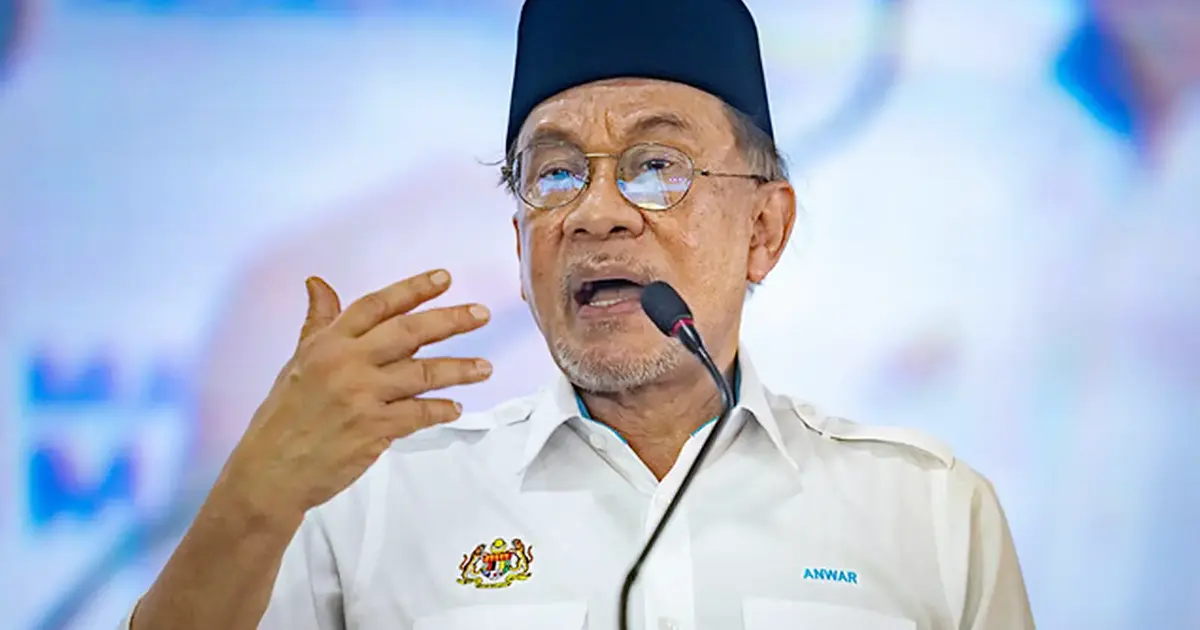
Prime Minister Anwar Ibrahim has issued a forceful warning to members of his cabinet to refrain from launching public attacks against coalition partners contesting in upcoming state elections, signalling that those who breach this expectation may be forced to step down from their ministerial roles. The directive underscores growing tensions within Malaysia's unity government framework as various political parties prepare for electoral contests at the state level, where competing interests sometimes override broader coalition unity.
Anwar's caution reflects a delicate balancing act inherent in Malaysia's governing coalition, which brings together parties with sometimes divergent political agendas and regional power bases. The unity government model, introduced as a measure to stabilize Malaysian politics following the 2022 general election, relies heavily on restraint and mutual respect among member parties. Any breach of this understanding—particularly when senior ministers use their official platforms to undermine coalition allies—threatens the stability that the government has sought to maintain since taking office.
The prime minister's statement addresses a perennial challenge in coalition governance: distinguishing legitimate political competition from acts that destabilize the broader ruling alliance. Ministers holding high office possess significant institutional resources, including media access, government communications machinery, and public platforms, which can be mobilized for electoral advantage. When these tools are deployed against coalition partners rather than opposition candidates, the potential for damage to inter-party relationships becomes acute. Anwar's warning signals that such misuse would constitute grounds for immediate removal from government.
This directive becomes particularly significant in the Malaysian context, where state elections often serve as testing grounds for party popularity and as venues for intra-coalition rivalries to intensify. Coalition partners may compete for the same constituencies or pursue overlapping political strategies, creating natural friction. However, the unity government framework explicitly requires that such competitions remain within bounds that preserve overall coalition integrity. The threat of ministerial resignation represents a serious enforcement mechanism in a system where cabinet positions carry considerable weight and prestige.
The backdrop to Anwar's warning includes instances in recent months where coalition members have publicly criticized one another or engaged in competitive positioning that risked undermining the government's image of cohesion. State-level elections provide opportunities for parties to enhance their local standing and improve their negotiating positions within the coalition structure. Yet if these competitions devolve into personal or partisan attacks using government resources, they create precedents that could fragment the coalition further. The prime minister's intervention seeks to prevent such deterioration before it becomes systemic.
For Malaysian voters and observers of coalition politics, Anwar's stance demonstrates a willingness to enforce discipline within government ranks, even when doing so requires confronting senior or popular figures. This approach appeals to those who view coalition instability as damaging to governance continuity and economic confidence. However, it also raises questions about whether the unity government model can genuinely accommodate the electoral ambitions of its constituent parties without periodic friction or threats of resignation.
The broader implications extend beyond immediate state electoral contests. How effectively Anwar enforces this principle will influence the trajectory of coalition governance over the medium term. If ministers who attack coalition allies face genuine consequences, other cabinet members will recalibrate their campaign strategies accordingly. Conversely, if the warning goes unheeded or unenforced, it signals that the coalition's stated unity principles are negotiable, potentially accelerating the erosion of trust among member parties.
Regionally, Malaysia's unity government has been closely watched as an experiment in post-election coalition management. Southeast Asian democracies often face questions about whether competing parties can govern together effectively, and the Malaysian case offers instructive lessons. A coalition that maintains internal discipline while permitting legitimate political competition may prove more durable than one that splinters over state-level contests. Anwar's intervention reflects awareness that the unity government's long-term viability depends on establishing and enforcing clear boundaries around acceptable political behavior.
The threat of ministerial resignation also carries practical weight in Malaysia's political economy. Cabinet positions provide access to patronage networks, budget allocations, and policy influence that parties value highly. The prospect of losing these advantages serves as a powerful incentive for compliance with coalition protocols. Ministers contemplating competitive campaign strategies must now weigh the electoral benefits of aggressive tactics against the risk of forced removal from government.
Looking ahead, the prime minister's stance will likely influence how coalition partners conduct themselves during coming state elections. Parties will need to develop campaign approaches that advance their own electoral interests without crossing the line into attacks on coalition allies—a narrow path that demands careful calibration. Anwar's willingness to define and enforce this boundary suggests he views coalition stability as a priority that outweighs the short-term electoral gains individual parties might achieve through unrestricted campaign aggression.
The challenge for Anwar and his government lies in maintaining this discipline consistently while managing legitimate policy disagreements and electoral competition among coalition members. The unity government represents an ongoing negotiation between competing political forces bound together by shared interest in remaining in office. How successfully that negotiation is managed, particularly during electoral cycles, will substantially determine both the coalition's durability and the government's broader credibility with the Malaysian electorate.

