Prime Minister Datuk Seri Anwar Ibrahim has sought to reinforce the importance of cohesion and mutual respect by sharing a traditional four-line Malay pantun on his official Facebook page, signalling a message about consensus and camaraderie at a delicate moment for Malaysia's Federal Unity Government. The poetic post, which emphasised unity, discipline and solidarity through the classical art form, generated substantial online engagement, accumulating more than 11,500 reactions within just two hours of publication and prompting over 1,700 comments from followers who responded with enthusiasm and, in several cases, pantun compositions of their own.
The timing of Anwar's cultural intervention carries considerable significance. The Federal Government comprises two ordinarily antagonistic coalitions—Pakatan Harapan, which he chairs, and Barisan Nasional, led by Deputy Prime Minister Datuk Seri Dr Ahmad Zahid Hamidi—who have forged an unprecedented power-sharing arrangement at the federal level. This partnership has repeatedly proven fragile, with periodic public friction and conflicting statements threatening to destabilise the administration. The pantun thus reads as a subtle yet direct appeal for restraint and remembrance of shared responsibility.
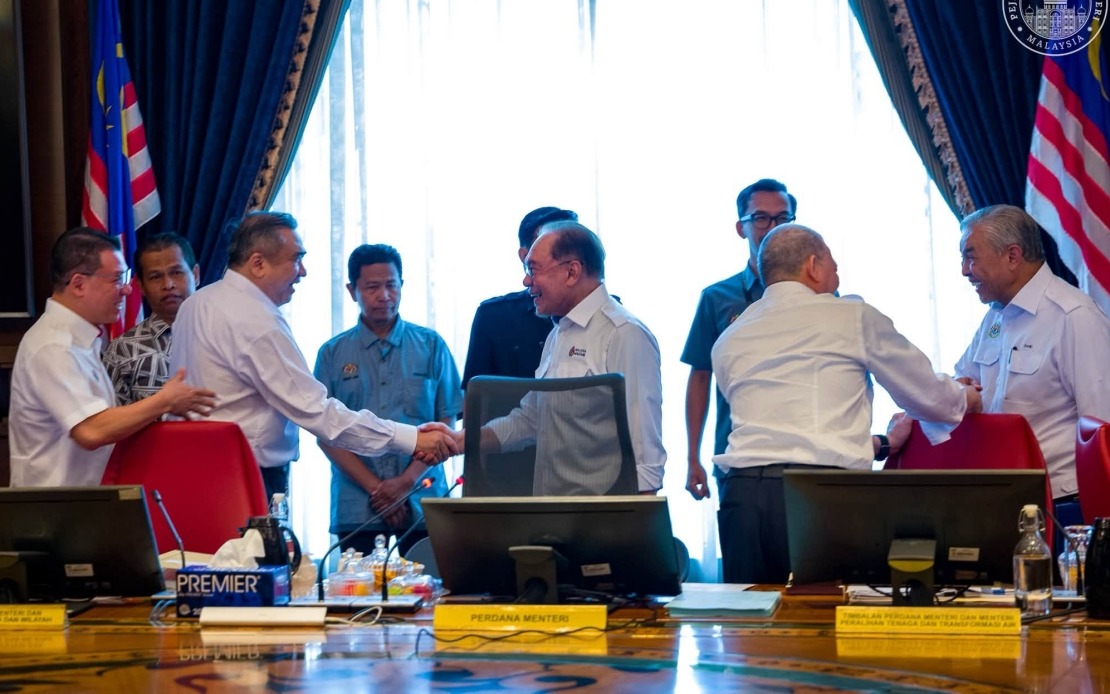
For Malaysian readers accustomed to decoding political messaging, the post's subtext warrants close examination. By choosing to communicate through the medium of pantun rather than conventional statement, Anwar employed a distinctly Malaysian cultural form that carries deep associations with harmony and traditional values. This rhetorical choice suggests an attempt to elevate the conversation beyond partisan squabbling into a realm of shared national heritage. The accompanying photograph of Cabinet members including Transport Minister Anthony Loke, all displaying relaxed demeanour during an official meeting, reinforced the visual narrative of a functioning, collegial government.
The post arrives amid heightened friction within the coalition structure stemming from the forthcoming Negeri Sembilan state election, scheduled for August 1st following the dissolution of the State Assembly on June 5th. Early voting will occur on July 28th. The election presents a particularly complex challenge to the Federal Unity Government's cohesion because both component parts intend to contest vigorously. Pakatan Harapan, chaired by Anwar, is fielding candidates across all 36 state seats, while Barisan Nasional, under Ahmad Zahid's leadership, is contesting 25 constituencies while simultaneously forging an electoral pact with Perikatan Nasional, the opposition coalition.
This arrangement reveals the fundamental tension within Malaysia's current political settlement. The two coalitions maintain government partnership in Putrajaya while simultaneously competing for control of state assemblies. Such competition inevitably generates friction, as elected representatives in both camps face grassroots pressure to prioritise their coalition's interests over federal unity. The Negeri Sembilan election particularly tests this arrangement because both PH and BN possess significant support bases in the state, making a decisive outcome unlikely and increasing the prospect of post-election recriminations.
The online reception to Anwar's pantun suggests that substantial segments of the Malaysian public view the maintenance of Federal stability as important, even as they retain strong partisan preferences. The commentariat responding to the post praised what many characterised as the Prime Minister's conciliatory tone and demonstrated statesmanship. This positive reception indicates receptiveness to narratives emphasising consensus and cohesion, particularly among segments of the population concerned about political turbulence. For political leaders, such responses provide encouragement to continue emphasising unity rhetoric, even when structural incentives for coalition rivalry remain intact.
The choice to accompany the pantun with an evergreen 1980s musical hit added another layer to the messaging strategy. By pairing traditional cultural content with nostalgic popular music, Anwar created a multimedia composition that appealed across generational and demographic lines. This approach reflects contemporary political communication in Southeast Asia, where leaders increasingly employ multi-platform strategies to reach diverse audiences and avoid the formality associated with conventional political addresses.
For the broader Malaysian political system, Anwar's intervention represents an attempt to manage one of the most significant structural challenges facing the Federal Government: maintaining coalition discipline while allowing component parties sufficient autonomy to satisfy their respective grassroots constituencies. The Negeri Sembilan election will test whether such rhetorical appeals can successfully contain the centrifugal forces threatening the unity arrangement. Should either coalition emerge from the election claiming mandate or victory, renewed demands for enhanced representation or policy influence seem inevitable, placing fresh strain on federal cohesion.
Regionally, Malaysia's Federal Unity Government remains an unusual arrangement attracting significant attention from neighbouring democracies navigating their own coalition politics. The success or failure of Anwar's approach to managing intra-coalition tensions carries implications for democratic governance across Southeast Asia, where coalition-building increasingly characterises competitive political systems. The resort to cultural messaging and appeals to national solidarity offers a distinctly Malaysian model for addressing such challenges, one emphasising shared heritage and traditional values rather than purely procedural or institutional mechanisms.
Looking forward, the effectiveness of Anwar's unity messaging will be assessed not merely by online engagement metrics but by whether the Federal Government survives the Negeri Sembilan electoral contest without serious rupture. The pantun itself, regardless of its immediate political impact, will likely be remembered as a significant moment in Malaysian political communication—an instance when a sitting Prime Minister chose poetry over conventional rhetoric to address the nation at a moment of institutional vulnerability. Whether such cultural interventions prove sufficient to sustain the fragile coalition arrangement remains an open question that Malaysian voters and international observers will continue monitoring closely.

