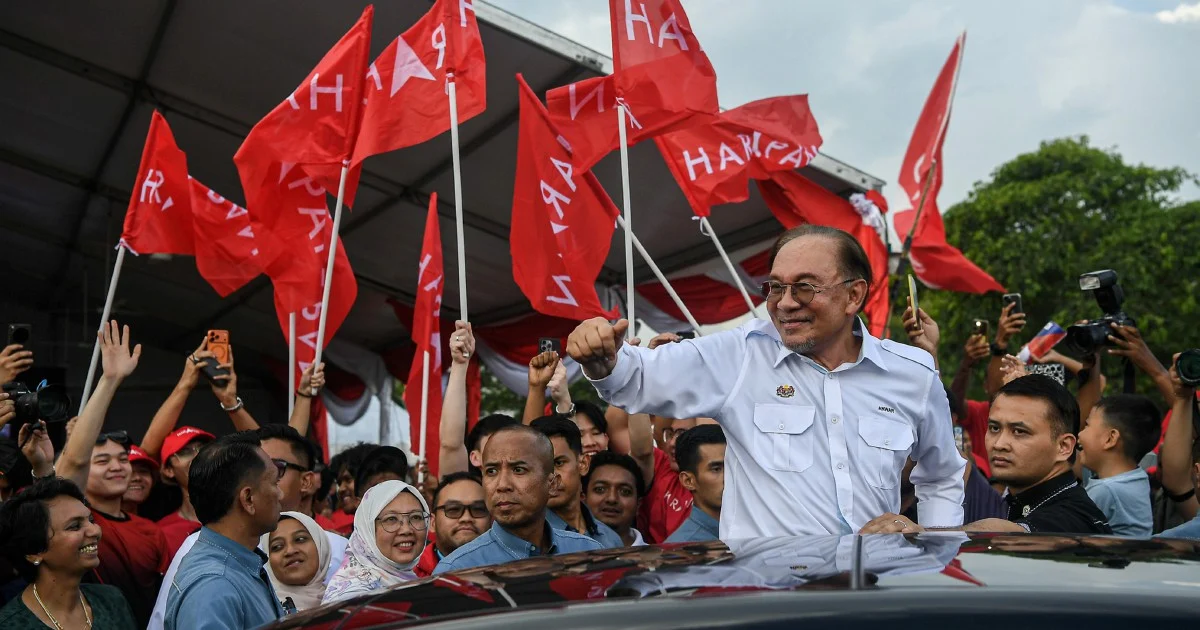
Prime Minister Datuk Seri Anwar Ibrahim has launched a pointed critique at political opponents unwilling to share platforms with the Democratic Action Party, framing their reluctance as a fundamental disrespect for voters' democratic choices. The Pakatan Harapan chairman raised the matter while addressing supporters in Segamat, signalling his frustration with what he views as an obstinate rejection of coalition reality that emerged from recent electoral contests.
The rebuke carries particular significance within Malaysia's evolving political landscape, where seat allocations and power-sharing arrangements hinge on the outcomes of nationwide ballots. Anwar's comments underscore the precarious balance that underpins the ruling coalition, which depends on maintaining unity across its disparate member parties despite their distinct ideological traditions and grassroots constituencies. The defence of DAP's position suggests mounting strain within the broader opposition and among those outside government who resist the current power configuration.
Anwar's argument rests on a principle of electoral legitimacy: voters collectively determined the composition of parliament, and therefore the resulting government reflects the people's mandate rather than any particular leader's preference. By extension, his framing implies that refusing to work alongside DAP amounts to rejecting the electorate's will. This rhetorical strategy attempts to elevate coalition-building above partisan grievances, positioning cooperation as a civic obligation rather than a matter of convenience.
The DAP's inclusion in Pakatan Harapan has proven consistently contentious, particularly among segments of the Malay-Muslim electorate who harbour concerns about the party's advocacy positions on religious matters and secular governance. These sensitivities have given opposition parties ammunition to distance themselves from coalitional arrangements involving the party, calculating that such separatism appeals to voters harbouring similar reservations. The willingness of some politicians to forgo collaborative opportunities rather than appear associated with DAP reflects calculations about electoral viability in their respective constituencies.
Anwar's defence must navigate treacherous political terrain. While emphasising that voters endorsed the current government, he simultaneously needs to accommodate legitimate concerns within his own coalition about how Pakatan Harapan is perceived among key demographic groups. The statement appears designed partly for internal consumption—reassuring coalition partners, particularly DAP, that their position remains secure despite external criticism. Such reassurance matters when coalitions depend on mutual commitment and when defections could imperil parliamentary majorities.
The timing of these remarks reflects broader anxieties within the ruling coalition about its political durability. Successive by-elections and state-level developments have demonstrated that electoral support remains volatile, particularly as voters express dissatisfaction with inflation, cost-of-living pressures, and perceived inaction on governance issues. Opposition parties have grown more confident in their critique, and some within the government's own ranks have questioned the viability of multi-ethnic, multi-faith coalitions facing coordinated challenges from rivals mobilising along narrower demographic lines.
For Malaysian readers observing national politics, Anwar's comments illuminate the fundamental tension between inclusive, pragmatic governance and the identity-based appeals that resonate powerfully across Malaysia's diverse electorate. The refusal of some politicians to cooperate with DAP reveals how electoral mathematics intersect with deeply rooted cultural and religious concerns. This dynamic will likely shape government stability and opposition strategy for the foreseeable future.
The statement also carries implications for Southeast Asia's broader democratic trajectory. Malaysia's coalition politics demonstrate how multiparty systems navigate diversity, but also expose vulnerabilities when parties prioritise narrow electoral gain over institutional stability. Anwar's appeal for respect toward voters' choices represents an attempt to subordinate sectarian concerns to democratic procedure—an approach that remains contested within Malaysian society.
Internal coalition dynamics may prove decisive in determining whether Pakatan Harapan can sustain its parliamentary majority through the next electoral cycle. The willingness of politicians to defy Anwar by refusing platforms with DAP signals that discipline within the coalition cannot be taken for granted. Younger politicians especially may calculate that their future prospects improve through tactical repositioning rather than loyalty to incumbent arrangements. These pressures will likely intensify if government popularity continues eroding amid economic challenges.
The Segamat remarks demonstrate that Anwar recognises coalition fragmentation as an immediate threat requiring rhetorical reinforcement of its legitimacy. By framing cooperation as respect for democratic outcomes, he attempts to transform what might otherwise appear as mere power maintenance into a higher civic principle. Whether this argument persuades politicians with immediate electoral incentives to distance themselves from DAP remains uncertain, particularly if opinion polls continue suggesting that association with the party damages prospects in crucial constituencies.
Moving forward, the sustainability of Pakatan Harapan's governance model depends significantly on whether parties can collectively manage concerns about the coalition's composition without resorting to public recriminations that erode voter confidence. Anwar's defence of DAP inclusion provides a baseline commitment, yet political realities may eventually force tactical compromises that, while preserving formal coalitional arrangements, effectively alter DAP's substantive influence within government decision-making structures.

