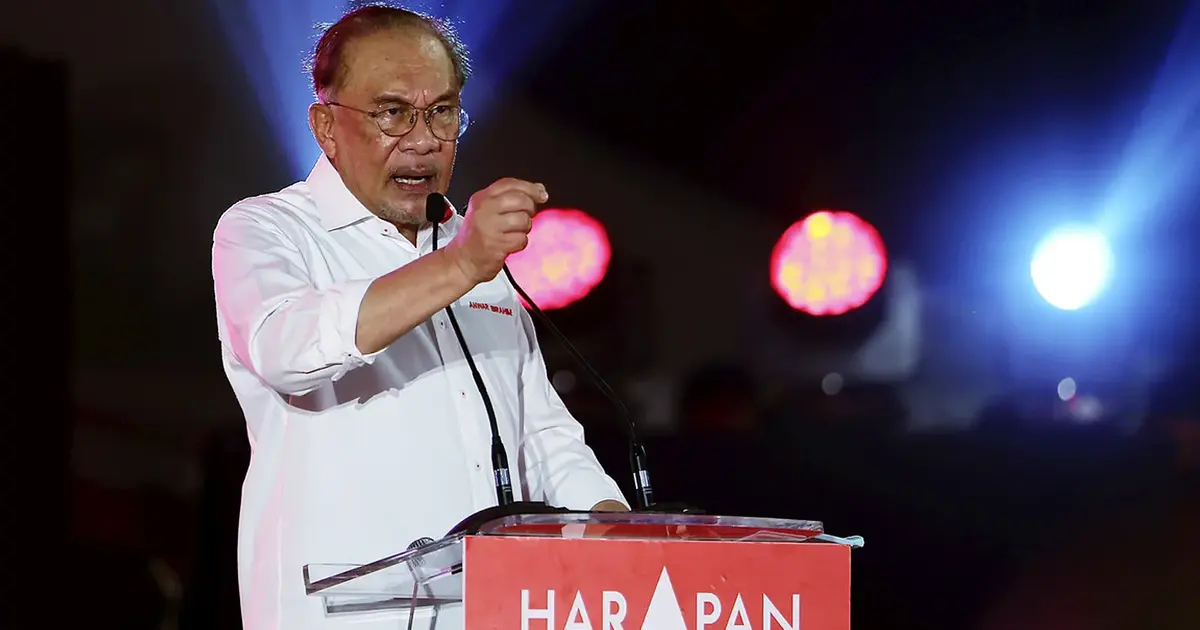
Prime Minister Anwar Ibrahim has called on all political parties contesting the Negeri Sembilan state election to exercise restraint when discussing issues related to the state's royal institution, warning that such matters ought to remain above the partisan fray. The Pakatan Harapan chairman's appeal underscores growing concerns about maintaining the depoliticization of constitutional monarchies across Malaysia's federal system, particularly during intense campaign periods when rhetoric can become heated and divisive.
Anwar's intervention reflects a broader understanding within Malaysian politics that the institution of rulers occupies a constitutionally protected space that transcends electoral competition. The principle of keeping royal matters beyond the reach of party politics has long been considered foundational to Malaysia's political stability, even as other state institutions have become increasingly subject to partisan scrutiny and contestation. By directing his message specifically at political contestants, the Prime Minister was essentially reinforcing an unwritten but widely observed convention that electoral campaigns should not serve as platforms for substantive debates about the prerogatives, roles, or conduct of state rulers.
The timing of Anwar's statement carries particular significance given Negeri Sembilan's position within the Malaysian federation. As a state with its own hereditary ruler and unique constitutional arrangements within the broader framework of constitutional monarchy, Negeri Sembilan's political processes carry implications that extend beyond the boundaries of the state itself. The Dewan Negara system that governs the state, distinct from other Malaysian jurisdictions, adds another layer of institutional complexity that demands careful handling during electoral discourse.
Political analysts have noted that campaign seasons frequently test the boundaries of permissible political speech, with candidates and party representatives sometimes venturing into territory that touches on sensitive constitutional or institutional matters. By issuing this advisory before campaigning intensifies, Anwar appears to be establishing clear expectations for acceptable conduct across all participating parties, regardless of their size, resources, or perceived influence. This preemptive approach differs from reactive interventions that might be seen as selective enforcement or show of favoritism toward any particular political faction.
The Pakatan Harapan chairman's position aligns with statements historically made by other senior political figures in Malaysia who have emphasized the necessity of protecting monarchical institutions from becoming entangled in partisan political disputes. Such pronouncements serve multiple functions: they reinforce constitutional principles, provide guidance to party members and supporters, and signal to the broader electorate that certain red lines remain inviolable regardless of political disagreements. This messaging becomes especially important in a multi-ethnic, multi-faith democracy like Malaysia where institutional trust remains crucial for social cohesion.
For political parties, Anwar's call presents both a practical and a principled imperative. Practically, any party perceived as transgressing these boundaries risks significant reputational damage and potential backlash from voters across the political spectrum who value institutional stability. Principally, the call appeals to the constitutional framework within which Malaysian democracy operates, reminding contestants that their mandate, however obtained, remains subordinate to fundamental laws and institutional frameworks that predate and supersede electoral outcomes. This distinction between electoral authority and constitutional supremacy remains vital to Malaysia's political system.
The statement also carries implications for how Southeast Asian democracies more broadly approach the relationship between electoral politics and traditional institutions. Malaysia's experience with constitutional monarchy differs notably from many neighbouring countries, and the careful management of this dynamic during campaign periods provides a model that prioritizes institutional continuity over political expedience. For regional observers monitoring democratic health in Southeast Asia, such expressions of restraint and institutional respect offer encouraging signals about the maturity of political contestation.
Regional political observers note that Anwar's intervention comes at a moment when Malaysian politics has witnessed increasing polarization along multiple axes, from religious to economic to generational lines. The ability of established political figures to invoke shared commitments to institutional protection suggests that despite partisan divisions, certain consensus positions remain viable. This capacity to find common ground on fundamental matters of constitutional governance, even while competing intensely on policy and electoral positioning, distinguishes mature democracies from those experiencing institutional breakdown.
For voters in Negeri Sembilan preparing to cast ballots in the upcoming state election, Anwar's message clarifies that substantive political competition should focus on governance capacity, policy platforms, and direct partisan appeals rather than on matters touching the royal institution. This delineation allows voters to engage fully with electoral choices without feeling that fundamental constitutional arrangements are themselves subject to contestation. The separation preserves space for vigorous democratic competition while insulating institutions deemed essential to national stability from the volatility of electoral cycles.
Moving forward, Anwar's statement may serve as a benchmark against which the conduct of various political campaigns will be measured. Political analysts and civil society observers will likely monitor whether all contestants respect this boundary or whether certain parties attempt to exploit royal or constitutional issues for electoral advantage. The willingness of established political actors to police their own boundaries in service of constitutional propriety ultimately determines whether such conventions remain functional in an increasingly fragmented political landscape.
The Prime Minister's call represents a reminder that even in competitive democratic environments, shared commitments to institutional protection remain possible and necessary. As campaigning intensifies across Negeri Sembilan, the true test of Malaysian political maturity will lie not in Anwar's initial appeal but in the consistent behavior of parties and candidates who demonstrate through their actions that some matters genuinely do transcend partisan interest, and that such restraint ultimately serves democracy itself.

