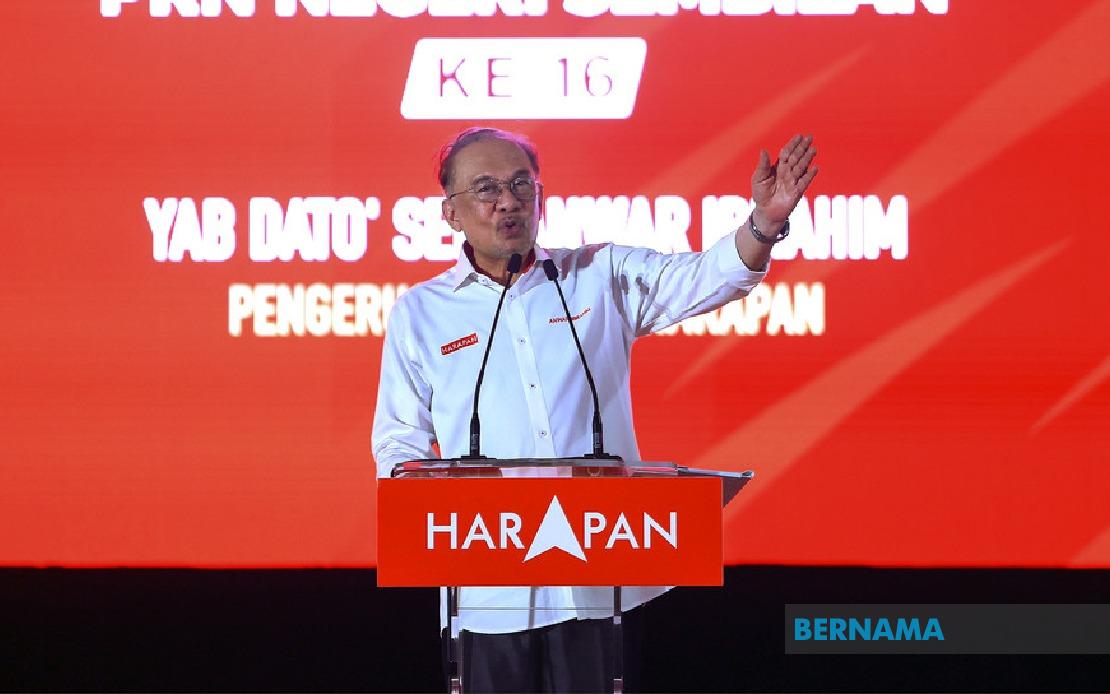
Prime Minister Datuk Seri Anwar Ibrahim has called on voters in Negeri Sembilan to back Pakatan Harapan in the upcoming state election, framing the vote as critical to maintaining the development trajectory established over the past several years. Speaking through a Facebook statement, the PH chairman stressed that sustaining the coalition's mandate would preserve the progress that has transformed the state through collaborative efforts between the state administration and the Federal Government.
The appeal comes ahead of a significant electoral contest, with the 16th Negeri Sembilan state election set for August 1. Anwar's intervention underscores the national significance of the race, as the outcome could signal broader trends in voter sentiment toward the federal government and its coalition partners. The timing of his statement reflects the strategic importance PH places on retaining control of the state, where it has governed since the 2018 political realignment.
Anwar specifically praised Menteri Besar Datuk Seri Aminuddin Harun, using the affectionate abbreviation "Tok Min", for his stewardship since 2018. The Prime Minister highlighted qualities of integrity, humility and accountability as hallmarks of the state administration, presenting these attributes as reasons voters should maintain continuity. This personal endorsement from the federal leadership serves to elevate Aminuddin's standing and associate the state government directly with national governance standards.
Central to Anwar's message is the argument that state-federal cooperation has been instrumental in delivering tangible benefits. The coalition administration has leveraged this partnership to advance various development projects, the PM suggested, though he acknowledged that substantial work remains unfinished. This framing attempts to position a PH victory not merely as a local contest but as part of a broader national development agenda spanning multiple levels of government.
The Prime Minister's appeal carries particular weight in the Malaysian political context, where personality and trust in leadership figure prominently in electoral decisions. By positioning himself alongside Aminuddin and emphasizing their shared commitment to good governance, Anwar attempts to create a unified message that transcends state boundaries. For voters in Negeri Sembilan, the statement conveys that supporting PH locally means participating in a larger project of national renewal and prosperity.
Anwar warned against what he characterized as regression, cautioning voters not to allow the progress achieved to "come to a halt halfway". This phrasing suggests that interrupting PH's mandate through electoral change could jeopardize ongoing projects and derail future initiatives. The rhetorical strategy positions voting for the opposition as a risky proposition that could undermine accumulated gains, a common approach in electoral campaigns across Southeast Asia.
The election timeline demonstrates the proximity of the contest. Nominations are scheduled for Saturday immediately following Anwar's statement, with early voting set for July 28 and the main polling day on August 1. This compressed calendar means campaigning will be intense, and statements from senior leaders like the Prime Minister serve as key messaging moments in the limited window available to shape voter perceptions.
For Malaysian observers, Anwar's intervention raises broader questions about the state of PH's political organization. The coalition's need to mobilize its chairman to appeal for votes suggests potential challenges in grassroots support or concerns about complacency. Negeri Sembilan, while not among Malaysia's largest states, holds symbolic importance as a test case for PH's continued viability in state-level politics, particularly as the party navigates factional tensions and competition from both the Perikatan Nasional coalition and other political forces.
The emphasis on clean administration and stable governance reflects PH's primary political brand, distinguishing its pitch from opponents. In recent Malaysian electoral contests, anti-corruption and good governance messaging have resonated with portions of the electorate, though effectiveness varies by locality and demographic. Anwar's framing suggests PH believes this message remains compelling in Negeri Sembilan, where the state administration has maintained relatively low-profile governance without major scandals.
Anwar's invocation of Islamic values, beginning his statement with "Alhamdulillah" (praise be to God) and closing with "Insya-Allah" (God willing), also reflects the religious dimension of Malaysian politics. This language choice appeals to the substantial Muslim majority in both Negeri Sembilan and nationally, positioning PH governance as aligned with Islamic principles of accountability and service. Such framing helps counter narratives suggesting opposition parties have stronger Islamic credentials.
The outcome in Negeri Sembilan could carry implications beyond the state itself. As part of a broader cycle of state elections across Malaysia, the result will be interpreted as a barometer of PH's electoral strength and the coalition's trajectory. Should PH maintain or expand its mandate, it would strengthen Anwar's hand in managing federal coalition politics and pursuing his legislative agenda. Conversely, significant losses could embolden critics within and outside the coalition regarding PH's durability as a governing force.

