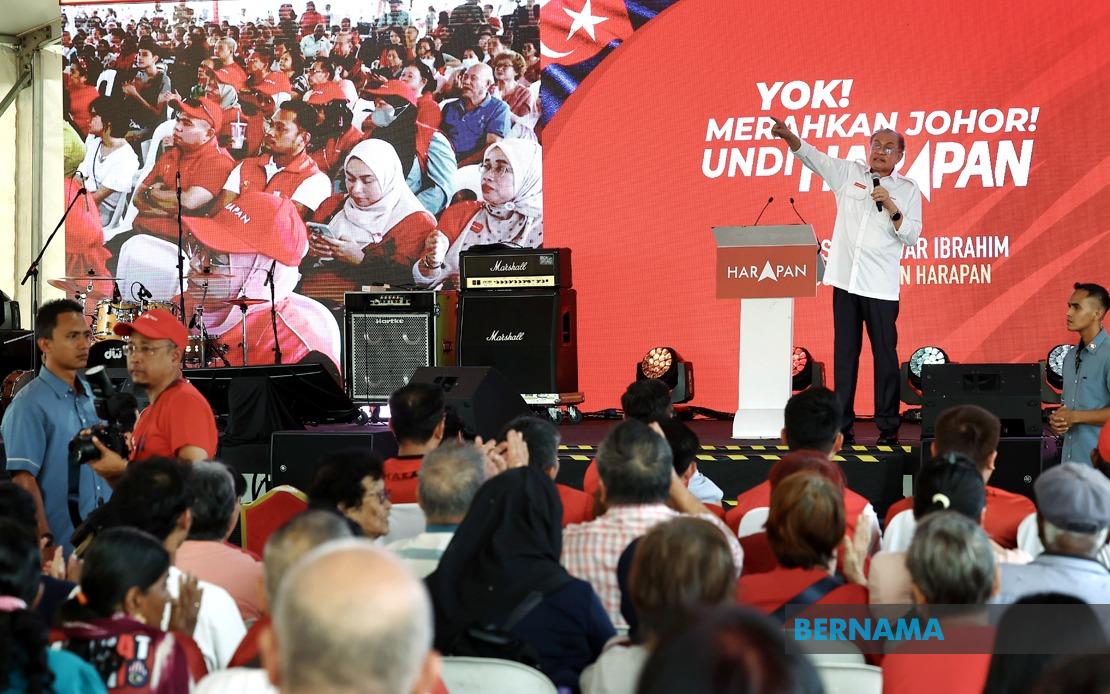
Prime Minister Datuk Seri Anwar Ibrahim has called on political parties vying in the Johor state election to refrain from making mileage out of Datuk Seri Najib Razak's imprisonment, urging them instead to concentrate their campaign messaging on tangible improvements to the people's quality of life and sound fiscal management. Speaking at a campaign event in Kulai on July 10, Anwar emphasised that the former prime minister is currently serving his sentence and should no longer be a focal point of electoral discourse, suggesting that continued politicisation of his detention represented a distraction from substantive governance issues.
The timing of this appeal is significant given that Malaysia continues to grapple with the financial aftermath of the 1Malaysia Development Berhad scandal. Anwar highlighted that the government remains saddled with approximately RM51 billion in outstanding 1MDB-related debts, a figure that serves as a persistent reminder of the cost of past financial mismanagement. The magnitude of this obligation underscores a broader challenge facing policymakers across Southeast Asia: how nations balance accountability for corruption with the practical burden of repaying funds that cannot be recovered or substantially clawed back through legal remedies.
During his remarks, Anwar articulated a compelling counterfactual argument about resource allocation. He stressed that had the 1MDB funds not been diverted, those billions could have been redirected toward essential public infrastructure and social services. The hypothetical illustrates the opportunity cost of corruption in tangible terms that resonate with ordinary citizens—improved schools, better-equipped hospitals, expanded road networks, and enhanced social safety nets for vulnerable populations. This framing attempts to shift the conversation from personalities and political settling of scores toward the material consequences of financial impropriety and its ongoing impact on Malaysians' living standards.
The Prime Minister's intervention reflects an apparent tension within Malaysia's political landscape between those who wish to keep questions of accountability and institutional reform centre stage and those who view continued focus on past wrongdoing as counterproductive to nation-building. Anwar's stance suggests that his administration believes the electorate should be persuaded to judge parties based on their forward-looking economic and social programmes rather than their willingness to repeatedly invoke the Najib situation. This positioning attempts to claim the high ground of governance maturity and forward momentum.
However, Anwar's appeal also reveals the challenge facing any government that inherits the consequences of predecessor administrations' financial misconduct. The RM51 billion debt burden is not something that can be simply set aside or depoliticised through rhetorical appeals. It remains a concrete policy constraint that shapes budget allocations and fiscal capacity in the present day. Analysts in Southeast Asia might note that Malaysia's experience with managing inherited corruption-related debts presents lessons for other countries in the region confronting similar institutional challenges.
The Johor state election campaign context adds another layer to Anwar's intervention. Johor has historically been a significant political battleground, and state-level contests often feature intense competition between rival coalitions seeking to mobilise voters around both local concerns and national issues. By signalling that his government wishes to move beyond the Najib narrative, Anwar may be attempting to establish a framework where Pakatan Harapan candidates are judged on their competence and policy platforms rather than their association with prosecuting or defending against 1MDB-related claims.
Present at the campaign event were several government and party officials, including Youth and Sports Minister Mohammed Taufiq Johari and Deputy Investment, Trade and Industry Minister Sim Tze Tzin, alongside party youth leader Muhammad Kamil Abdul Munim and Bukit Batu Pakatan Harapan candidate Arthur Chiong Sen Sern. Their attendance underscored the structured nature of the campaign activity and the coordinated messaging around economic management and welfare that the government coalition wished to promote.
Anwar's phrase "enough is enough" encapsulates an implicit argument that Malaysian society has spent sufficient emotional and political capital on the Najib matter and should redirect its attention to contemporary challenges. This sentiment may resonate with portions of the electorate fatigued by corruption narratives, though critics might counter that such fatigue itself represents a risk if institutional weaknesses remain unaddressed. The tension between moving forward and ensuring lasting accountability mechanisms are robust enough to prevent recurrence of past scandals remains unresolved.
The reference to continuing 1MDB debt repayment obligations also implicitly acknowledges that the financial consequences of the scandal will persist across electoral cycles and government administrations. Malaysian voters and regional observers might contemplate how long such shadow costs will constrain fiscal flexibility and whether the benefits of closure and forward momentum outweigh the risks of permitting past wrongdoing to become simply a historical episode rather than a catalyst for systemic reform.
Anwar's intervention suggests that Malaysia's ruling coalition has calculated that emphasising economic stewardship and social provision offers a more sustainable electoral strategy than sustained campaigns around prosecutions or defences of the previous administration. Whether this gambit succeeds in redirecting campaign discourse in Johor and subsequent electoral contests will reveal much about voter priorities in Malaysia and the balance between accountability and pragmatism in contemporary Southeast Asian politics.

