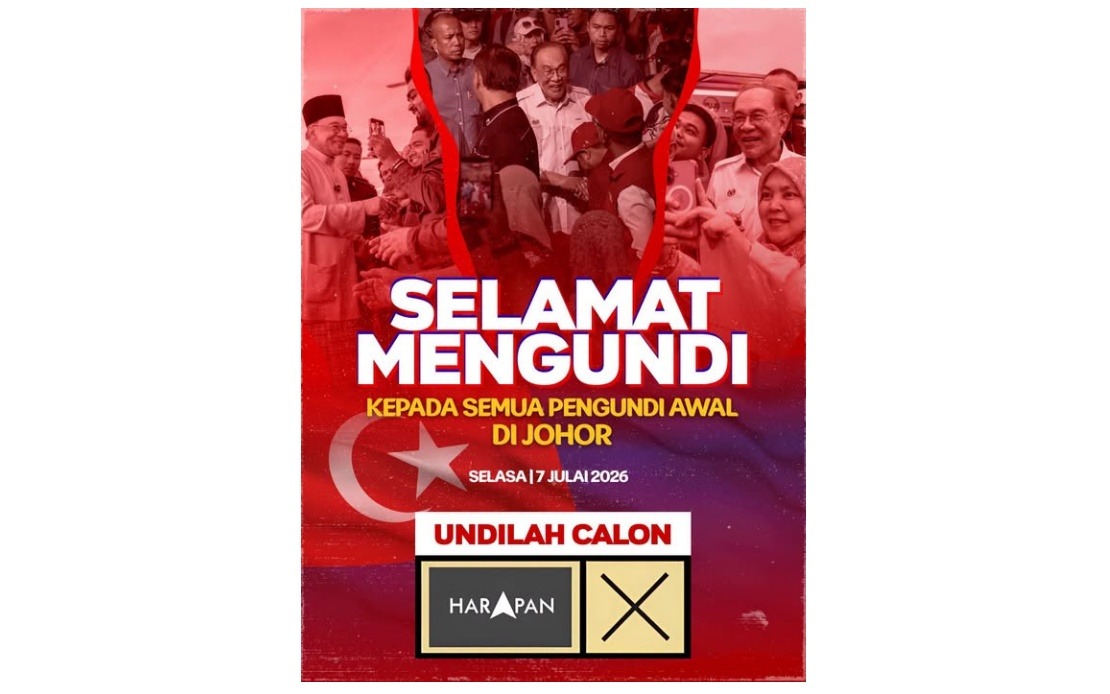
Prime Minister Datuk Seri Anwar Ibrahim has made a direct appeal to early voters participating in Johor's 16th state election, urging them to back Pakatan Harapan candidates in what has shaped up to be a significant contest for the strategic southern state. Through a Facebook message released on July 7, the leader of the ruling coalition expressed confidence that voters would make choices benefiting Johor's development and prosperity, framing the election as a referendum on which political direction the state should take.
The early voting exercise, conducted across 64 polling centres throughout Johor, drew approximately 24,751 registered voters who were given the opportunity to cast ballots before the main election scheduled for Saturday. These early voters comprised primarily members of Malaysia's security forces and their families, a demographic whose participation in elections is managed separately due to operational requirements. The arrangement allows uniformed personnel to discharge their civic duty without disrupting security and law enforcement duties during the standard polling period.
The early voting contingent consisted of 12,041 Malaysian Armed Forces personnel and their spouses alongside 12,710 members of the Royal Malaysia Police and General Operations Force, together with their families. This division of voters reflects the structured approach Malaysia employs to accommodate those serving in positions essential to national security. Polling centres were distributed strategically across the state, with 53 dedicated facilities for police personnel and 11 for armed forces members, all opening at 8 am with closing times varying between noon and 6 pm depending on the anticipated voter volume and registered numbers at each location.
Pakatan Harapan's campaign strategy in Johor focuses on fielding candidates across every available seat in the state assembly, demonstrating the coalition's confidence and commitment to contesting for control of the state government. The coalition deployed a combined force of 56 candidates divided among its component parties, with PKR contributing 20 candidates, Amanah providing 19, and DAP fielding 17. This distribution reflects the current internal balance within Harapan and represents the coalition's broadest effort in a state election since gaining federal power in 2018.
The broader election contest involves 172 candidates competing across the 56 state assembly seats, indicating that several constituencies will feature three-way or multi-cornered contests beyond the Harapan-Opposition binary. This candidate proliferation suggests fragmentation in the opposition vote or the emergence of independent candidacies, potentially affecting how votes translate into seats under Malaysia's first-past-the-post electoral system. The stakes are particularly high given Johor's size and economic importance as Malaysia's second-largest state by population.
Approximately 2.7 million eligible voters across Johor are registered to participate in Saturday's main polling day, making this election a substantial exercise in democratic participation. The voter population represents a significant constituency that any government seeking to govern Johor must consider, and the turnout figures will be scrutinised closely as an indicator of public engagement with the electoral process. In recent Malaysian state elections, turnout rates have varied considerably, influenced by factors ranging from weather conditions to voter enthusiasm and perceived stakes of the contest.
Anwar's intervention in the campaign, through his direct appeal to early voters, underscores Harapan's strategic prioritisation of Johor as a battleground state. The Prime Minister's willingness to personally engage voters, rather than delegating messaging to state-level leaders, signals the coalition's recognition that retaining or gaining ground in Johor carries implications for the broader political balance in Parliament. Johor has historically been a Barisan Nasional stronghold, and any significant gains by Harapan would represent a notable political shift in Malaysian electoral geography.
The messaging employed by Anwar—emphasising development, prosperity, and forward movement under Harapan—reflects the coalition's campaign narrative across recent elections. By connecting voting choices directly to state progress and framing Harapan as the vehicle for achieving that progress, the Prime Minister attempted to elevate the election beyond local factional politics into a choice about governance competence and vision. This rhetorical approach has become central to how Harapan campaigns since returning to opposition in 2023.
For Malaysian observers and regional analysts, the Johor election serves as an important test of political sentiment two years into Anwar's tenure as Prime Minister. The results will provide insights into whether Harapan can consolidate support in key states or whether the coalition's federal dominance masks underlying weakness at the state level. The security forces' voting patterns, captured through the early voting process, may also offer preliminary indicators of broader voter sentiment, though security personnel represent a specific demographic with particular considerations influencing their electoral choices.

