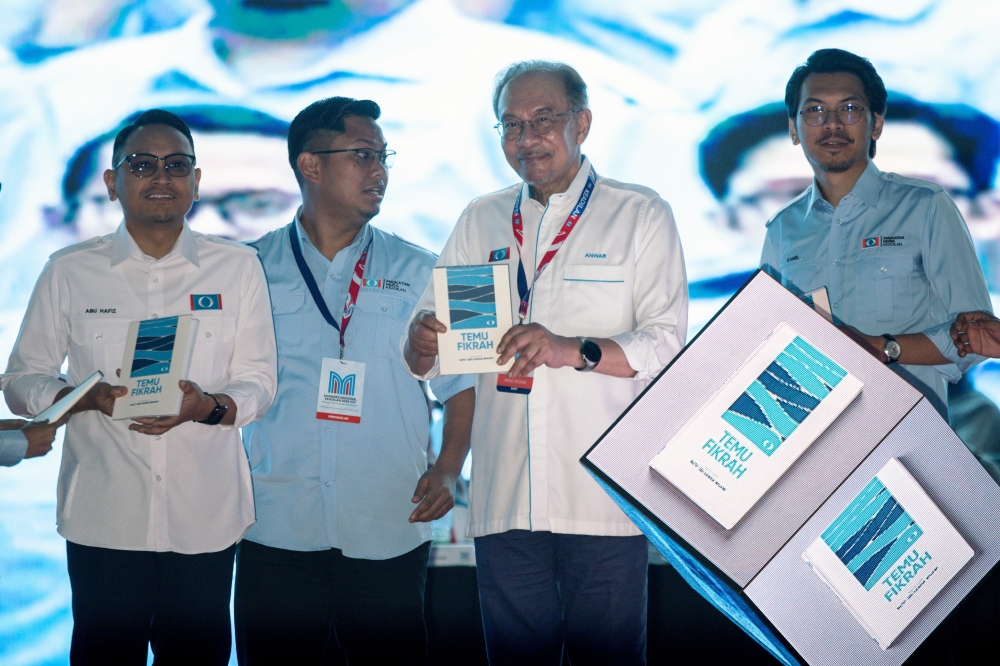
Prime Minister and Parti Keadilan Rakyat (PKR) president Datuk Seri Anwar Ibrahim has launched Temu Fikrah, an ambitious manifesto and practical handbook designed to shape the ideological direction and operational capacity of PKR Youth. The initiative, unveiled in Melaka, represents a deliberate effort to embed party values into youth activism whilst simultaneously anchoring the party's younger cadre within the broader Madani governance framework that underpins the current administration.
Temu Fikrah, which translates loosely as "thought gathering" or "idea confluence," signals PKR's recognition that maintaining relevance in Malaysian politics requires more than electoral victories—it demands a coherent intellectual foundation that can guide activists and leaders through complex governance challenges. By coupling a traditional manifesto with an operational manual, the party is attempting to bridge the gap between aspirational politics and practical administration, addressing a persistent weakness in how political parties translate campaign promises into institutional capacity at the grassroots level.
The launch in Melaka carries symbolic significance within Malaysian political geography. The state has proven volatile in recent electoral cycles, with shifting coalitions and demographic changes creating opportunities for all major parties. By showcasing PKR Youth's renewed focus and ideological clarity in this contested terrain, Anwar signals the party's intention to consolidate support among younger voters whilst demonstrating that PKR remains intellectually and organizationally engaged rather than merely coasting on the leverage of holding the prime ministership.
Courage, positioned as a central pillar of Temu Fikrah, appears designed to address perceptions that PKR has become cautious since entering government. The emphasis on this value suggests internal acknowledgment that coalition politics and the demands of holding high office can erode the activist energy that built the party during its opposition years. By explicitly championing courage as a youth movement value, party leadership is attempting to retain the idealistic edge that attracted many supporters whilst managing the compromises inherent in governing as part of a broad-based coalition.
Creativity as a governing principle reflects an attempt to position PKR as forward-thinking and adaptable rather than bound to rigid ideological formulas. In the Malaysian context, where economic challenges persist and technological disruption accelerates, emphasizing creative problem-solving appeals to younger voters and party members frustrated with conventional approaches. This intellectual framing also serves as implicit criticism of more tradition-bound competitors, allowing PKR to claim the mantle of innovation and progressive thinking.
Integration with the Madani framework represents a strategic alignment with the government's broader policy agenda. Madani governance, emphasizing prosperity, empowerment, and harmony, has become the lexicon through which Anwar's administration legitimizes its decisions. By ensuring PKR Youth explicitly operationalizes Madani principles, the party creates multiple benefits: it demonstrates internal cohesion around government policy, it gives younger members clear guidance on how to advocate for party positions, and it creates measurable standards against which party performance can be evaluated in public discourse.
The dual nature of Temu Fikrah—manifesto and manual—reveals sophisticated political thinking about youth engagement. Manifestos typically articulate vision and values; manuals provide concrete instructions for action. By combining both, PKR acknowledges that today's youth activists, particularly those engaged in urban and semi-urban areas, expect not merely inspirational rhetoric but practical pathways for involvement. The manual component likely addresses organizational structure, campaign methodology, community engagement protocols, and frameworks for translating national policy into local impact.
For Malaysian observers and regional analysts, this initiative reflects broader trends in how Southeast Asian political parties are adapting to demographic change and rising expectations among younger constituents. Youth movements increasingly demand intellectual coherence and operational transparency rather than accepting top-down directives. Parties that fail to articulate coherent ideological frameworks whilst simultaneously providing practical pathways for participation risk losing younger members to rival organizations or to political disengagement entirely.
The timing of Temu Fikrah's launch also merits attention within Malaysia's political calendar. As the government approaches mid-term assessments and potential electoral cycles loom, PKR is signalling that its youth wing remains mobilized and ideologically focused. This prevents perceptions that government participation has led to organizational atrophy, a criticism that frequently undermines ruling parties in Southeast Asia.
For the broader Madani administration, Anwar's emphasis on anchoring party youth activism within the governance framework addresses a persistent challenge: ensuring that coalition partners and party members view themselves as stakeholders in government success rather than merely extracting benefits from office. By equipping PKR Youth with clear ideological reference points and operational guidelines aligned with government priorities, Anwar creates mechanisms for channeling youth energy toward governance outcomes rather than toward intra-coalition factional struggles.
The manifesto-manual approach also acknowledges that different segments of PKR Youth have different needs. Some members seek intellectual engagement and ideological clarity; others prioritize practical skills and community organizing tools. By addressing both constituencies through a unified framework, the party maximizes its appeal whilst maintaining coherence around shared objectives and values.

