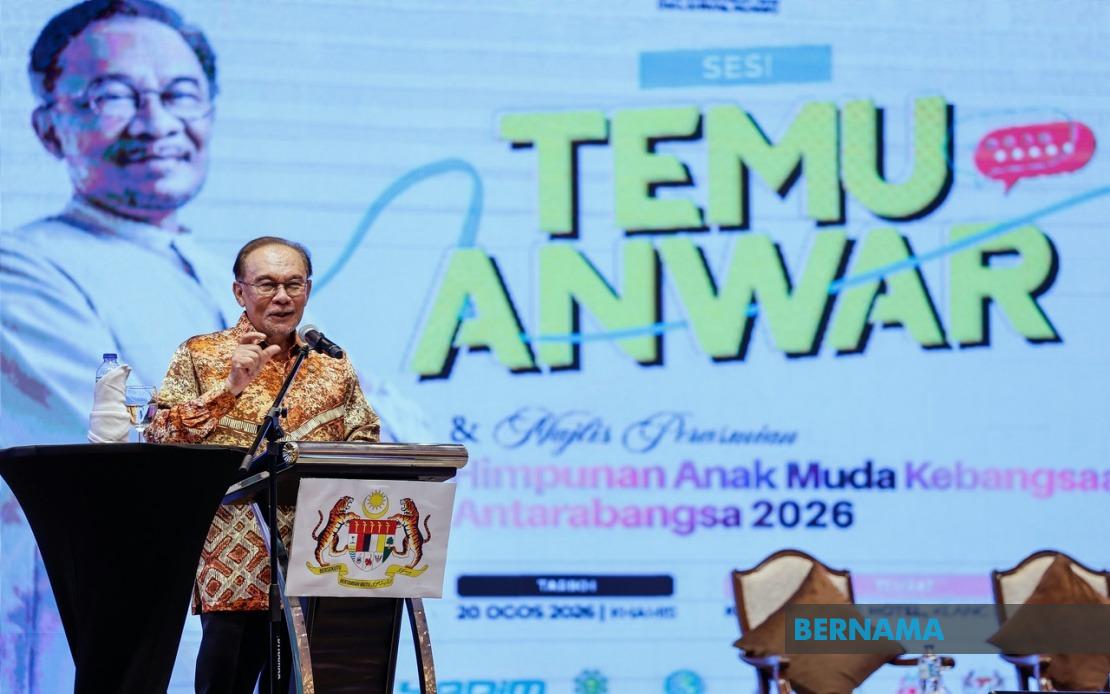
Prime Minister Datuk Seri Anwar Ibrahim has indicated that significant policy announcements will be forthcoming in late August and mid-September, marking what appears to be a concentrated period of major government decisions. Speaking at a youth engagement forum in Klang today, the Prime Minister disclosed plans to make one important statement on the eve of National Day on Aug 30, followed by another during Malaysia Day celebrations on Sept 16, and a third during the Budget presentation in early October. The timing suggests the government is aligning policy rollouts with key national occasions, a strategy that could amplify their political messaging and national visibility.
While the Prime Minister maintained secrecy about the specific contents of these announcements, he framed them within a broader narrative of listening to constituent concerns and responding to changing economic conditions. Speaking at the Temu Anwar session held during the opening of Himpunan Anak Muda Antarabangsa (HAMKA) 2026, Anwar emphasised a consultative approach to governance, noting that he would seek diverse perspectives before finalising policy positions. This language reflects an attempt to position the administration as responsive and deliberative, particularly important when addressing the younger demographic whose support remains crucial for political longevity.
The focus of today's engagement centred on youth welfare, particularly those engaged in the gig economy—a sector that has expanded dramatically across Malaysia and Southeast Asia as traditional employment structures have shifted. A student's question about government measures to protect gig workers prompted Anwar to outline existing and planned protections. He highlighted the Malaysian Gig Economy Commission (SEGiM), a body established to provide oversight and advocacy for workers operating in ride-sharing, delivery, and freelance sectors. Additionally, the government intends to introduce new legislation targeting small businesses, recognising that many gig workers operate as micro-entrepreneurs dependent on digital platforms.
The acknowledgement that current assistance programmes may be insufficient represents a significant concession from the government. Rather than defending existing measures defensively, Anwar presented the issue as one requiring ongoing refinement and expansion. This approach may reflect awareness that gig workers remain inadequately protected compared to traditional employees, lacking statutory benefits such as sick leave, retirement contributions, and accident insurance. For Malaysian voters, particularly younger ones struggling with economic precarity, this represents both a recognition of their concerns and an implicit admission that policy frameworks have lagged behind economic realities.
Beyond immediate welfare measures, the Prime Minister indicated openness to restructuring access to business financing for university graduates. He specifically mentioned the National Entrepreneurial Group Economic Fund (TEKUN), a government scheme intended to catalyse entrepreneurship among younger Malaysians. Currently, applicants typically must demonstrate prior business experience before securing financing—a requirement that effectively locks out recent graduates attempting their first venture. Anwar suggested this criterion warrants reassessment given evolving labour market conditions and the shrinking pool of stable corporate employment opportunities.
The pivot toward supporting graduate entrepreneurs reflects broader economic anxieties within Malaysia. While the country maintains relatively strong GDP growth, real wage growth has stagnated, and corporate hiring has grown more cautious amid global economic uncertainty. By removing barriers to financing for educated youth, the government signals recognition that traditional career pathways—securing stable corporate employment—are no longer universally accessible. This represents tacit acceptance of a labour market transformation that has already occurred on the ground but has been slow to register in policy frameworks.
Anwar's emphasis on consulting stakeholders before finalising positions may appear cautious, yet it suggests genuine deliberation is occurring within government circles on these substantive issues. However, the absence of concrete timelines or implementation details means that these announcements, when they arrive, will require close scrutiny. Malaysian audiences have witnessed previous announcements that generated initial enthusiasm but proved limited in scope or funding when finally detailed. The September and October timeline provides an opportunity to assess whether the government commits meaningful resources or merely offers symbolic gestures.
For Southeast Asian observers, Malaysia's approach to gig economy regulation carries regional significance. Thailand, Indonesia, and the Philippines all grapple with similar issues of protecting platform workers while maintaining labour market flexibility. Malaysia's evolution on this issue, including the establishment of SEGiM and pending legislation, may set precedent or provide lessons for neighbouring economies. A robust regulatory framework could establish Malaysia as a model for protecting vulnerable workers without stifling the digital economy that provides essential income for millions across the region.
The clustering of announcements around national celebrations—particularly Malaysia Day on Sept 16, which commemorates the formation of the Malaysian federation—may also carry symbolic weight beyond policy substance. Using these occasions to unveil youth-focused initiatives frames such measures as investments in national cohesion and future development. This framing could prove particularly important if announcements involve redistributive measures or sector-specific interventions that might otherwise provoke opposition from business interests or conservative constituencies.
The Budget announcement scheduled for early October represents the culmination of this announcement sequence, and likely the moment when financial allocations become concrete. While the Prime Minister has signalled openness to policy innovation, budget constraints will ultimately determine what proves feasible. The coming weeks will reveal whether these announcements constitute genuine policy evolution addressing youth employment and economic security, or primarily serve as political positioning ahead of potential electoral contests.

