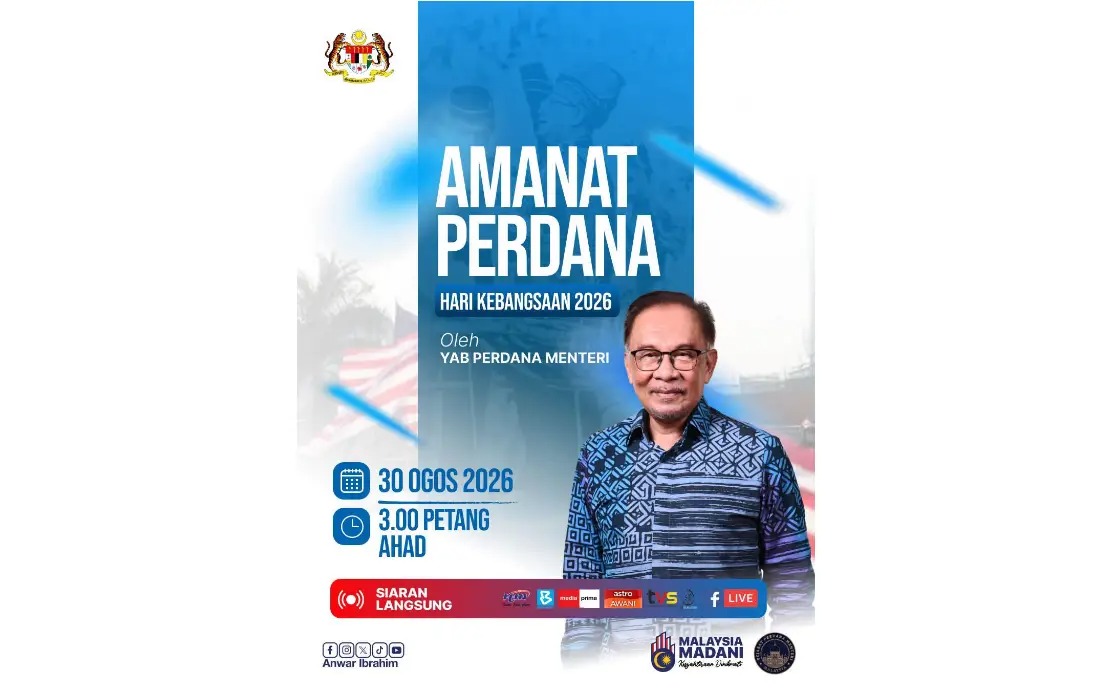
Prime Minister Datuk Seri Anwar Ibrahim will use tomorrow's National Day address at the Putrajaya International Convention Centre (PICC) to announce several significant initiatives aimed at addressing concerns central to Malaysians' daily experience. The announcement, which will take place in the afternoon, represents an important moment for the government to articulate its vision and priorities as the nation marks another year of independence.
Through a Facebook statement, Anwar signalled that his address would focus on matters directly impacting ordinary Malaysians and their quality of life. The speech will also serve as a moment for reflection on how the present generation can build upon the foundations laid by their predecessors and ensure that the sacrifices made during the independence struggle continue to bear meaningful fruit. This framing suggests the government intends to connect historical memory with contemporary governance challenges.
The Prime Minister emphasised the historical significance of the occasion, noting that Malaysia approaches nearly seven decades since achieving independence. This extended timeline allows for perspective on how far the nation has travelled institutionally and socially since 1957. Anwar's reference to the efforts of preceding generations—characterised by the struggle, bloodshed and determination that secured sovereignty—serves to ground current policy discussions in the foundational values that animate the Malaysian state. Such contextualisation resonates particularly in an era when some question what independence should mean in practical terms for citizens.
Central to Anwar's pre-address messaging is the concept of intergenerational responsibility. He articulated that today's Malaysians must recognise their duty to safeguard and give substantive meaning to the independence their forebears secured. This philosophical positioning frames governance not as merely technical management but as stewardship of a national inheritance requiring active commitment. For Malaysian and regional observers, this rhetoric suggests the administration views its agenda as rooted in foundational national principles rather than partisan advantage.
The Prime Minister's call for strengthening national unity appears particularly timely in Malaysia's contemporary political landscape. Anwar explicitly urged citizens to celebrate National Day by reinforcing bonds of solidarity across community lines while consciously rejecting divisive rhetoric. His specific mention of guarding against incitement that could generate animosity between different racial and religious communities speaks to enduring tensions in Malaysia's plural society. This appeal carries weight given Malaysia's historical experience with communal discord and the ongoing challenges of managing religious and ethnic sensitivities.
Anwar's emphasis on preserving peace and citizen welfare represents a direct connection between social cohesion and economic and social development. In Malaysia's context, where economic opportunity and equitable growth remain contested issues, the government appears to be framing national unity not as an abstract ideal but as a practical prerequisite for prosperity and security. This messaging aligns with international evidence suggesting that societies characterised by strong social trust and reduced intercommunal tension tend to enjoy better economic outcomes.
The choice of venue—the Putrajaya International Convention Centre—underscores the ceremonial and national significance attached to the address. Putrajaya, as Malaysia's purpose-built administrative centre, provides a symbolic backdrop that reinforces the connection between this government statement and formal state authority. For regional observers watching Malaysian politics, the venue selection indicates that tomorrow's announcements are intended for domestic audience impact as much as international communication.
The timing of Anwar's pre-address statement, released through social media, demonstrates how contemporary Malaysian political communication has evolved. By providing advance context through Facebook, the Prime Minister shapes the interpretive frame through which citizens and media will receive tomorrow's formal address. This two-stage communication strategy—preview followed by main event—has become standard practice for major government announcements across Southeast Asia, allowing for narrative control and amplification.
For Malaysian stakeholders across business, civil society and opposition quarters, tomorrow's speech will serve as a significant indicator of government priorities in the second half of 2024. The nature and specificity of the announced initiatives will signal whether the administration intends to pursue incremental policy adjustments or more substantial structural reforms. Regional observers and foreign investors monitoring Malaysia's political-economic trajectory will similarly scrutinise the address for indications regarding fiscal policy, economic strategy and the government's approach to persistent challenges in education, healthcare and infrastructure.
The emphasis on historical consciousness and contemporary responsibility also carries implications for how Anwar's government wishes to be perceived domestically and internationally. By connecting National Day observance to inclusive governance principles and rejection of divisive politics, the administration positions itself as defender of Malaysia's constitutional pluralism. This framing matters for assessing whether the current government can build the cross-community consensus necessary to implement significant reforms while maintaining the political stability essential for economic confidence in the region.

