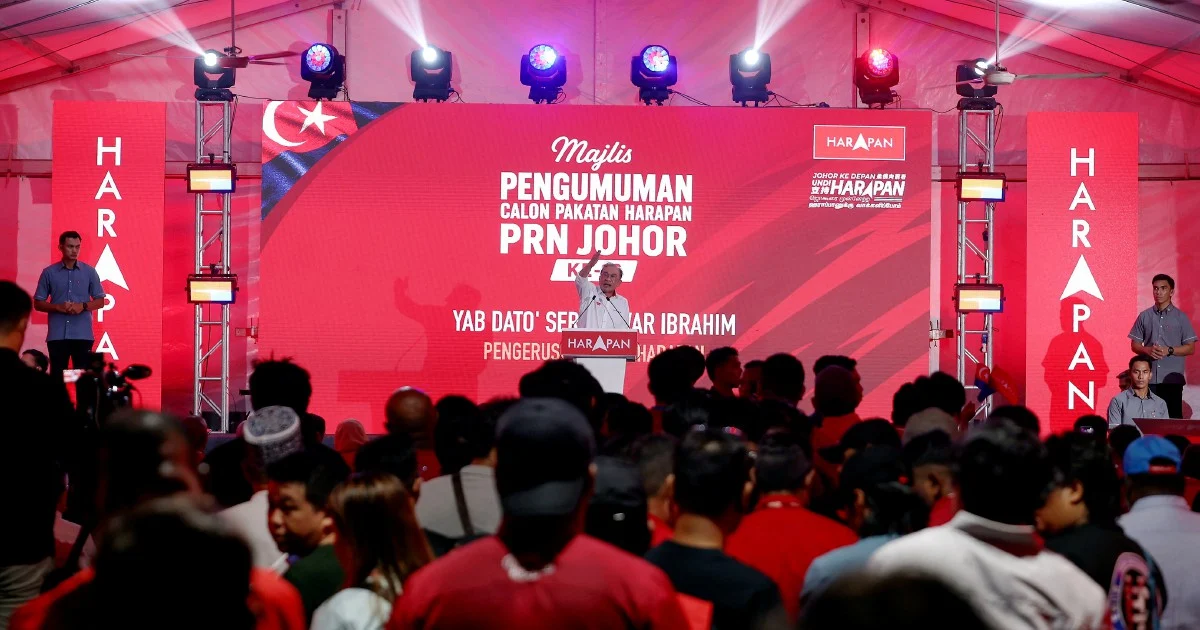
Pakatan Harapan chairman Datuk Seri Anwar Ibrahim has drawn a clear line regarding the scope of the forthcoming Johor state election, arguing that the contest should remain confined to the political sphere without drawing in the state's royal establishment. Speaking at an event in Tangkak, the Prime Minister emphasised that electoral battles ought to be waged between political parties and candidates competing for voter support, rather than becoming entangled with constitutional institutions dedicated to the welfare and stewardship of the state.
Anwar's remarks come at a particularly sensitive moment in Malaysian politics, when the relationship between political competition and constitutional monarchy has periodically become a point of tension. The distinction he draws reflects a well-established convention in democratic practice: that while Malay Rulers hold important ceremonial and custodial roles within the constitutional framework, the exercise of political power through elections should operate independently of royal involvement. This separation is essential to preserve both the sanctity of the electoral process and the dignity of the monarchy itself.
The Johor state election represents a significant test of political fortunes in one of Malaysia's most economically important and strategically located states. Johor has traditionally been a stronghold of the Barisan Nasional coalition, though recent political realignments and shifts in voter sentiment have made the outcome less predictable than in previous electoral cycles. For Pakatan Harapan, which governs the federal government, the Johor contest offers an opportunity to expand its foothold in a state where its influence remains limited compared to peninsular neighbours like Selangor and Penang.
The implicit concern underlying Anwar's statement appears to centre on ensuring that royal institutions maintain their constitutional neutrality and remain above the fray of partisan competition. In Malaysia's constitutional monarchy, the Rulers occupy positions of symbolic national unity and constitutional authority that transcend any particular political faction or campaign. Should electoral matters become intertwined with royal institutions, it could potentially undermine public confidence in both the impartiality of the monarchy and the integrity of the democratic process itself.
Historically, Malaysia's political system has generally observed clear boundaries between these domains. The Rulers provide stability and continuity to the nation's constitutional structure, while elected officials and political parties compete for the mandate to govern. Mixing these roles risks confusion about the proper sphere of each institution and could expose the monarchy to allegations of partisanship—a situation that serves no one's interests and could damage the institution's standing among diverse segments of the population.
Anwar's statement also carries implications for how political campaigns should be conducted in Johor during the election period. Candidates and parties should rely on their policy platforms, track records, and ability to connect with voters, rather than seeking to leverage relationships with royal institutions to gain electoral advantage. This approach strengthens democracy by ensuring that political success flows from genuine popular support and effective governance proposals rather than from perceived proximity to power centres outside the electoral sphere.
The timing of Anwar's clarification suggests awareness that some elements within the political landscape may be tempted to blur these boundaries. By publicly articulating the principle that elections should remain political contests, the Pakatan Harapan chairman is setting expectations for how all participants—whether from his coalition or opposing camps—should conduct themselves during the campaign. This preemptive stance serves as a guardrail against any potential attempts to weaponise royal institutions or create the appearance that electoral outcomes somehow depend on royal preferences.
For Malaysian democracy to function effectively and retain public legitimacy across the country's diverse communities, the independence of electoral competition from non-political institutions must be maintained. This principle becomes especially important in states like Johor, where the historical role of the Johor sultanate carries particular weight and cultural significance. Voters in the state need confidence that their ballots determine the outcome, not external institutional pressures or backdoor negotiations involving royal bodies.
Anwar's statement reflects broader concerns about maintaining institutional health during periods of political competition. When political actors respect appropriate boundaries and refrain from instrumentalising non-partisan institutions, it creates space for the monarchy to continue serving its constitutional functions—guardian of Islamic matters, ceremonial head of state governance, and symbol of national continuity. Conversely, allowing elections to become entangled with royal institutions risks pulling the Rulers into controversial situations that could strain their relationships with segments of society.
As Johor heads toward its electoral showdown, the distinction Anwar has articulated will likely prove influential in shaping campaign conduct among major political players. Both Barisan Nasional and Pakatan Harapan, along with smaller parties contesting the election, would be wise to take his message seriously. By keeping the contest squarely in the political arena—where it belongs—all parties demonstrate respect for the constitutional order and confidence in their ability to win support through legitimate democratic means.
The underlying message extends beyond this single state election. It reinforces that Malaysia's constitutional system depends on institutions respecting their defined roles and boundaries. When political competition remains within its proper sphere, the monarchy retains its position as a unifying force, elected officials govern with legitimacy derived from voters, and the public maintains faith in the democratic system. This compartmentalisation of institutional functions, while sometimes challenging to maintain in practice, remains fundamental to the nation's political stability and constitutional health.