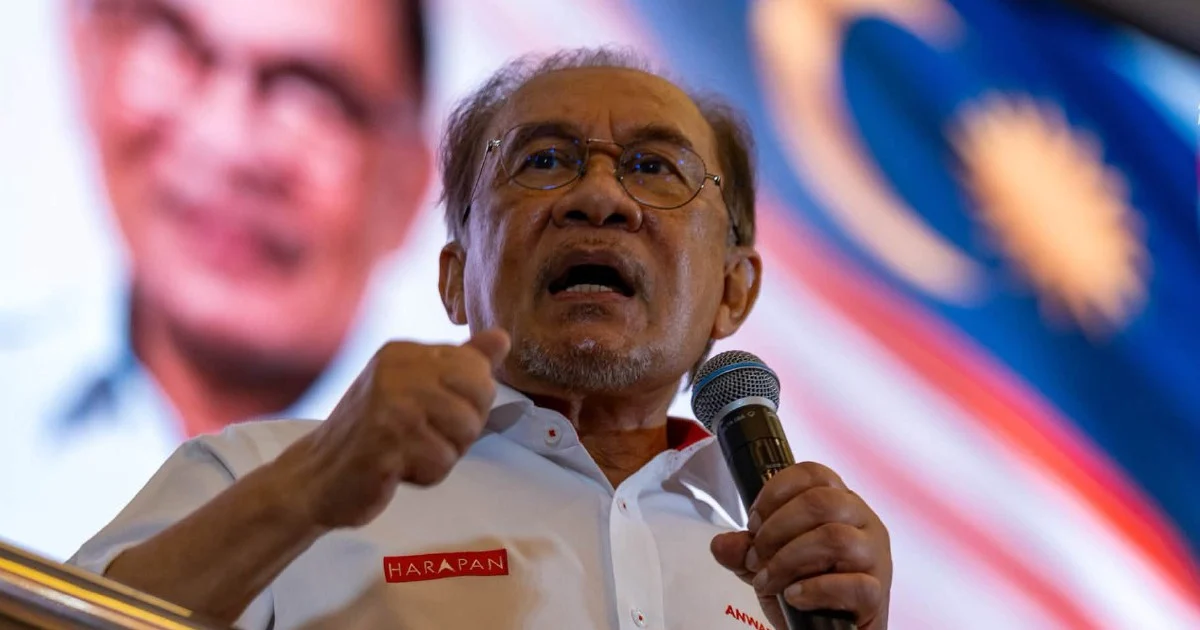
Prime Minister Datuk Seri Anwar Ibrahim has made clear that Malaysia will not pursue diplomatic arrangements with Singapore to facilitate voting for Malaysian citizens employed across the Causeway during the Johor state election scheduled for July 11. The statement reflects the government's approach to managing electoral logistics while maintaining the sovereignty and independence of Malaysia's voting processes.
The prospect of cross-border voting arrangements has emerged as a practical consideration for electoral planners, given the substantial number of Malaysians who work in Singapore on a daily or permanent basis. The Johor election, which will determine the composition of the state assembly and by extension the state government, presents particular challenges for these workers who may struggle to return home to cast their votes. However, Anwar's position indicates that addressing this challenge will remain entirely within Malaysia's domestic framework rather than involving third-party facilitation from neighbouring countries.
This decision underscores a broader principle regarding electoral integrity and national sovereignty. Permitting another country, even a close ally like Singapore, to play an administrative role in the voting process would introduce complexities around the authenticity of voter rolls, verification procedures, and the security of ballot operations. Malaysia's Election Commission has consistently emphasised its independence in managing all aspects of the electoral system, and involving a foreign jurisdiction would fundamentally compromise that position.
The logistics of managing voters who live and work across the Causeway have long presented difficulties for Malaysian elections. Hundreds of thousands of Malaysians, predominantly from Johor but also from other states, commute to or reside in Singapore for employment. Many occupy skilled and professional positions in Singapore's financial, technology, and healthcare sectors. During state and federal elections, these workers face the choice of either taking leave to return to Malaysia to vote, absorbing the travel costs and time expenditure, or forgoing their voting rights entirely. The July 11 election will again present this dilemma to Johor-based workers.
Alternative solutions for addressing cross-border voter participation remain available within Malaysia's existing electoral framework. Previous elections have employed methods such as postal voting and early voting provisions, though these mechanisms have their own administrative complexities and safeguards. The Election Commission could theoretically expand access to these mechanisms for workers with employment beyond Malaysia's borders, though this would require careful implementation to prevent abuse and maintain the integrity of the process.
Anwar's clarification also signals Malaysia's confidence in its own institutional capacity to manage elections without external support, even from Singapore with which Malaysia shares extensive bilateral cooperation across trade, security, defence, and cultural domains. The relationship between the two countries encompasses numerous collaborative frameworks, but electoral management has remained firmly within each nation's exclusive purview. This boundary reflects international norms around electoral sovereignty and the principle that voting systems must remain under the complete control of each nation's government.
From a broader Southeast Asian perspective, the decision reflects how individual nations guard their electoral independence even within regional integration frameworks. Unlike some federal systems in Europe or other regional blocks that have developed mechanisms for cross-border voting or expatriate participation, Southeast Asian nations have generally preserved strict national control over electoral processes. Malaysia's approach is consistent with this regional norm and with the practices of other ASEAN member states.
The statement also addresses practical concerns that political observers have noted. Any arrangement requiring Singapore's cooperation would inevitably delay voting results processing, as ballots or voter information would need to transit between jurisdictions. Given that state election results typically determine which coalition is mandated to form government, any delays to counting could create a period of political uncertainty. Maintaining voting operations entirely within Malaysia ensures that results can be tabulated and declared swiftly.
For Malaysian workers in Singapore who are registered voters in Johor, the implication is that they will continue to face the existing options: returning to Malaysia to vote in person, utilising postal or early voting if eligible, or exercising their right to decline participation. Employers in Singapore, many of whom have substantial Malaysian workforces, will not be able to accommodate voting arrangements at their premises or coordinate with Singapore authorities to facilitate voting processes.
The practical impact may extend beyond just Johor, as the principle articulated by Anwar could influence how Malaysia approaches similar challenges in future federal elections or elections in other states with significant cross-border workforces. Selangor and Penang also have populations with notable commuting or working relationships to neighbouring areas, and the electoral logic would be consistent across these jurisdictions.
From an election administration perspective, Anwar's position also reflects the technical reality that Malaysia's voter registration system is designed around residential addresses within Malaysian territory. Expanding voting mechanisms to foreign soil would require establishing parallel verification systems to confirm eligibility and prevent double voting. The administrative burden and potential vulnerabilities in security would significantly outweigh any convenience benefits for affected workers.
Looking forward, civil society organisations and electoral observers may scrutinise how Malaysia implements voting access for cross-border workers through its existing frameworks. Advocacy groups have periodically argued that Malaysia's postal and early voting provisions should be expanded to accommodate workers abroad, and Johor's July 11 election may provide a case study for evaluating whether current provisions adequately serve this demographic.
Ultimately, Anwar's clarification provides certainty to both Malaysian voters and Singapore's government that the July 11 Johor election will proceed under standard Malaysian electoral arrangements, without novel cross-border administrative frameworks that might create diplomatic or operational complications for either nation.

