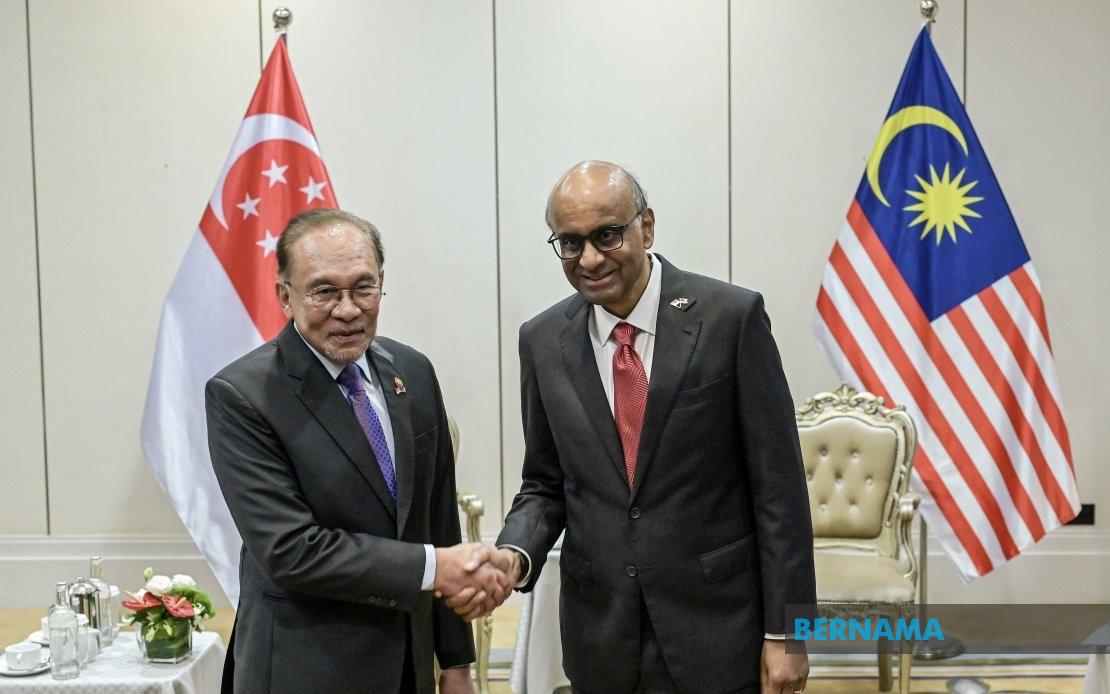
Prime Minister Datuk Seri Anwar Ibrahim held formal discussions with Singapore President Tharman Shanmugaratnam on Monday in Kuala Lumpur, part of a reciprocal state visit that underscores the deepening institutional engagement between Malaysia and Singapore at the highest levels of government. The meeting, which extended for 40 minutes, brought together senior figures from both nations including Malaysia's Foreign Minister Datuk Seri Mohamad Hasan, Investment, Trade and Industry Minister Datuk Seri Johari Abdul Ghani, and Entrepreneur and Cooperatives Development Minister Steven Sim Chee Keong, alongside high-ranking officials from Singapore.
The courtesy call followed a formal state welcome ceremony held earlier at Istana Negara, where Tharman was received by Yang di-Pertuan Agong Sultan Ibrahim with full ceremonial honours befitting a visiting head of state. This three-day visit, spanning July 13 to 15, represents a diplomatic reciprocation of the Malaysian monarch's state visit to Singapore, which took place from May 6 to 7, 2024. The structured exchange of high-level visits demonstrates how both nations have institutionalised their engagement, ensuring regular dialogue at the executive and royal levels.
The timing of Tharman's visit comes at a particularly significant moment for Malaysia-Singapore relations. The two countries share one of Southeast Asia's most complex bilateral relationships, shaped by geographic proximity, historical ties, and intricate economic interdependence. Singapore's strategic importance to Malaysia extends well beyond traditional diplomatic courtesy; it remains Malaysia's second-largest trading partner globally, and assumes even greater significance within the ASEAN context, where Singapore ranks as Malaysia's largest trading partner among the bloc's member states.
Economic metrics provide a compelling backdrop to these high-level talks. Bilateral trade between Malaysia and Singapore reached RM402.35 billion, equivalent to approximately US$93.97 billion, in 2025, reflecting a modest 1.5 per cent increase compared to the preceding year. More encouraging is the year-to-date performance; during the first five months of 2025, bilateral trade surged 14.5 per cent to RM189.90 billion (US$47.87 billion), substantially outpacing the corresponding RM165.93 billion (US$37.65 billion) recorded during the same period in 2024. This acceleration suggests that trade momentum has intensified despite broader global economic uncertainties.
For Malaysian policymakers and business stakeholders, Singapore's role extends beyond merchandise trade. The city-state functions as a crucial financial hub, a gateway to regional and global capital markets, and an important source of foreign direct investment into Malaysia. The presence of Investment and Trade ministers at Monday's meeting signals that economic cooperation remains central to the bilateral agenda, likely encompassing infrastructure projects, cross-border investments, and regulatory harmonisation initiatives that facilitate seamless commerce.
The selection of officials attending the meeting reveals strategic priorities. Mohamad Hasan's participation underscores the diplomatic dimension, while Johari's presence highlights trade and investment concerns. Steven Sim Chee Keong's involvement suggests discussions around entrepreneurship, small and medium-sized enterprise development, and cooperative frameworks that could benefit Malaysian businesses seeking to expand into Singapore or tap regional supply chains anchored in the island nation. This multi-ministerial approach indicates comprehensive coverage of bilateral relationship dimensions.
For Malaysia, maintaining robust relations with Singapore carries particular significance in several domains. Beyond trade, security cooperation, maritime safety, and coordinated responses to regional challenges require constant diplomatic attention. The two nations share the Straits of Malacca, one of the world's most trafficked waterways, necessitating cooperation on environmental protection, anti-piracy measures, and freedom of navigation. Water supply agreements, transportation links, and cross-border labour issues periodically surface as matters requiring high-level attention and careful negotiation.
From a regional perspective, Malaysia-Singapore relations serve as a barometer for ASEAN's internal cohesion. Both nations wield considerable influence within the bloc, and their bilateral relationship patterns can either facilitate or complicate collective ASEAN positions on matters ranging from South China Sea navigation to coordinated responses to economic challenges. Tharman's state visit thus carries implications extending beyond bilateral interests, touching upon the broader architecture of Southeast Asian regionalism and cooperation.
The visit also provides an opportunity to address emerging challenges facing both nations. Singapore and Malaysia are both navigating digital transformation, supply chain reconfiguration following geopolitical shifts, and the transition towards more sustainable economic models. Conversations during such high-level visits typically explore these forward-looking dimensions, identifying areas where complementary policies and joint initiatives can generate shared benefits. Malaysian companies seeking to develop green technologies or enhance digital capabilities may find partnership opportunities through frameworks discussed at state visit level.
The restoration of regular high-level visits between Malaysia and Singapore reflects a broader pattern of stabilisation in bilateral ties after periods of tension. Both nations have demonstrated commitment to managing differences constructively while emphasising shared interests. This mature diplomatic approach, evidenced through structured state visits and comprehensive ministerial engagement, provides a solid foundation for addressing contemporary challenges and capitalising on opportunities emerging from regional economic integration and global trade realignment. For Malaysian stakeholders, this diplomatic engagement translates into a more predictable, rules-based operating environment for businesses and investors operating across both economies.

