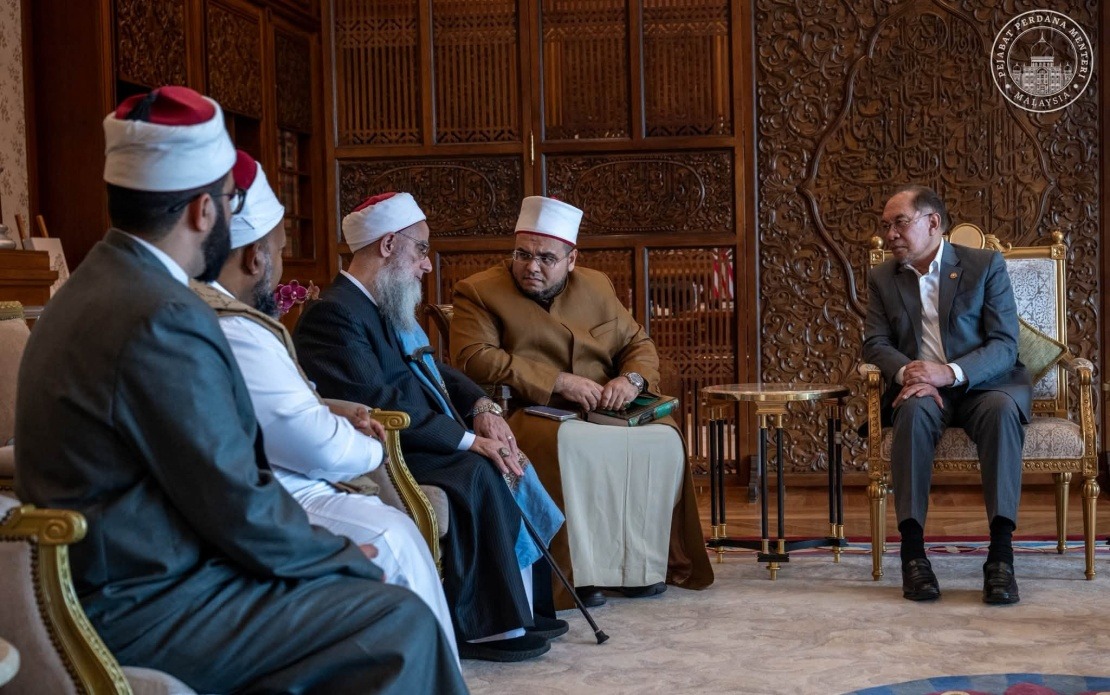
Prime Minister Datuk Seri Anwar Ibrahim received a visit from prominent Egyptian Islamic scholar Sheikh Dr Mustafa An-Nadwi Al-Hasani Mansurah at his Putrajaya office on July 20, according to a statement shared on his official social media channels. The meeting highlighted the Malaysian premier's engagement with influential figures in the Islamic intellectual tradition, underscoring his administration's emphasis on dialogue with respected scholars and thought leaders across the Muslim world.
Sheikh Dr Mustafa, who hails from the Egyptian city of Mansurah, carries significant credentials within Islamic academic circles. The scholar is particularly recognised for his expertise in hadith studies and his commitment to emphasising moral values alongside rigorous theological scholarship. His intellectual pedigree traces back to his studies under Sheikh Abul Hasan Ali al-Nadwi, a globally recognised Islamic scholar and preacher whose influence extends across multiple generations of Muslim intellectuals and community leaders throughout Asia, the Middle East and beyond.
In his public remarks, Anwar characterised Sheikh Dr Mustafa's approach to scholarship as representative of a broader intellectual philosophy that prioritises depth and wisdom over sensationalism. This framing carries particular resonance in Malaysia's contemporary political and social environment, where questions about the balance between populism and substantive governance remain contested. The Prime Minister's emphasis on scholarly approach to knowledge and values reflects an attempt to position Malaysia's leadership within a tradition of thoughtful, principle-based Islamic intellectualism rather than reactive or emotion-driven decision-making.
The imagery Anwar employed in describing knowledge transmission—comparing wisdom to morning dew that arrives quietly yet brings life-giving nourishment—suggests a philosophical approach to leadership that values contemplation and reflection. This poetic framing stands in contrast to the rapid-fire, often confrontational nature of modern political discourse, where immediate reactions and sharp retorts dominate social media and news cycles. For Malaysian audiences, this stance carries implications about how the current government positions itself relative to prevailing communication styles.
During their exchange, Anwar and Sheikh Dr Mustafa discussed current affairs, though specific details of their substantive conversations were not disclosed in the public statement. The Prime Minister also indicated that the Egyptian scholar was conducting knowledge-sharing sessions throughout his Malaysian visit that week, suggesting a broader engagement with Malaysian Muslim communities, academicians and religious leaders. Such visits by international Islamic figures typically involve lectures, seminars or meetings with relevant institutions and organisations.
Anwar expressed particular gratitude for Sheikh Dr Mustafa's counsel and spiritual invocations on behalf of Malaysia. The Prime Minister specifically highlighted prayers offered for the nation's continuing unity and prosperity, reflecting concerns that resonate prominently within Malaysian political discourse. Unity, particularly in a context of religious and ethnic diversity, represents a cornerstone of how successive Malaysian governments have framed their legitimacy and vision for the nation's future.
Beyond the immediate diplomatic courtesy of the meeting, the visit carries symbolic significance regarding Malaysia's positioning within broader Islamic intellectual networks. The Malaysian government under Anwar has sought to cultivate connections with respected Islamic scholars and institutions internationally, potentially as a counterweight to more conservative or orthodox interpretations that dominate certain segments of domestic religious discourse. Engagement with scholars known for emphasising moderation, wisdom and scholarly depth aligns with the administration's stated commitment to progressive Islamic governance.
The emphasis on hadith studies and traditional Islamic knowledge in Sheikh Dr Mustafa's credentials reflects the continuing importance of classical Islamic scholarship within contemporary Muslim societies. Despite rapid modernisation and technological change, these traditional fields of study maintain significant prestige and influence within Islamic intellectual circles. For Malaysian policymakers and religious authorities, such engagement signals openness to diverse approaches within Islamic thought while maintaining connection to foundational scholarly traditions.
Sheikh Dr Mustafa's visit also occurs within the context of Malaysia's broader diplomatic and religious engagement strategy with the Middle East and North Africa region. Egypt, as the Arab world's most populous nation and home to significant Islamic institutions, holds particular weight in Muslim-majority Asia's calculations. The receipt of prominent Egyptian scholars reflects Malaysia's efforts to maintain and strengthen these regional connections, particularly important given the historical and contemporary influence of Egyptian Islamic thought on Southeast Asian Muslim communities.
Anwar's public acknowledgment of the visit and his characterisation of scholarly excellence underscores his administration's messaging regarding values and intellectual substance in governance. The Prime Minister concluded his remarks by praying for Sheikh Dr Mustafa's continued wellbeing and effectiveness in guiding communities with wisdom, moderation and compassion—qualities that implicitly reflect Anwar's own stated aspirations for Malaysia's religious and social leadership. This framing positions the Malaysian government as aligned with a particular vision of Islamic thought that prioritises measured, compassionate engagement over confrontation or rigidity.

