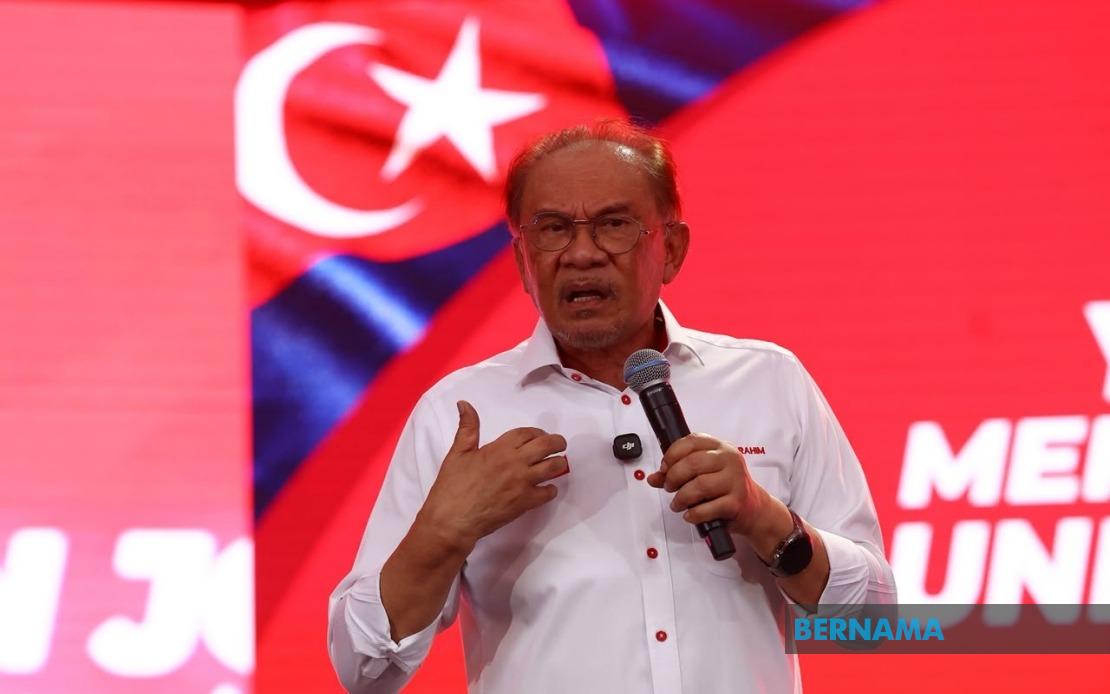
Prime Minister Datuk Seri Anwar Ibrahim has firmly rejected allegations circulating on social media that he acquired a new luxury BMW vehicle for his own use, describing such claims as baseless and part of a misinformation campaign designed to undermine his administration's credibility. Speaking at a campaign event in Batu Pahat on July 9, Anwar characterised the accusations as particularly hypocritical given his government's commitment to supporting vulnerable communities and combating corruption.
During remarks made at the 'Yok! Meriahkan Johor! Undi Harapan' programme in Senggarang, held as part of Pakatan Harapan's push for the 16th Johor state election, the Prime Minister stressed that the BMW in question was not a recent purchase but rather an existing government vehicle that had been in service for some time. His pointed questioning of why critics would "spread lies" about the matter reflected visible frustration with what his office views as coordinated efforts to damage his political standing through false narratives about personal extravagance.
Beyond addressing the BMW allegation, Anwar took the opportunity to provide clarity on another vehicle matter that has attracted public scrutiny—the Mercedes-Benz sedan he currently uses for official duties. The Prime Minister underscored that this vehicle was a gift bestowed upon him by His Majesty Sultan Ibrahim, King of Malaysia, a significant detail that shapes how the asset is properly categorised and owned. Rather than claiming personal ownership, Anwar explained that the vehicle has been formally registered under the Prime Minister's Department, a procedural distinction that separates his private interests from official state assets.
This governance approach reflects a wider principle Anwar emphasised during his remarks: a commitment to transparent and ethical stewardship of public resources. He contrasted his administration's position with what he characterised as the practices of predecessors, stating that unlike "others who siphon off and steal the people's money," his government maintains a clear firewall between personal assets and official state property. The statement carried implicit criticism of perceived corruption in previous administrations, a recurring theme in Pakatan Harapan's political messaging.
The Prime Minister's Department and the Ceremonial and International Conference Secretariat Division issued a formal statement earlier in the week that corroborated Anwar's account, confirming that the BMW vehicle is indeed an established government asset rather than a newly procured official vehicle. According to the statement, the BMW falls under the management and operational control of BIUPA and is designated for official government logistics purposes. This categorical designation is important because it removes the vehicle from any realm of personal acquisition and places it squarely within the framework of state transportation infrastructure.
The timing of these allegations and their circulation through social media platforms underscore the evolving nature of political contestation in Malaysia, where digital channels now serve as primary vectors for both factual information and deliberate disinformation. During a sensitive period of state-level campaigning, such claims gain particular traction as opposition figures and supporters attempt to sway voter perceptions through character attacks and questions about leadership integrity. Anwar's direct rebuttal at a campaign rally demonstrates the political stakes involved and his apparent determination to prevent such narratives from gaining purchase with voters.
Packatan Harapan's campaign machinery mobilised additional resources to support Anwar's message, with Communications Minister Datuk Fahmi Fadzil, who also serves as the coalition's communications director, present at the Senggarang event. The attendance of coalition candidates contesting three nearby state seats—Onn Abu Bakar for Senggarang, Mohd Khuzzan Abu Bakar for Semerah, and Felicia Poh Rui Ling for Penggaram—highlighted the integrated nature of national and state-level campaigning, with messages emanating from the Prime Minister's podium carrying weight for candidates seeking to build momentum ahead of polling day.
For Malaysian voters, particularly those in Johor, such controversies raise questions about the standards of accountability expected from political leadership and the mechanisms available to verify claims made about officials' conduct and asset acquisition. The distinction between genuine corruption and politically motivated allegations has become increasingly blurred in public discourse, making independent verification and transparent institutional responses essential to maintaining democratic confidence. Anwar's decision to address the matter publicly rather than leave it to official channels alone reflects an understanding that perception management has become integral to contemporary political competition.
The forthcoming Saturday polling day in Johor will occur against this backdrop of scrutiny regarding political leaders' personal conduct and financial integrity. With Pakatan Harapan contesting all 56 state seats, the coalition's ability to neutralise such allegations and maintain voter confidence in its leadership will significantly influence electoral outcomes. The state election thus serves as a crucial test of whether Anwar's government can retain public support despite the relentless stream of claims and counter-claims that characterise Malaysia's increasingly polarised political environment.

