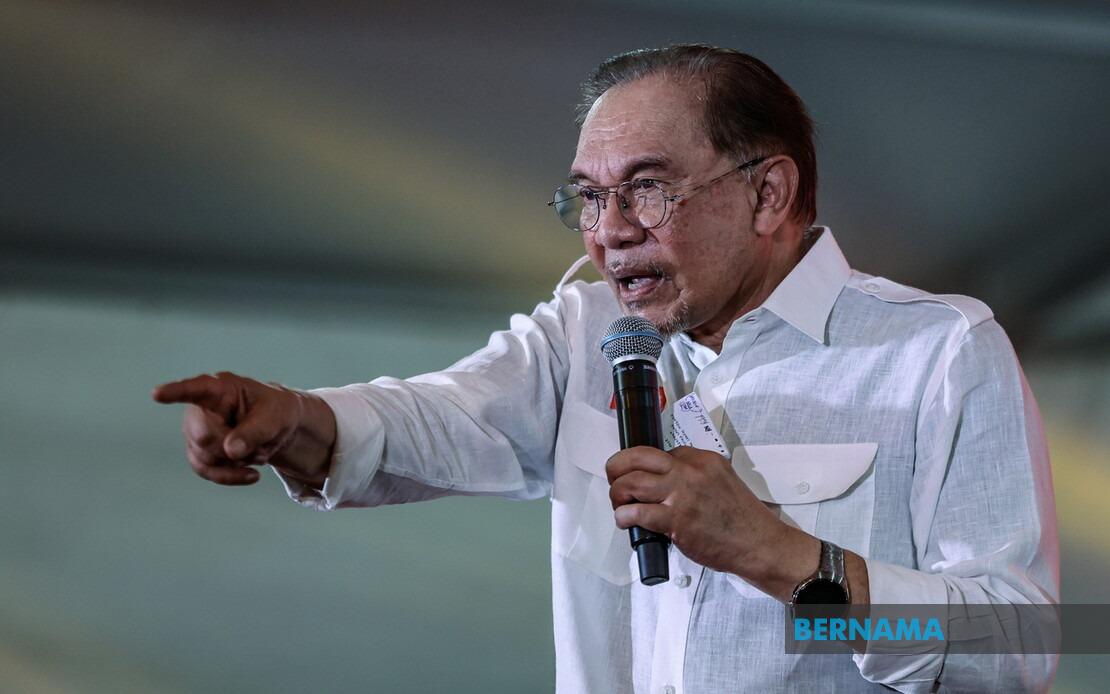
Prime Minister Datuk Seri Anwar Ibrahim has expressed frustration with the escalating political rhetoric from Kedah Menteri Besar Datuk Seri Muhammad Sanusi Md Nor, insisting that the Federal Government's commitment to improving infrastructure and economic prospects in Kedah remains unwavering despite the tension between leaders.
Addressing party faithful at a Pakatan Harapan campaign event in Simpang Renggam on July 10, Anwar characterised Sanusi's attacks as unjustified given the tangible investments and strategic initiatives his administration has channelled into the northern state. The Pakatan Harapan chairman underscored that his government has consistently prioritised Kedah's development objectives, working to enhance living standards and economic opportunities for its residents across various sectors.
The Prime Minister drew attention to a particularly symbolic gesture: his decision to bring Thai Prime Minister Anutin Charnvirakul to Bukit Kayu Hitam rather than to the nation's capital, a move designed to underscore the federal government's focus on boosting cross-border economic cooperation in the region. This choice of venue for the bilateral engagement signals recognition that Kedah's prosperity is intertwined with strengthened ties and enhanced trade facilitation with Thailand, potentially opening new markets and employment avenues for residents in both Perlis and Kedah.
The centrepiece of this bilateral engagement was the official opening of a new road alignment connecting the Bukit Kayu Hitam Immigration, Customs, Quarantine and Security Complex with Thailand's Sadao Customs, Immigration and Quarantine Complex. Such infrastructure represents more than mere physical connectivity; it streamlines the movement of goods and people across the shared border, reducing transaction costs and processing times that have long hampered border trade. For Malaysian exporters and importers, particularly those operating in northern states, such improvements translate directly into enhanced competitiveness and reduced operational expenses.
Anwar's frustration appears rooted in what he perceives as ingratitude and partisan posturing from Sanusi, who has publicly mocked the Prime Minister's governance approach while declining to participate in development announcements within Kedah itself. Reports indicate that Sanusi has criticised Anwar for acting as though states are overly dependent on federal largesse, a characterisation the Prime Minister disputes. The absence of Kedah's chief minister from the Bukit Kayu Hitam event created an awkward political tableau, with the federal government extending tangible benefits while the state administration maintained distance.
Critically, Anwar articulated a unifying vision that transcends partisan divisions. He emphasised that despite Kedah being governed by the opposition Parti Islam SeMalaysia, his sense of responsibility extends universally across Malaysia's states and communities. This stance reflects a pragmatic acknowledgment that federal resources and infrastructure projects cannot be weaponised for political advantage without undermining national development goals. The Prime Minister's willingness to invest in opposition-held territories, even as those territories' leaders criticise him, demonstrates either considerable political maturity or perhaps a calculated strategy to win over voters in Kedah by demonstrating that development is not contingent upon voting for Pakatan Harapan.
Beyond infrastructure, Anwar signalled potential expansion of the Sumbangan Asas Rahmah assistance programme, contingent upon continued political stability and voter endorsement of Pakatan Harapan. This cash assistance initiative, which provides direct support to lower-income households, has become a cornerstone of the government's social protection agenda. Increasing the allocation would require demonstrating fiscal discipline and preventing financial leakage, challenges that Anwar claims his administration is actively addressing through better governance and financial management.
The timing of these remarks, delivered during a campaign stop ahead of the Johor state election, underscores the intersection of development policy and electoral politics in Malaysian governance. Anwar's attendance at five separate campaign events across Johor on that single day reflects the intensity with which Pakatan Harapan is contesting state elections, with the Prime Minister personally endorsing party candidates and rallying grassroots support. The strategic deployment of the Thai Prime Minister's visit and the infrastructure announcement appears designed to demonstrate tangible results that party machinery can leverage during campaign messaging.
For regional observers, the Bukit Kayu Hitam corridor development carries broader significance beyond bilateral relations. As Southeast Asia increasingly prioritises cross-border economic integration and regional supply chain resilience, such infrastructure improvements reflect Malaysia's positioning within these frameworks. Enhanced border facilities facilitate not only Thailand-Malaysia trade but also integrate northern Malaysia more effectively into broader ASEAN economic networks, potentially attracting investment and manufacturing capacity seeking optimised regional positioning.
The Kedah dispute also illuminates persistent tensions within Malaysia's federal system regarding resource allocation and political loyalty. Opposition-governed states occupy an ambiguous position: entitled to fair treatment under constitutional provisions, yet potentially vulnerable to perceptions of federal neglect if their leaders actively antagonise the national government. Sanusi's public criticism, while politically satisfying to his base, risks being framed as obstruction of development initiatives that could benefit ordinary Kedahans. Anwar's public emphasis on his inclusive approach appears calculated to expose this contradiction to voters.
Moving forward, the trajectory of federal-state relations in Kedah will likely reflect broader patterns emerging across Malaysia's political landscape. If Pakatan Harapan maintains its coalition government and strengthens its electoral position, the government may continue expanding infrastructure investments in strategically important regions regardless of their political governance. Conversely, should opposition parties gain ground, tensions over resource allocation and inter-governmental cooperation may intensify, potentially complicating the execution of cross-border and regional development initiatives that require coordinated implementation across multiple tiers of government and different political jurisdictions.

