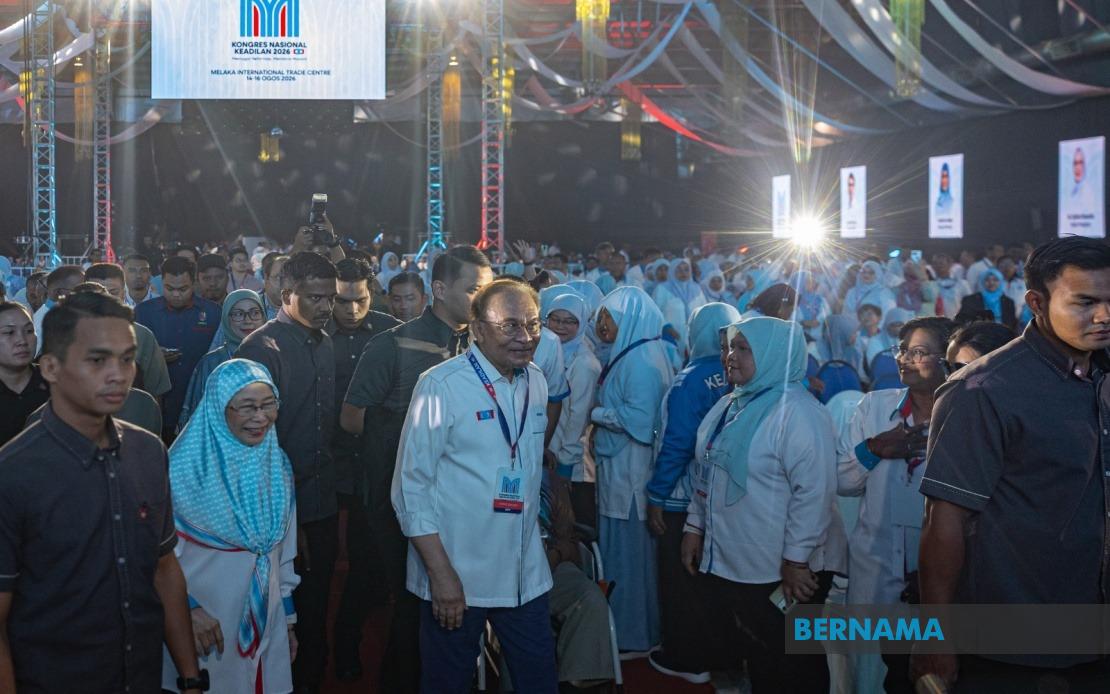
Prime Minister Datuk Seri Anwar Ibrahim has reaffirmed his determination to sustain the governing coalition between the Unity Government and UMNO-Barisan Nasional, signalling that Malaysia's political direction will remain firmly anchored to pragmatism and national interest rather than factional tensions. Speaking at the PKR National Congress 2026 in Melaka on August 16, the PKR president emphasised that recent political developments have not shaken his conviction that continued partnership serves the nation better than pursuing alternative alignments or engaging in damaging power struggles.
Anwar's remarks come at a sensitive juncture in Malaysian politics, where periodic rumours of coalition fractures have threatened investor confidence and policy continuity. By publicly restating his preference for stability, the Prime Minister has sought to reassure stakeholders—both domestic and international—that despite occasional friction within the broader Unity Government framework, the federal executive remains united around core economic and governance objectives. This messaging is particularly significant given Malaysia's vulnerability to rapid capital outflows when political uncertainty intensifies, a lesson learned painfully during previous transition periods.
The Prime Minister articulated a philosophical position that elevates collective wellbeing above individual advancement or partisan scoring. He argued that political choices must not be hostage to personal ambitions, positional jockeying, or emotional reactions to past slights. Instead, decisions should be filtered through a single lens: what serves the rakyat and strengthens the nation. This framing implicitly appeals to the broader electorate's fatigue with zero-sum political competition and underscores why, in Anwar's calculation, maintaining UMNO-BN partnership delivers tangible benefits that factional warfare cannot.
Economic momentum underpins much of this strategic thinking. Anwar linked political stability explicitly to prosperity through sustained growth. The coalition's ability to pass budgets, implement long-term infrastructure projects, and maintain predictable policy frameworks depends on parliamentary arithmetic remaining stable. A breakdown of the UMNO-BN arrangement would require either fresh elections—inherently destabilising and costly—or a reconfiguration with untested partners whose legislative discipline and governing experience remain unproven. Malaysia's recent GDP performance and investor recovery are directly tethered to this political settlement, making Anwar's preference for continuity less ideological than pragmatic.
The timing of this declaration at a major PKR gathering carries weight. By addressing party members directly, Anwar signals that PKR, despite being Pakatan Harapan's anchor, accepts the arithmetic of coalition politics. PKR cannot govern alone; it requires both internal party discipline and external partnership stability. Some party grassroots may harbour resentment toward UMNO or frustration with power-sharing constraints, yet Anwar is clearly setting expectations that party loyalty demands acceptance of this reality. This manoeuvre simultaneously reinforces his authority within PKR and sends a cooling signal to any factions tempted by speculative alternatives.
Recent events referenced obliquely by Anwar likely include various political skirmishes, leadership challenges within component parties, or vocal disagreements over policy direction. Rather than detailing specific grievances, he chose to transcend them rhetorically, positioning the coalition's continuation as a choice grounded in wisdom rather than resignation. This rhetorical move—emphasising deliberation and careful judgment—subtly contrasts his approach with what opponents might characterise as more impulsive or revenge-driven political strategies. For Malaysian voters fatigued by instability, this presentation of pragmatic statesmanship carries appeal.
The Unity Government itself represents a historic realignment. The 2022 formation of this coalition between historically antagonistic forces—Pakatan Harapan and UMNO-BN—was born from necessity after the 2022 election produced no single-majority bloc. What initially appeared a temporary marriage of convenience has gradually calcified into a functional governing arrangement. Anwar's endorsement of its continuation signals that trial-and-error experimentation has validated the partnership's utility despite ideological differences. For Malaysian politics, this represents a subtle but important maturation: accepting that governance stability sometimes requires working across historical divides.
For Southeast Asia's largest economy and a critical regional hub, political predictability carries outsized weight. Foreign investors, development banks, and regional partners calibrate their commitments based partly on Malaysia's perceived political risk. Anwar's public commitment to coalition continuity therefore extends beyond domestic messaging; it reassures Bangkok, Singapore, Jakarta, and Beijing that Malaysia remains a dependable partner for trade, investment, and security cooperation. In an era of regional economic competition, reputational stability translates directly into economic advantage.
The broader implication of Anwar's stance involves reconceptualising Malaysian democracy around functional coalitions rather than winner-take-all majoritarian politics. With Malaysia's demographic and geographic diversity, and the persistence of multiple political blocs with substantial voter bases, the mathematical likelihood of single-party supermajorities has diminished. Anwar's apparent comfort with this new normal—his insistence that stability and prosperity matter more than ideological purity—suggests a recalibration of political expectations. Future governments may increasingly require cross-ideological partnerships, making his coalition model potentially the template rather than the exception.
Yet tensions remain latent. UMNO and PKR harbour fundamentally different visions for Malaysia's future, and shared power necessarily involves constant negotiation over policy priorities, resource allocation, and succession planning. Anwar's reaffirmation of commitment does not erase these underlying differences; rather, it establishes a framework for managing them constructively. The question facing Malaysian politics is whether this framework can accommodate future crises, leadership transitions, or economic shocks without fracturing. Anwar has bet that it can—and that this bet represents the highest service he can render to the nation.

