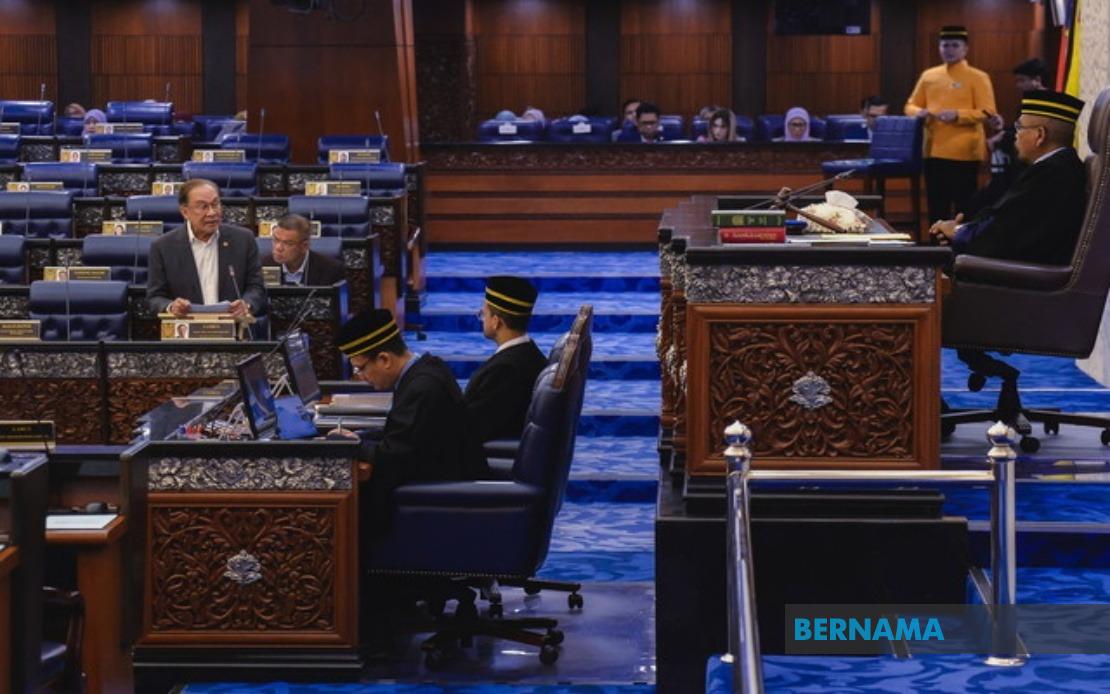
Prime Minister Datuk Seri Anwar Ibrahim has made clear that the prohibition against announcing fresh projects or introducing new policies during election campaigns remains strictly enforced under Malaysian election law. Speaking during Minister's Question Time in Parliament on June 30, Anwar reiterated the government's unwavering commitment to upholding Section 24B of the Election Offences Act 1954, which forms the legal backbone of these restrictions. The clarification came as the nation prepared for state elections in Johor, Melaka and Negeri Sembilan, prompting Datuk Seri Dr Shahidan Kassim from Perikatan Nasional to seek confirmation on the scope and enforcement of these rules.
The Prime Minister's remarks underscore a fundamental principle governing Malaysian electoral conduct: once the nomination day has been officially declared, the machinery of government cannot be commandeered to unveil new spending commitments or policy initiatives. This restriction applies uniformly across all levels of administration, whether through municipal authorities, state governments, or federal agencies. Anwar stressed that the government's position on this matter has not shifted, reinforcing that adherence to these guidelines is non-negotiable regardless of which political party holds office. The emphasis on consistent enforcement reflects broader concerns about maintaining electoral integrity and preventing the abuse of state resources for political advantage during campaigns.
However, the Prime Minister drew an important distinction that clarifies the practical application of these rules. Projects that received prior approval or were allocated funding in earlier federal budgets are not subject to the campaign announcement prohibition. This distinction matters significantly for ongoing developmental initiatives, as it allows government agencies to continue implementing previously committed projects without being constrained by campaign timelines. The nuance acknowledges that completely halting all government communication about projects would be administratively impractical and economically counterproductive, while still maintaining safeguards against using campaign periods to introduce new spending pledges designed to sway voters.
The question raised by Dr Shahidan Kassim reflected legitimate concerns about enforcement mechanisms, particularly given Malaysia's history of electoral contestation. The opposition politician sought clarity on how the government would ensure compliance across its various departments and state administrations, a question that speaks to the challenge of coordinating such restrictions across a complex bureaucratic system. Implementation becomes especially challenging when different political administrations govern federal and state levels, creating potential pressure points where the distinction between campaign-period restrictions and routine governance can become blurred. Anwar's parliamentary response attempted to address these enforcement concerns by reaffirming the government's commitment while outlining the legal and practical boundaries.
Section 24B of the Election Offences Act 1954 represents one of several legal mechanisms designed to level the playing field between incumbent administrations and opposition parties contesting elections. The provision recognizes an inherent structural advantage enjoyed by governments in power—the ability to deploy state resources and announce public spending to generate goodwill among voters. By prohibiting new project announcements during campaigns, the legislation seeks to prevent governing parties from using state machinery as an electoral tool. This becomes particularly relevant in the Malaysian context, where federal and state governments may be controlled by competing coalitions, creating scenarios where enforcement becomes a test of institutional impartiality.
The timing of Anwar's statement, coinciding with imminent state elections, highlights the practical relevance of these restrictions. Election campaigns in Malaysia typically run for several weeks following nomination day, creating a window when restrictions must be observed. During this period, government spokespersons must exercise careful language when discussing ongoing initiatives, distinguishing between continuing previously announced programs and introducing new commitments. Failure to maintain this distinction can invite legal challenges or accusations of electoral misconduct, potentially delegitimizing election outcomes and undermining public confidence in the fairness of the process.
For Malaysian voters and observers, understanding these rules provides insight into the formal constraints on political behavior during elections. While Anwar's reaffirmation suggests the government takes these restrictions seriously, the practical enforcement record remains an area of ongoing scrutiny. Opposition parties and civil society organizations often monitor campaign periods closely, documenting government announcements to identify potential violations. The presence of such monitoring itself serves as a deterrent, though determining whether a particular announcement violates the rules sometimes requires nuanced legal interpretation.
The restriction on new project announcements also reflects a broader international trend in democracies where electoral regulations attempt to limit the use of public resources for partisan advantage. Many Commonwealth nations maintain similar provisions, recognizing that the power to spend is the power to influence elections. Malaysia's approach, enshrined in decades-old legislation, demonstrates an institutional acknowledgment of this principle, even as implementation challenges persist.
Looking toward the forthcoming state elections, Anwar's parliamentary clarification serves as both a reminder to government officials and a benchmark against which opposition parties and election observers will measure compliance. The distinction he drew between previously funded projects and new initiatives provides administrative guidance, though gray areas will inevitably emerge in practical application. As political competition intensifies ahead of these contests, maintaining credible enforcement of these rules becomes essential for preserving the perceived legitimacy of electoral outcomes across Malaysia's diverse political landscape.

