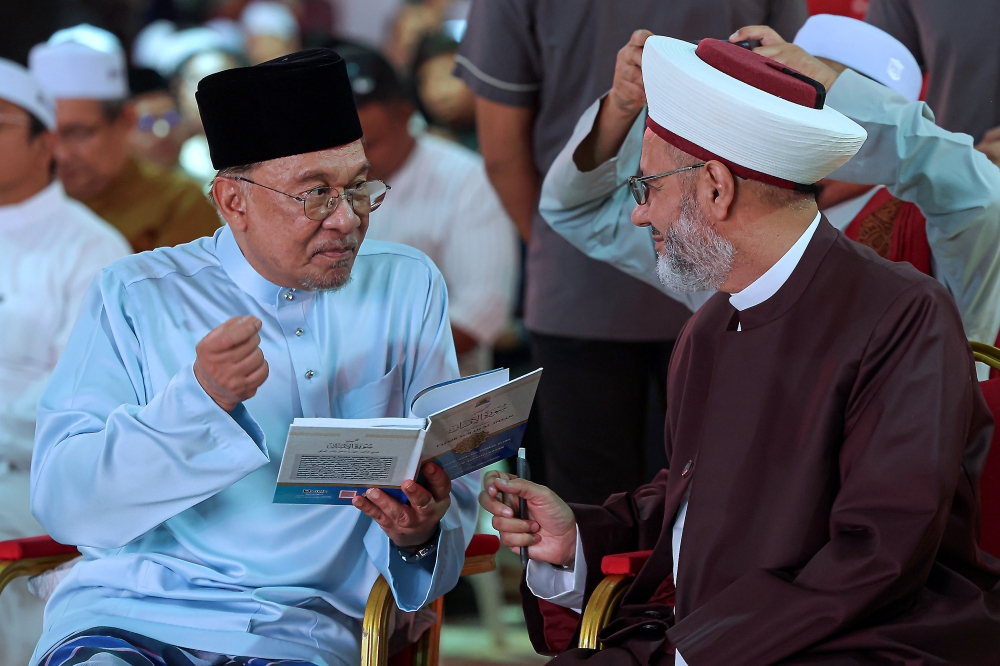
Prime Minister Datuk Seri Anwar Ibrahim has held up the Grand Imam of Al-Azhar, Ahmed Al-Tayyeb, as a leading voice for interfaith dialogue and moderation within the Islamic world, reflecting Malaysia's own commitment to balanced religious governance. In remarks highlighting the significance of the Al-Azhar institution, Anwar positioned the Grand Imam as instrumental in countering extremist narratives and fostering understanding across religious boundaries—priorities that resonate deeply with Malaysia's multicultural framework.
The endorsement underscores a diplomatic alignment between Kuala Lumpur and Cairo on matters of religious interpretation and social cohesion. Al-Azhar, one of Islam's most influential educational and theological centres, has long wielded considerable authority in shaping contemporary Islamic thought across the Muslim-majority world. Its leadership carries particular weight in guiding discourse on how Islam adapts to modern challenges while maintaining doctrinal integrity. Anwar's commendation reflects Malaysia's strategic interest in supporting institutional voices that champion gradualism and inclusivity rather than sectarian rigidity.
The timing of Anwar's comments coincides with growing global concern about religious polarization and radicalization. By elevating Al-Tayyeb's profile, the Malaysian Prime Minister signals alignment with Egypt's institutional approach to religious authority—one that exercises considerable pedagogical influence over millions of students and adherents throughout the Middle East, North Africa, and beyond. This positioning matters for Malaysia's own religious management, where the government navigates balancing Islamic governance with pluralistic governance frameworks.
Al-Tayyeb's tenure as Grand Imam has been marked by his willingness to engage with non-Muslim religious leaders and to articulate Islamic teachings in ways that emphasize universal values of peace and coexistence. His interventions on issues ranging from religious freedom to women's rights have often contradicted hardline interpretations favoured by more conservative constituencies within global Islam. Anwar's recognition of these efforts suggests Malaysia views such moderate theological voices as vital counterweights to extremist ideologies that have destabilized multiple regions.
The relationship between Malaysia and Egypt extends beyond religious leadership to encompass broader geopolitical coordination. Both nations are influential players within the Organisation of Islamic Cooperation and other multilateral forums where Islamic perspectives shape international dialogue. By publicly endorsing Al-Tayyeb's brand of moderation, Anwar amplifies a particular vision of what contemporary Islamic governance should embody—one responsive to pluralistic societies while maintaining religious authenticity.
For Malaysian policymakers, the endorsement carries domestic significance as well. Malaysia's Federal Constitution enshrines Islam as the federation's religion while guaranteeing freedom of worship to other faiths, a balance requiring continuous careful stewardship. Anwar's highlighting of moderate Islamic leadership internationally provides doctrinal cover for his own administration's religious policies, subtly reinforcing that progressive Islamic interpretation enjoys support from globally respected scholarly authorities.
Al-Azhar's influence extends into education, Islamic jurisprudence, and religious authority across dozens of countries. Institutions like Malaysia's International Islamic University and various state-level Islamic bodies often reference Al-Azhar's scholarly positions when developing curricula and issuing religious guidance. By championing the Grand Imam's moderation agenda, Anwar strengthens the hand of similar institutional actors within Malaysia who advocate for inclusive Islamic pedagogy and reasoned theological debate.
The statement also positions Malaysia as a constructive participant in shaping Islamic discourse during a period of significant geopolitical tension affecting Muslim-majority regions. By associating Malaysia with Al-Tayyeb's moderate stance, Anwar projects a vision of Malaysian leadership concerned with intellectual and spiritual renewal rather than confrontational identity politics. This has practical implications for Malaysia's diplomatic relationships across the Middle East and its credibility as a voice within Islamic civilization.
Regionally, Malaysia's endorsement of Al-Azhar's moderation framework carries implications for Southeast Asian Islam. As the most developed Muslim-majority democracy in the region, Malaysia's positioning on global Islamic leadership shapes how other Southeast Asian governments and religious institutions calibrate their own approaches to religious authority and theological innovation. Anwar's remarks thus ripple beyond bilateral Egypt-Malaysia relations to influence broader regional patterns of Islamic institutional development.
The Grand Imam's global moderation icon status, as framed by Anwar, also addresses concerns among Western audiences and secular constituencies about Islam's compatibility with pluralistic governance. By spotlighting Al-Tayyeb's interfaith work and his scholarly rejection of extremist interpretations, Anwar implicitly distances mainstream Islamic institutional practice from violent ideologies that claim Islamic justification. This narrative proves useful domestically where Malaysia continues managing complex religious-secular tensions.
Moving forward, this alignment between Anwar's government and Al-Azhar's institutional vision likely signals increased coordination on matters of Islamic education, theological training, and interfaith programming. Such collaboration could involve expanded student exchanges, joint research initiatives, and coordinated messaging on contentious theological questions facing modern Islam. For Malaysia, such partnerships reinforce institutional capacity for managing religious affairs in sophisticated, intellectually grounded ways.
Ultimately, Anwar's commendation reflects a deliberate strategic choice to associate Malaysia with Islamic moderation as a governing philosophy, both domestically and internationally. By elevating Al-Tayyeb as a global icon representing this approach, the Prime Minister articulates an aspirational model for how Islamic societies and institutions can preserve religious integrity while embracing pluralism, interfaith respect, and intellectual openness—values increasingly central to Malaysia's self-conception and regional standing.

