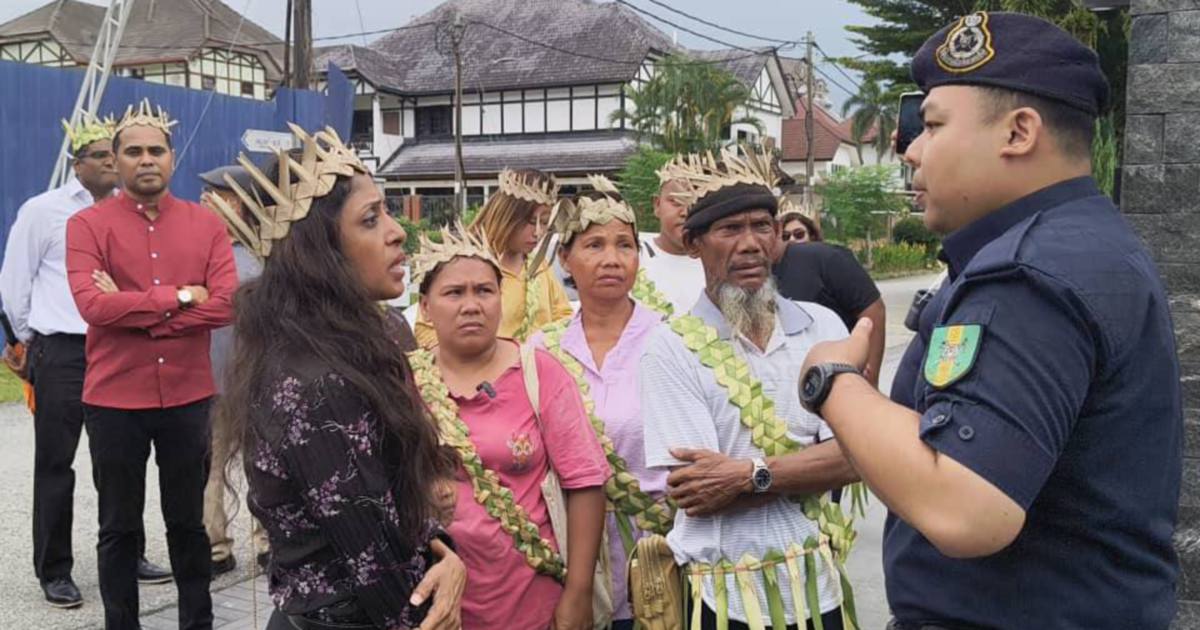
Residents of Kampung Sungai Cot have welcomed fresh assurances from Prime Minister Datuk Seri Anwar Ibrahim regarding their long-standing land dispute, marking a potential shift in how the government addresses indigenous land claims. For Juliana Jazlin Ismail, a village resident, the Prime Minister's personal commitment to intervening in the matter brought tangible relief after years of navigating bureaucratic obstacles and legal uncertainty that have typified Orang Asli engagement with Malaysian authorities.
The Orang Asli, Malaysia's indigenous populations scattered across peninsula settlements, have historically faced significant challenges in securing legal recognition and protection of their ancestral lands. Land disputes involving these communities typically involve competing claims from developers, government agencies, and local authorities, with indigenous groups often lacking the institutional resources and political leverage to defend their territorial interests effectively. Kampung Sungai Cot's situation exemplifies a pattern repeated across numerous Orang Asli settlements, where communities find themselves vulnerable to displacement or partial seizure of their territories without meaningful consultation or compensation.
The significance of Anwar's direct intervention lies partly in the symbolic weight of prime ministerial attention to indigenous grievances. Historically, Orang Asli communities have experienced limited high-level government engagement with their concerns, often relegated to handling by lower-tier bureaucracies or marginalized within broader policy discussions. Personal assurances from the nation's chief executive signal a potential recalibration of priorities within the Pakatan Harapan administration regarding indigenous rights and land security, areas where previous governments often pursued development-first agendas at the expense of Orang Asli welfare.
For Malaysian context, the Orang Asli constitute roughly 180,000 individuals distributed across the peninsula, representing one of the nation's most economically disadvantaged and socially vulnerable populations. Their historical disconnection from formal property and land registration systems has created persistent legal vulnerabilities. Many ancestral territories occupied for generations lack formal documentation recognized within Malaysia's modern legal framework, placing Orang Asli communities at inherent disadvantage when disputes arise with entities possessing superior bureaucratic capacity and capital resources.
The mechanism through which Anwar proposes to intervene requires attention. If the Prime Minister's commitment translates into concrete institutional support—including legal representation, community-led surveys establishing historical occupation, or regulatory protection against arbitrary land transfers—the outcome could establish meaningful precedent for how government addresses indigenous land claims. Conversely, assurances without corresponding administrative action would represent merely symbolic gestures familiar to communities accustomed to unfulfilled political promises.
The timing of these assurances aligns with broader regional discussions surrounding indigenous rights and land recognition. Countries including the Philippines and Indonesia have implemented systems providing greater legal recognition of indigenous land tenure, creating comparative pressure on Malaysia to strengthen protections for Orang Asli communities. International human rights frameworks increasingly emphasize indigenous land rights as fundamental to cultural preservation and economic self-determination, standards against which Malaysia's record faces scrutiny within regional and global forums.
Kampung Sungai Cot's dispute illustrates the intersection of multiple governance failures affecting Orang Asli populations. Environmental degradation, agricultural transformation, and urban expansion have progressively encroached upon traditional territories, while institutional mechanisms designed to protect indigenous interests remain ineffective or underutilized. Clear property boundaries, secure tenure security, and participatory mechanisms enabling communities to influence decisions affecting their lands represent fundamental prerequisites for indigenous welfare that many Malaysian settlements still lack.
The enthusiasm evident among villagers responding to the Prime Minister's assurance reflects profound desperation within communities facing uncertainty about their future tenure security and settlement viability. This emotional response underscores how instrumental land remains to Orang Asli identity, subsistence patterns, and community cohesion. For populations whose historical relationship with territory extends generations prior to modern state formation, land disputes represent existential challenges rather than mere property disagreements.
Expectations now rest upon translating political commitments into administrative outcomes. The government must demonstrate capacity to mediate between competing stakeholder interests—including development pressures, government land allocation, and community rights—through transparent processes prioritizing indigenous voices. Establishing clear procedures for resolving future disputes would prove more valuable than interventions in individual cases, creating systemic frameworks benefiting broader Orang Asli populations facing similar challenges across numerous settlements.
For Southeast Asia's broader indigenous populations, Malaysia's handling of cases like Kampung Sungai Cot carries regional implications. How effectively the Anwar government translates indigenous advocacy into policy implementation will influence whether other governments perceive indigenous land rights as political priority or continue relegating these concerns to peripheral policy domains. The Orang Asli communities' cautious optimism represents hope that political leadership acknowledges their long-marginalized status deserves genuine institutional support rather than rhetorical sympathy.

