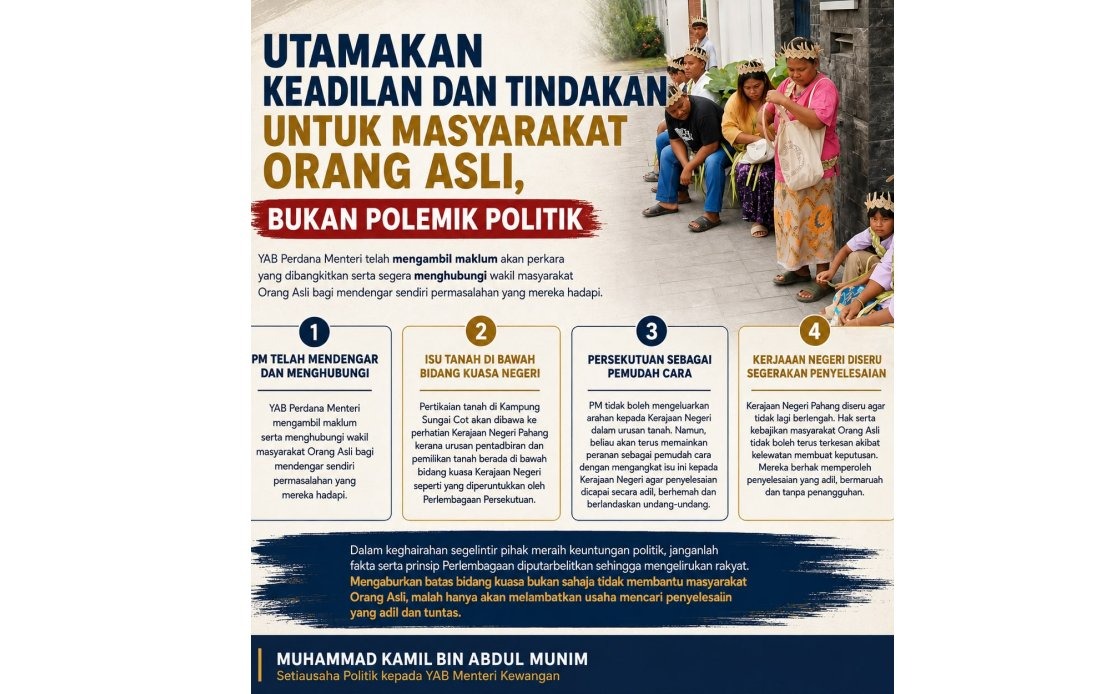
Prime Minister Datuk Seri Anwar Ibrahim has reaffirmed his commitment to assist in resolving a protracted land dispute affecting the Orang Asli community in Kampung Sungai Cot, Maran, Pahang, pledging to work with state authorities to achieve a swift and equitable outcome. According to Muhammad Kamil Abdul Munim, political secretary to the Finance Minister, the Prime Minister will continue in a facilitation capacity, engaging the Pahang State Government to help expedite resolution through channels that respect both constitutional governance and the legal framework governing land administration in Malaysia.
The Prime Minister has already undertaken direct engagement with representatives from the affected Orang Asli community, listening to their concerns and understanding the practical challenges they face on the ground. This hands-on approach reflects a broader commitment within the federal government to address indigenous land concerns, though it also illustrates the complex constitutional architecture that governs property matters in Malaysia's federal system. By personally meeting with community representatives, Anwar signalled political recognition of the issue's sensitivity and the genuine hardship experienced by the vulnerable community.
Crucially, Muhammad Kamil emphasised that land administration and property ownership remain within the jurisdiction of state governments under the Federal Constitution. This constitutional constraint means the Prime Minister cannot unilaterally direct Pahang authorities to resolve the matter according to federal preferences, a limitation that reflects Malaysia's federal structure where states retain significant autonomy over land matters. However, Muhammad Kamil clarified that constitutional boundaries do not equate to federal indifference, stressing that while the Prime Minister lacks direct authority, his office is actively engaged in facilitating dialogue and pressing for expedited action.
The clarification appears partly defensive, suggesting that some political actors have attempted to weaponise the land dispute by misrepresenting the federal government's constitutional role and capacity. Muhammad Kamil accused certain parties of distorting constitutional principles and factual circumstances in pursuit of political advantage, arguing that such tactics ultimately undermine rather than advance the interests of the Orang Asli community. This rhetorical pushback indicates that the issue has become contested political terrain, with various stakeholders positioning themselves around the land rights question.
The Pahang State Government now faces direct pressure from the federal executive to act decisively. Muhammad Kamil's statement urges state authorities to fulfil their responsibilities without further delay, framing swift action as a matter of both legal obligation and moral imperative. The appeal carries implicit criticism of administrative sluggishness, suggesting that the state government's pace of decision-making has prolonged the community's uncertainty and vulnerability regarding their ancestral lands. For the Orang Asli residents of Kampung Sungai Cot, the accumulation of bureaucratic delays represents more than mere administrative inconvenience; it threatens economic security and cultural continuity tied to their territorial claims.
The Orang Asli indigenous communities across Malaysia have historically faced marginalisation in land disputes, often lacking the institutional resources and legal representation to contest claims from more economically powerful actors. Kampung Sungai Cot's situation exemplifies broader patterns where indigenous land rights remain contested despite constitutional recognition of Orang Asli interests in various federal provisions. The dispute's persistence suggests either genuine complexity in establishing legal title or institutional reluctance to prioritise indigenous claims against competing commercial or development interests.
On Friday, Anwar publicly committed via social media to raising the matter with Pahang authorities, explicitly acknowledging the state's jurisdictional primacy over land questions. This communication strategy—transparent about the limitations of federal intervention while reaffirming federal commitment to facilitation—attempts to manage public expectations while demonstrating political engagement. The social media announcement ensures public visibility of federal action, countering any perception that the issue has been ignored or deprioritised at the highest political level.
Muhammad Kamil's emphasis on fairness, dignity, and timely resolution articulates normative principles that should theoretically guide state decision-making, yet the need to invoke them suggests existing uncertainty about whether these principles will actually govern Pahang's approach. The statement implicitly warns against protracted delays or resolutions that fail to adequately protect Orang Asli interests, signalling that federal monitoring will continue and that inadequate outcomes may invite further political attention and potential federal intervention through alternative mechanisms.
For Malaysian readers and Southeast Asian observers, this dispute illustrates enduring tensions between constitutional federalism and indigenous rights protection. While Malaysia's constitutional framework allocates land matters to states, this allocation can inadvertently marginalise indigenous communities whose claims require coordinated federal-state action and whose vulnerability may exceed their capacity to navigate state-level bureaucracies effectively. The Anwar government's engagement with Kampung Sungai Cot suggests incremental evolution in how federal authority responds to indigenous grievances, moving beyond purely legalistic interpretation of jurisdictional boundaries toward more active facilitation of equitable outcomes.
The ultimate resolution of this dispute will test both Pahang's administrative capacity and political will to prioritise indigenous land rights over competing interests. It will also demonstrate whether federal facilitation, absent direct authority, can sufficiently incentivise state-level action on behalf of vulnerable communities. As indigenous land disputes continue surfacing across Malaysia's states, the approach taken in Kampung Sungai Cot may establish precedents for how federal-state coordination can be mobilised to protect Orang Asli interests while respecting constitutional federalism.

