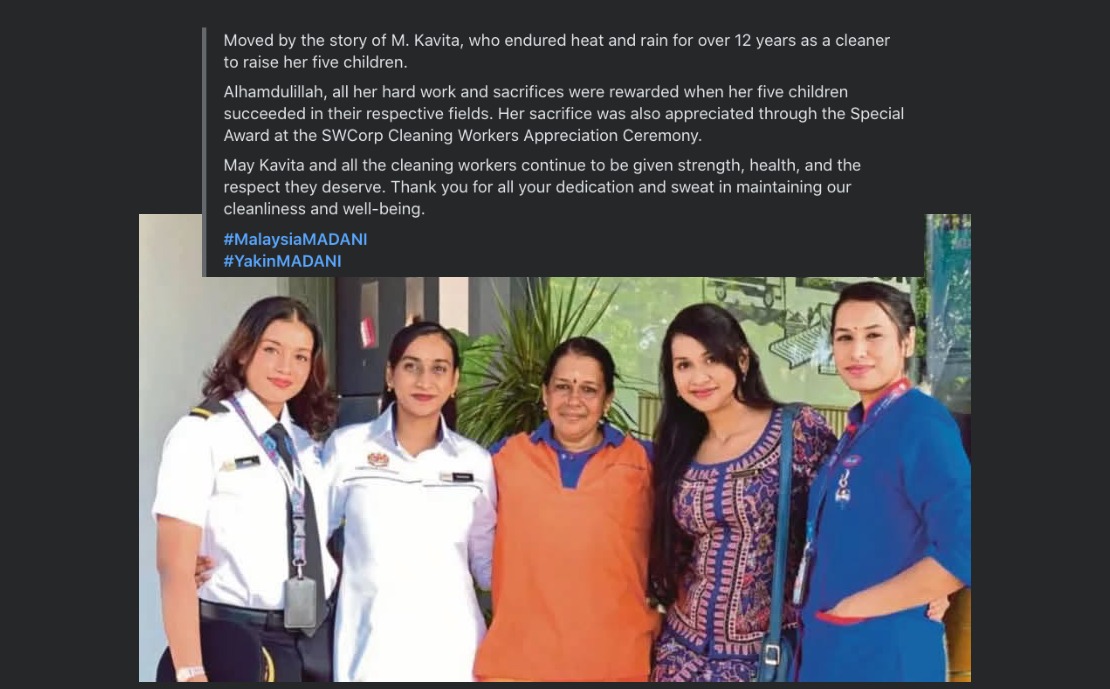
Prime Minister Datuk Seri Anwar Ibrahim has publicly celebrated the remarkable life journey of M. Kavita, a street sweeper whose commitment to her family and work has resonated deeply across Malaysian society. Through a Facebook post, Anwar acknowledged Kavita's twelve-plus years of labour in challenging weather conditions, work that enabled all five of her children to establish themselves successfully in their chosen professions.
Kavita's story encapsulates a broader narrative about Malaysia's essential workforce—those who perform critical sanitation and maintenance duties that underpin urban living standards. Her case highlights the often-overlooked contributions of cleaning and street maintenance workers who form the backbone of municipal services across the country. The Prime Minister's recognition underscores an important shift towards acknowledging and respecting workers in roles that are frequently undervalued despite their indispensable nature.
The labour of street sweepers and sanitation workers extends beyond mere job duties; it represents a social commitment that protects public health and maintains the cleanliness standards essential to thriving communities. Anwar's tribute specifically referenced Kavita's unwavering dedication to maintaining clean surroundings while simultaneously safeguarding the well-being of Malaysian citizens. This framing positions sanitation workers not as peripheral to society but as integral to the functioning of modern urban environments.
What distinguishes Kavita's narrative is the tangible success of her children across diverse professional sectors. Her four daughters have pursued careers as a pilot, cabin crew member, and staff nurse, with her fifth child similarly achieving professional success. These accomplishments represent the fruits of a parent's persistent sacrifice—working in demanding conditions year-round to finance education and support ambitions. The diversity of their careers illustrates how parental investment in education can open pathways across multiple industries and socioeconomic levels.
The emotional centrepiece of Kavita's story emerged during a spontaneous family gathering at her workplace last month, when her daughters arranged a surprise birthday celebration for her fiftieth birthday. The moment became particularly poignant when the daughters appeared wearing their professional uniforms, visually representing the culmination of their mother's years of effort. This occasion struck a chord with Malaysian social media users, whose widespread sharing of the story indicates resonance with themes of family sacrifice, intergenerational mobility, and maternal devotion.
Beyond the personal narrative, Kavita's recognition carries implications for Malaysia's broader conversation about worker dignity and social mobility. Her trajectory demonstrates that socioeconomic position at any given moment need not determine outcomes for subsequent generations. The emphasis on her children's achievements—spanning aviation, healthcare, and other professional sectors—illustrates how education and family support can facilitate upward mobility, a particularly relevant message for a developing economy seeking to expand its middle class.
Kavita's contributions were formally acknowledged at SWCorp's Cleaning Workers' Day Appreciation ceremony, where she received a Special Award. This institutional recognition complements the grassroots celebration her story generated across social media platforms. The dual acknowledgment—both from government leadership and dedicated worker appreciation events—signals a coordinated effort to elevate the status of sanitation and cleaning workers within Malaysian society.
The Prime Minister's message extended beyond individual commendation to encompass the broader population of street sweepers and cleaning workers nationwide. Anwar expressed wishes that all such workers continue to receive blessings of strength, good health, and the respect they rightfully deserve. This universalising of Kavita's case to represent her entire profession elevates the conversation from celebrating individual achievement to advocating for systemic respect and recognition of sanitation work.
For Malaysian readers, particularly those from working-class backgrounds, Kavita's story carries profound symbolic weight. It challenges societal hierarchies that often diminish certain occupations and affirms that dignity and success are accessible regardless of initial circumstances. The narrative also speaks to parents navigating economic constraints while aspiring to provide better opportunities for their children—a experience familiar to many Malaysian households.
The timing of this recognition amid broader discussions about worker welfare and social protection reflects Malaysia's evolving consciousness regarding its workforce. As the nation progresses economically, questions about fair treatment, dignified working conditions, and recognition for essential workers become increasingly important. Kavita's story, while particular to her circumstances, serves as a mirror for these larger policy conversations.
Anwar's public tribute also demonstrates political awareness of how celebrating ordinary Malaysians' achievements can reinforce narratives of social cohesion and opportunity. By highlighting a single worker's dedication and her children's success, the Prime Minister simultaneously honours individual perseverance and suggests that Malaysia's systems can facilitate upward mobility when families and individuals invest in education and development.
The broader implications extend to Malaysia's reputation as a nation that values all contributions to society. Sanitation and maintenance workers, while sometimes invisible in daily discourse, prove absolutely essential when absent. Kavita's recognition helps make visible these typically overlooked workers, potentially encouraging greater appreciation for service sector employees across Malaysian organisations and communities.

