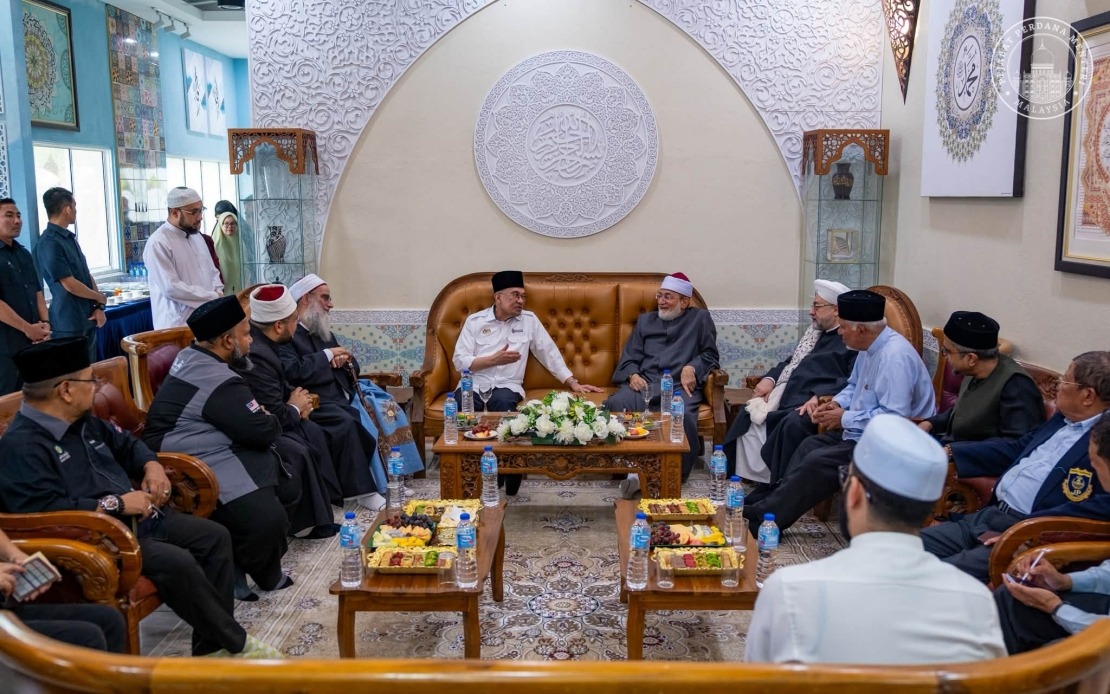
Prime Minister Datuk Seri Anwar Ibrahim made time in his schedule this week to meet with three internationally recognised Islamic scholars who are currently visiting Malaysia. The encounters took place at Nasyrul Quran and represented an opportunity for the nation's top political leader to engage directly with religious figures of considerable standing in the Islamic world.
The three scholars represent different but equally important dimensions of Islamic scholarship and practice. Among them was Egyptian hadith scholar Al-Fadhil Al-Allamah Al-Muhaddith Syeikh Dr Mustafa al-Nadwi Al-Hasani, whose expertise in hadith—the recorded sayings and practices of the Prophet Muhammad—carries significant weight in Islamic theological circles. Hadith scholarship remains fundamental to Islamic jurisprudence and religious practice across the Muslim world, and such specialists are regularly sought for guidance on complex matters of faith and law.
The second visitor was Al-Fadhil Al-Allamah Al-Muqri' Syeikh Dr Ahmad Isa Al-Ma'sarawy, a world-renowned Quran reciter whose knowledge and mastery of Quranic recitation represents another crucial pillar of Islamic learning. Quranic memorisation and recitation have been highly valued throughout Islamic history, and contemporary specialists in this field continue to influence religious practice and education across Muslim-majority nations.
The third scholar was Al-Fadhil Al-Syeikh Maulana Al-Sayyid Afeefuddin Al-Jailani, who serves as grand custodian of the waqf, mosque and maqam—the sacred shrine—associated with Syeikh Abdul Qadir Al-Jailani, a towering figure in Islamic mysticism and spirituality. This custodian role places him at the intersection of Islamic heritage preservation and contemporary religious leadership, responsibilities that extend across multiple countries where followers of this revered tradition reside.
In remarks posted on social media, Anwar conveyed that the meetings allowed him to inquire after the scholars' wellbeing and to request their spiritual guidance and prayers. Such consultations between political leaders and senior religious figures are commonplace in Muslim-majority democracies, reflecting the deeply intertwined nature of religious and public life in these societies. Anwar's approach signals his administration's interest in maintaining strong relationships with the global Islamic scholarly community.
The Prime Minister expressed gratitude for the scholars' willingness to travel to Malaysia and to dedicate their time to sharing Islamic knowledge and wisdom with local audiences. These kinds of visits serve multiple purposes in Malaysia's religious landscape: they elevate the quality of Islamic discourse, provide opportunities for local Muslim communities to learn from internationally respected teachers, and enhance Malaysia's standing as a centre for Islamic learning in Southeast Asia. The presence of such scholars also reflects Malaysia's position as a hub for Islamic education and interfaith dialogue within the region.
Anwar's stated hope, outlined in his social media statement, centred on ensuring that the scholars' presence would generate broader knowledge, spiritual blessings, and heightened affection for Islam among Malaysians. Beyond the immediate gatherings where these scholars teach and preach, their visits contribute to what might be termed the intellectual and spiritual ecosystem of Malaysian Islam—creating ripple effects through educational institutions, mosque networks, and community organisations that subsequently amplify their influence.
The Prime Minister also highlighted his vision of leveraging such scholarly engagement to support his broader national development agenda. Specifically, he referenced efforts to construct a society characterised by virtue, learning, and harmonious coexistence—objectives that touch on both moral development and social cohesion. In Malaysia's diverse religious and ethnic context, such aspirations carry particular weight, as they implicitly acknowledge the role that religious knowledge and leadership play in maintaining national unity and preventing communal tensions.
The timing of these meetings, squeezed into Anwar's demanding schedule, underscores the priority his administration places on cultivating relationships with respected international Islamic figures. For a Prime Minister juggling economic policy, regional diplomacy, and domestic governance challenges, allocating time to such encounters signals strategic importance. It suggests that engagement with global Islamic scholarship is viewed not as peripheral but as integral to the government's conception of how Malaysia should develop.
These types of scholarly visits have become increasingly common across Southeast Asia in recent years as Muslim-majority nations seek to deepen their Islamic intellectual foundations while remaining open to global Islamic thought. Malaysia, with its relatively sophisticated Islamic institutional infrastructure and growing economic capacity to host such events, naturally attracts high-calibre visitors. The presence of these three scholars during this particular period may also reflect ongoing discussions about the future trajectory of Islamic education and practice in Malaysia and the broader region.
The meetings also carry subtle diplomatic implications. By receiving these international Islamic figures at the highest political level, Malaysia reinforces its credentials as a serious participant in global Islamic discourse and as a nation where religious leadership enjoys genuine political recognition. This can enhance Malaysia's soft power in the Islamic world while simultaneously demonstrating to domestic audiences that their government takes Islamic spiritual and intellectual dimensions seriously.

