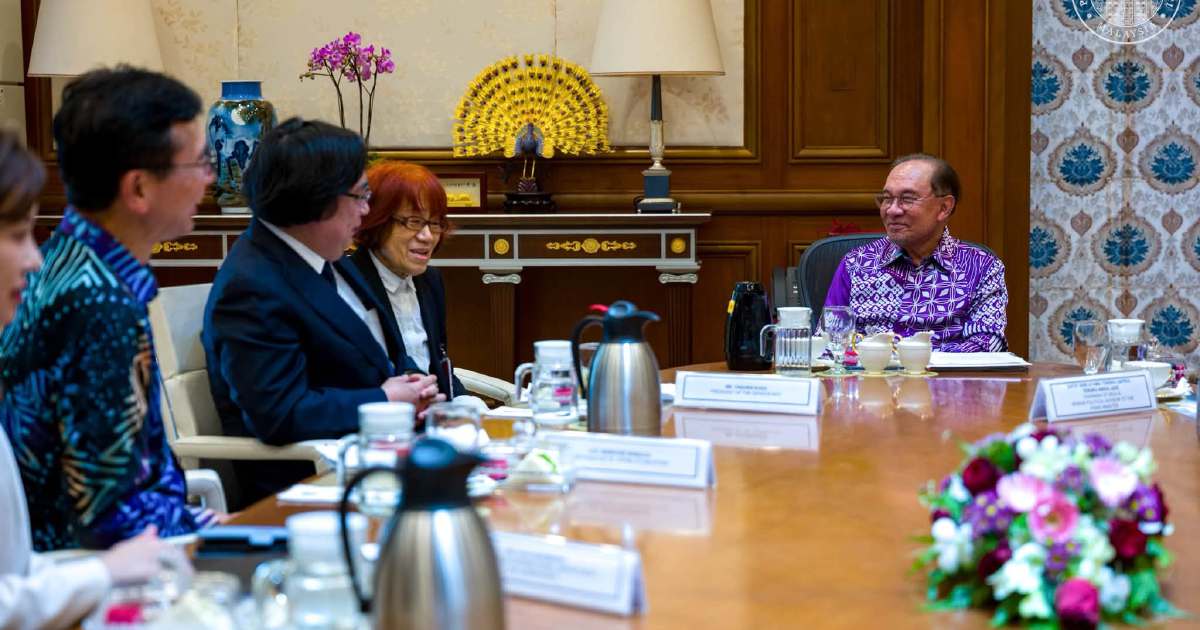
Prime Minister Datuk Seri Anwar Ibrahim received Yasushi Kudo, president of Genron NPO, at a courtesy meeting in Kuala Lumpur aimed at reinforcing the multifaceted partnership between Malaysia and Japan. The engagement underscores Malaysia's continued commitment to deepening institutional relationships with major Asian economic powers through structured dialogue platforms. Kudo's visit, led by one of Japan's most prominent civic engagement organisations, signals the importance both nations place on people-to-people and policy-level exchanges beyond traditional diplomatic channels.
Genron NPO occupies a distinctive position within Japan's soft power infrastructure as an independent think tank dedicated to advancing Japan's international strategic interests through intellectual discourse and high-level networking. The organisation convenes policy elites, business leaders, and academics to shape Japan's approach to regional security, trade, and diplomatic challenges. By engaging directly with Malaysian political leadership, Genron NPO extends Japan's influence across Southeast Asia's most important multilateral forum and bilateral partnerships, particularly with a country that maintains one of the region's most stable and diversified relationships with Tokyo.
Malaysia's role as both a major Southeast Asian economy and a critical node in Japan's regional strategy makes such exchanges particularly valuable. The discussions between Anwar and Kudo likely encompassed Japan's broader Indo-Pacific vision, a strategic framework that has gained prominence in Tokyo's foreign policy calculations over the past decade. This framework seeks to anchor Japan's security interests while promoting open trade and institutional cooperation across a vast geographical expanse stretching from the Indian Ocean to the Pacific. Malaysia, as a maritime nation straddling crucial sea lanes and a member of ASEAN, represents an indispensable partner in realising this vision.
Trade and investment formed a natural focal point for dialogue, given that Japan remains one of Malaysia's largest sources of foreign direct investment and a significant market for Malaysian exports. Japanese manufacturers have established substantial manufacturing and electronics bases throughout Malaysia, particularly in the Klang Valley and northern states, creating deep structural interdependencies. The meeting provided an opportunity to discuss potential expansion in these sectors, particularly in emerging areas such as green technology, semiconductor supply chain diversification, and digital infrastructure development. These conversations occur within a broader context of regional competition for investment and influence, as multiple great powers vie for technological and economic dominance.
Secondary economic considerations included discussions on research and development partnerships and knowledge-sharing initiatives in sectors where Japan possesses technological leadership. Malaysian interest in Japanese expertise spans renewable energy, industrial automation, automotive innovation, and healthcare technology. Collaborative frameworks in these areas benefit both economies: Japanese firms gain access to Southeast Asian markets and manufacturing platforms, while Malaysia accelerates technological capability building and creates high-value employment opportunities for its workforce. Such partnerships increasingly recognise sustainability imperatives, aligning with both nations' climate commitments.
Regional security concerns inevitably featured in substantive conversations between senior Malaysian and Japanese officials. The South China Sea remains a persistent source of tension and strategic uncertainty, with multiple claimants pursuing competing maritime interests. Japan's interests in the region centre on maintaining freedom of navigation, supporting a rules-based international order, and preventing any single power from establishing hegemonic control over vital shipping routes. Malaysia, as a coastal state with its own maritime claims and vested interests in stability, shares many of these concerns while balancing relationships with major powers including China. Dialogue between Anwar and Kudo likely explored how Malaysia and Japan could coordinate more effectively on regional security matters without unnecessarily escalating tensions.
The strategic dialogue framework itself deserves attention as a mechanism for sustained bilateral cooperation. Structured channels for regular communication between senior policymakers, think tanks, and business communities create spaces for frank discussion of divergent interests while building mutual understanding. For Malaysia, engagement with influential Japanese institutions like Genron NPO provides alternative perspectives on regional developments and opportunities for policy coordination. For Japan, direct access to Malaysian decision-makers facilitates better understanding of Southeast Asian priorities and constraints, ultimately producing more sophisticated and effective Japanese regional diplomacy.
Cultural and educational dimensions likely received mention, as both nations have invested substantially in people-to-people connections. Japanese language programmes in Malaysian universities, scholarship opportunities for Malaysian students in Japan, and cultural exchange initiatives all contribute to long-term relationship building. These softer elements of statecraft create constituencies within each country supportive of closer bilateral ties, providing political support for deeper cooperation on harder security and economic matters.
The broader significance of this meeting extends beyond the bilateral relationship itself. Malaysia's willingness to engage substantively with Japanese strategic thinking reflects Southeast Asia's complex diplomatic balancing act in an era of great power competition. By maintaining robust channels with multiple major powers—including Japan, China, the United States, and India—Malaysia pursues a pragmatic course designed to maximise benefits while minimising alignment costs. Such meetings also serve signalling purposes, demonstrating to regional and global audiences that Malaysia remains committed to institutional cooperation and liberal international frameworks.
Looking forward, the discussions initiated during Kudo's visit may yield concrete outcomes in subsequent months. Joint working groups on specific sectors, enhanced business delegations, or formal diplomatic initiatives could emerge from groundwork laid during high-level courtesy calls. The cyclical nature of such engagement means future visits by Malaysian officials to Japan and reciprocal hosting of Japanese delegations will continue, gradually building momentum in bilateral cooperation. Strategic patience and consistent engagement remain hallmarks of mature bilateral relationships in Southeast Asia.

