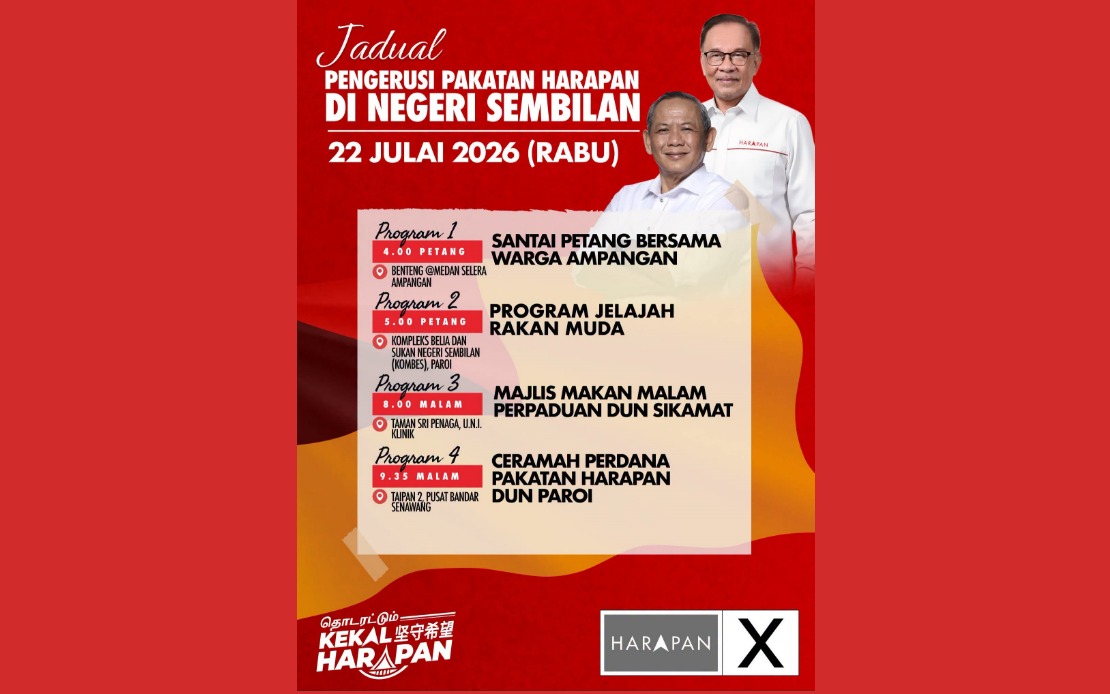
Prime Minister Datuk Seri Anwar Ibrahim is taking his campaign directly to voters across Negeri Sembilan, signalling the coalition's determination to retain control of the state government as the 16th state election enters its decisive phase. The PKR leader's personal intervention on the fifth day of campaigning underscores Pakatan Harapan's recognition that maintaining its hold on the premiership requires mobilising support from the ground up, particularly in constituencies where the race remains competitive. Anwar's presence is strategically timed to reinforce the coalition's messaging just days before early voting commences and ahead of the August 1 general polling.
The Prime Minister's itinerary across Ampangan, Paroi, Sikamat and Senawang reflects a calculated approach to reaching diverse voter segments. Beginning at 4 pm with an informal community gathering at Benteng @ Medan Selera Ampangan, Anwar will transition to youth-focused engagement at the Negeri Sembilan Youth and Sports Complex in Paroi at 5 pm. This progression from casual community interaction to structured youth programming suggests PH's attention to securing younger voters, a demographic that has proven decisive in recent Malaysian elections. The choice of venues in urban and semi-urban areas indicates the coalition is prioritising accessible, high-footfall locations where large crowds can be mobilised.
The inclusion of a unity dinner in Sikamat constituency demonstrates the internal consolidation work PH must undertake alongside its public campaign. Such events typically serve to align party machinery, resolve grassroots concerns and ensure that local party structures are fully activated. The culmination of Anwar's campaign day with a mega ceramah in Senawang provides the high-visibility platform necessary for generating media coverage and demonstrating organisational strength. These traditional political rallies remain influential in Malaysian electoral contexts, particularly in smaller states where direct engagement between national leaders and voters carries significant weight.
Pakatan Harapan's decision to contest all 36 state seats reflects confidence in its position, though the distribution of candidacies among coalition partners reveals the power dynamics within the alliance. PKR's 16 nominations, representing the largest share, underscores the party's primacy within the coalition and Anwar's personal authority in determining the slate. DAP's 11 candidates and Amanah's nine seats maintain the existing formula that has governed the coalition's internal negotiations since the 2020 general election. This balanced allocation helps prevent intra-coalition tension while maintaining each partner's stake in a potential state government.
The coalition's electoral strategy is anchored in the manifesto unveiled on Monday, which emphasises ten core commitments aimed at advancing Negeri Sembilan's development and inclusivity. Anwar's presence on the campaign trail serves to personalise these policy pledges, transforming abstract commitments into tangible leadership promises. For voters in Negeri Sembilan, seeing the Prime Minister directly advocate for the state's future creates a psychological connection between national and state-level governance, potentially influencing voters who believe stronger ties to federal leadership will benefit their state's prospects.
The timing of Anwar's campaign push reflects the compressed election calendar. Early voting on July 28 will enable certain categories of voters—primarily election workers and security personnel—to cast ballots ahead of the general polling day. This staggered voting process means campaigns must maintain momentum across both dates, as early voting results will likely be publicised and could generate momentum for either side heading into August 1. National party leaders typically intensify their presence in the days immediately before early voting, and Anwar's campaign schedule demonstrates PH's commitment to capturing maximum advantage during this critical period.
For the ruling Negeri Sembilan administration led by Menteri Besar Datuk Seri Aminuddin Harun, Anwar's active campaigning provides crucial validation and support. A sitting state government retains structural advantages in campaigning, including control over state machinery and administrative resources, but these are insufficient without popular legitimacy and effective national party backing. By putting Anwar front and centre, PH signals that federal resources and the Prime Minister's personal political capital are fully committed to preserving its state-level control. This reassurance is particularly important for local party activists and candidates who need confidence that their efforts are backed by the full machinery of the coalition.
The opposition in Negeri Sembilan, primarily Barisan Nasional and Perikatan Nasional, will undoubtedly seek to counter PH's high-profile campaign presence. National campaigns in Malaysian state elections often feature leaders from opposing coalitions visiting the same seats within days of each other, creating a public discourse around competing visions for governance. The intensity of Anwar's personal involvement may provoke similarly high-level counter-campaigning, elevating the state election from a local contest to a proxy battle reflecting broader national political competition.
For Malaysian voters beyond Negeri Sembilan, this state election carries implications for the stability of the current federal coalition. Any significant loss of ground by PH in Negeri Sembilan would embolden opposition parties and create pressure within the ruling coalition's leadership. Conversely, a decisive PH victory would strengthen Anwar's position within his own party and the broader coalition, providing momentum heading toward the next general election due no later than 2027. This explains why a relatively small state election attracts the intensive personal involvement of the Prime Minister.
The electoral commission's schedule, with early voting on July 28 and polling on August 1, concentrates the campaign into a brief window requiring maximum efficiency from all parties. Anwar's four-programme day represents concentrated effort to reach multiple constituencies and voter groups within a single day, a logistics-intensive undertaking that demonstrates PH's organisational capacity. Such displays of campaign efficiency can independently influence voter perceptions of party capability and readiness to govern.
As the campaign progresses toward its conclusion, the Negeri Sembilan election will serve as a significant barometer of public sentiment toward the current administration. Whether Anwar's personal campaign intervention proves sufficient to consolidate PH's position will become clear within days, with results providing important signals about the current government's popular support and the effectiveness of its coalition mechanics ahead of more consequential electoral contests.

