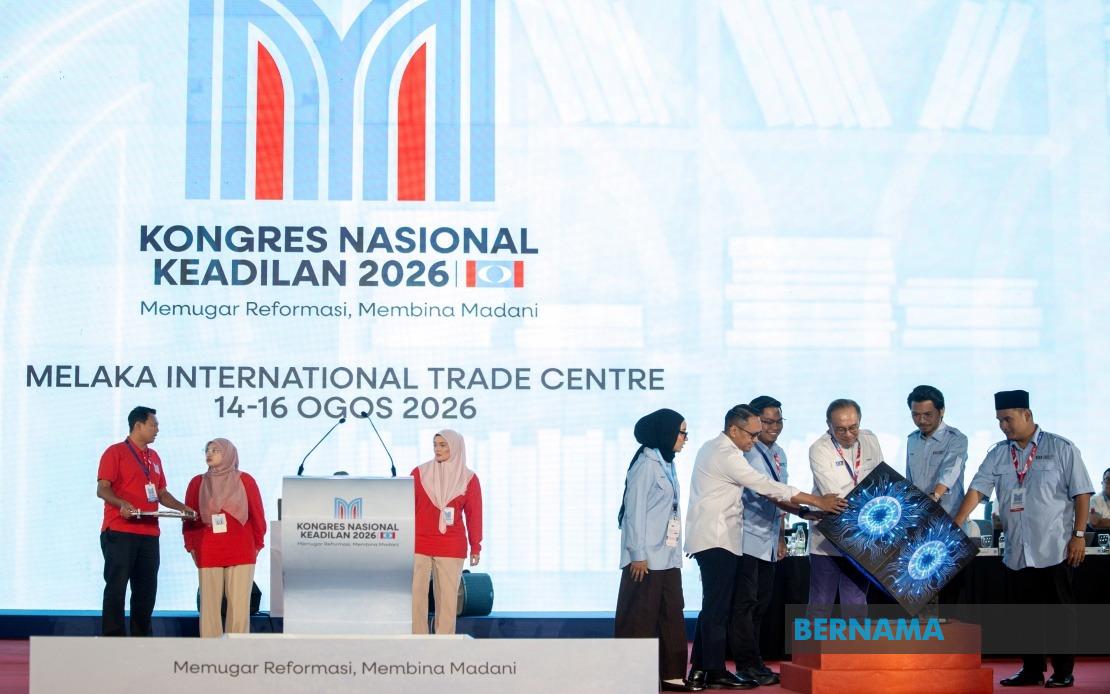
Prime Minister Datuk Seri Anwar Ibrahim unveiled a significant ideological text in Melaka on August 16, introducing a 113-page publication crafted to shape the intellectual and moral direction of Angkatan Muda Keadilan (AMK), the youth movement of Parti Keadilan Rakyat. Authored by Muhammad Kamil Ahmad Munim, head of AMK, and Ashraf Ahmad Hadi, an executive committee member, the document represents a deliberate effort by PKR's leadership to frame contemporary policy challenges through the lens of the party's foundational principles and the broader concept of Reformasi that has defined Malaysian reformist politics for decades.
Anwar's choice to launch the publication in Melaka carries symbolic weight, as the state has remained a significant political battleground and represents the party's efforts to deepen its institutional presence across Malaysia's regions. By personally overseeing this event, the Prime Minister signalled the importance of ideological coherence within PKR at a time when Malaysian politics faces mounting pressures from economic uncertainty, demographic shifts, and competing visions for the nation's future. The timing reflects a broader strategic calculation within PKR to consolidate support among younger voters and cadre members who will shape the party's trajectory in the coming decade.
In his remarks, Anwar characterised the publication as far more than technical policy guidance or routine political messaging. He positioned it instead as a manifesto for what he termed civilisational renewal, a concept that moves beyond conventional development discourse to encompass a re-humanisation of how Malaysia approaches national progress. This framing reflects growing concerns among reformist-oriented politicians that decades of top-down economic planning and technocratic governance have produced material gains while eroding social cohesion, civic participation, and moral purpose. By invoking civilisational renewal, Anwar sought to reconnect PKR's base to a vision of development that prioritises human dignity and social justice alongside economic metrics.
The Prime Minister's emphasis on moral responsibility and spiritual resilience addresses a critical generational challenge within Malaysian politics. Rather than celebrating youth activism as an end in itself, Anwar cautioned AMK members that the influence they wield represents a test of character and integrity rather than a prize to be exploited. This message, delivered at a moment when Malaysian society grapples with corruption, abuse of power, and eroding trust in institutions, carries particular resonance. Young people across Southeast Asia increasingly demand that leaders demonstrate not merely competence but authentic commitment to principles, and Anwar's framing appears designed to appeal to this sentiment while maintaining party discipline and ideological clarity.
The publication explicitly addresses the historical context of Malaysia's reform struggles, acknowledging that the nation remains burdened by past injustices and resource leakages that have undermined development outcomes and public confidence. By invoking this history, the document positions AMK members as inheritors of a struggle that demands intellectual courage and spiritual commitment rather than mere administrative skill. This approach allows PKR to frame contemporary policy debates within a longer narrative arc, connecting current challenges to historical patterns and positioning the party as the vehicle through which Malaysia can transcend these inherited obstacles. For a party that emerged from the 1998 Reformasi movement, maintaining this historical connection remains central to its identity and appeal.
The publication serves dual purposes within PKR's institutional architecture. At one level, it functions as a cadre-building instrument, providing structured guidance to AMK members on party history, foundational values, and the concrete meaning of Reformasi in contemporary contexts. This cadre-building function reflects international best practice among political parties seeking to develop coherent, informed membership bases rather than relying on charismatic leadership or transactional politics. By investing in ideological education, PKR aims to create a generation of party activists and leaders who can articulate the party's vision independently and sustain it beyond any single leader's tenure.
At another level, the document functions as an assertion of PKR's intellectual legitimacy within Malaysia's political landscape. Malaysian politics has long been contested terrain where Islamist parties, conservative nationalist movements, and reformist forces compete not only for votes but for the right to define Malaysia's national identity and policy direction. By publishing a substantial ideological text, Anwar and PKR signal that they possess a coherent vision capable of addressing contemporary challenges and providing direction for society. This intellectual dimension carries weight particularly among educated urban voters and younger professionals who increasingly demand programmatic substance from political parties rather than accepting personalities or ethnic mobilisation as sufficient political bases.
The AMK publication also reflects broader strategic considerations about how PKR can maintain cohesion within Malaysia's fractious coalition politics. Since the 2018 general election, PKR has navigated complex power-sharing arrangements with other reform-minded parties, conservative Islamic movements, and traditional political forces. By establishing clear ideological parameters through the AMK text, PKR leadership can create boundaries that distinguish the party from coalition partners while maintaining necessary political alliances. The emphasis on moral renewal and re-humanisation of development, for instance, differentiates PKR's approach from more technocratic or religiously particularist visions held by some coalition members.
The publication's focus on encouraging members to internalise the meaning of Reformasi speaks to tensions that have emerged within Malaysia's reform movement over nearly three decades. Reformasi initially represented a broad-based movement against authoritarianism and corruption under the Mahathir era, but its meaning has become contested as circumstances have changed. Younger generation members may lack direct memory of the 1998 crisis, and the concept risks becoming a hollow historical reference unless actively reinterpreted for contemporary contexts. By explicitly tasking AMK members with understanding and internalising Reformasi's meaning, the publication attempts to prevent the concept from becoming merely ceremonial while rooting current policy positions in historical principle.
The document's ambition to shape knowledgeable and principled members reflects deeper anxieties within Malaysian political leadership about institutional decay and the rise of populism. Across Southeast Asia, political parties and institutions face pressure from social media, polarisation, and declining civic engagement among younger generations. By creating structured ideological education programmes, PKR attempts to counter these trends through institutional investment. This strategy assumes that meaningful political engagement requires intellectual engagement with historical context and foundational principles, an assumption that may or may not resonate with digital-native younger voters who encounter political information through fundamentally different channels than earlier generations.
For Malaysian observers and regional analysts, the AMK publication represents a significant moment in how PKR and the broader reformist movement are evolving. The emphasis on civilisational renewal rather than merely technical governance improvements suggests that PKR leadership recognises the need to address not just policy questions but fundamental questions about national identity, purpose, and moral direction. In a region where multiple political and ideological currents compete for influence, such intellectual work carries strategic importance. Whether the publication succeeds in its stated goals of shaping a cohesive, principled cadre of younger leaders will become apparent in how AMK members apply its teachings in their political work across Malaysia's diverse constituencies and communities.

