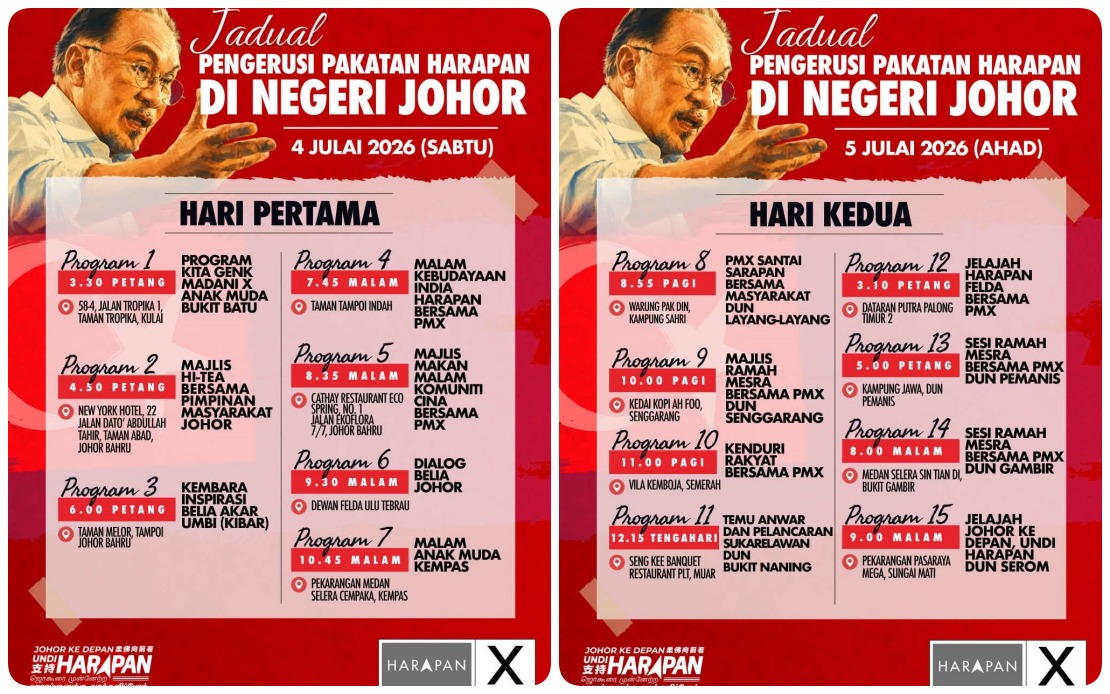
Prime Minister Anwar Ibrahim is mounting an intensive campaign drive for Pakatan Harapan across Johor today, undertaking seven separate engagements designed to mobilise voters ahead of the 16th state election on July 11. The PH coalition chairman's schedule reflects the strategic importance of the state to the federal government's political standing, with the party contesting all 56 assembly seats through its three component parties. The campaign blitz underscores the competitive nature of the Johor contest, where maintaining PH's presence remains critical for the coalition's viability in Malaysia's second-largest state by population.
The Prime Minister's itinerary begins with direct voter engagement in the morning, followed by a high tea reception with Johor community leaders scheduled for 4.50 pm at a local hotel. This two-pronged approach of grassroots interaction and elite engagement reflects a common campaign strategy in Malaysian politics, allowing Anwar to address both ground-level concerns and gather support from influential community figures across diverse backgrounds. The community leaders session provides an opportunity to discuss pressing state issues and build networks essential for translating electoral support into governance capacity.
Youth mobilisation features prominently in today's campaign agenda, with a dedicated Johor Youth Dialogue scheduled for 9.30 pm at Felda Ulu Tebrau Hall. This focus on younger voters highlights PH's recognition that demographic engagement will prove decisive in the election, particularly given youth concerns around economic opportunities, education, and the cost of living. Felda communities, traditionally important constituencies in rural Johor, represent a significant voting bloc that has historically swung between major coalitions depending on development performance and local grievances.
The intensity of Anwar's campaign schedule escalates tomorrow, when he will undertake eight additional programmes aimed at sustaining momentum among PH's candidate network and volunteer machinery. This consecutive-day campaign strategy serves multiple functions: it generates sustained media coverage, demonstrates party leadership commitment to the election outcome, and provides repeated opportunities for candidates to share platforms with the Prime Minister, boosting their visibility and credibility among voters. For many PH candidates, particularly those from DAP and Amanah representing constituencies where these parties lack historical strength, association with Anwar's leadership carries strategic electoral value.
Pakatan Harapan's candidate distribution across the three component parties reflects internal coalition dynamics and seat negotiations. PKR is fielding 20 candidates, Amanah 19, and DAP 17, demonstrating relatively balanced representation that aims to preserve coalition cohesion while respecting each party's core support bases. This allocation pattern also indicates which parties hold stronger traditional positions in certain Johor districts, though the decision to contest all 56 seats represents a coalition-wide commitment to maximising its representation rather than ceding territory to opposition coalitions.
The broader electoral context reveals an intensely contested field, with 172 candidates across all coalitions competing for the 56 assembly seats. This high candidate-to-seat ratio indicates that Johor remains a three-cornered or four-way contest involving multiple significant political forces, preventing any single coalition from taking electoral dominance for granted. The total candidate pool suggests that independent candidates and smaller parties are maintaining presence alongside the major coalitions, fragmenting the vote and creating unpredictable dynamics in certain constituencies.
Johor's electoral calendar compresses the campaign timeline considerably, with early voting on July 7 followed by general polling on July 11. This abbreviated campaign period means that high-visibility efforts such as Anwar's multi-day engagement schedule carry outsized significance, as media attention and voter awareness must crystallise rapidly. The early voting provision allows working voters and others with mobility constraints to participate, potentially broadening the electoral base, though historically early voting patterns can provide useful indicators of broader sentiment trends that campaigns monitor closely.
For Malaysian observers, the Johor campaign demonstrates how federal leadership directly intervenes in state-level contests, particularly when coalition fortunes appear uncertain. Anwar's personal campaign involvement signals PH's perception that the state election outcome carries consequences beyond Johor's boundaries, affecting the coalition's national standing and its capacity to govern effectively. States like Johor, with significant economic output and population, carry symbolic and material weight that makes electoral success there important for legitimacy and policy implementation.
The campaign strategy also reflects evolving Malaysian electoral behaviour, where urban-rural divides, generational differences, and economic anxiety increasingly influence voting patterns independent of traditional ethnic or religious alignments. By programming high-tea sessions with community leaders alongside youth dialogues, PH's campaign acknowledges this fragmentation and attempts to construct a broad coalition addressing multiple constituencies with distinct priorities. Success in Johor would strengthen PH's position for potential federal coalition adjustments and policy agendas, making the state election consequential for Malaysian politics beyond its immediate local outcomes.
For Southeast Asian observers monitoring Malaysian political stability, state elections like Johor's indicate whether federal coalitions can maintain coherence and expand support, or whether they face erosion that might force political realignments. A strong PH performance would reinforce the current federal coalition's viability, while significant losses could accelerate reassessments of political partnerships. The intensive campaign effort therefore represents more than routine electoral competition—it reflects competition for Malaysia's political direction and coalition composition in the post-2022 era.

