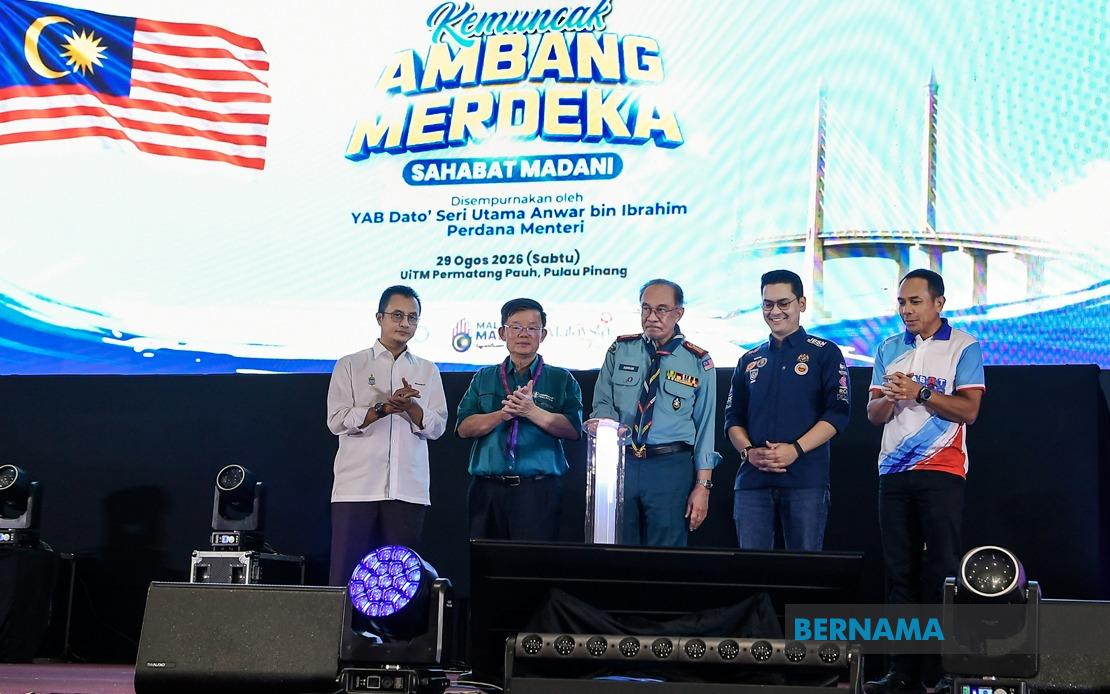
Prime Minister Datuk Seri Anwar Ibrahim has formally inaugurated Sahabat MADANI, a national volunteer movement designed to mobilise grassroots participation in community development across Malaysia. The launch took place at Universiti Teknologi MARA (UiTM) Permatang Pauh in Bukit Mertajam during the Ambang Merdeka Sahabat MADANI 2026 highlight programme, coinciding with Malaysia's National Day celebrations. According to the Implementation Coordination Unit of the Prime Minister's Department (ICU JPM), the initiative has already enrolled 11,060 volunteers across the country, signalling substantial early uptake of what the government positions as a cornerstone of its reform agenda.
The volunteer network represents a structured attempt to translate the government's Malaysia MADANI vision—centred on shared prosperity and inclusive development—into concrete community action. Rather than functioning as a traditional charity organisation, Sahabat MADANI is conceived as a coordinating mechanism that bridges government institutions, volunteer networks, and local communities. This tripartite approach reflects a recognition that sustainable social progress requires institutional capacity, civic engagement, and grassroots mobilisation working in concert. The movement deliberately emphasises cross-community participation, explicitly encouraging individuals from diverse ethnic, religious, and socioeconomic backgrounds to contribute their time and skills toward common objectives.
The stated priorities of Sahabat MADANI extend across several dimensions of social welfare and opportunity creation. Volunteers are mobilised to support vulnerable populations, including the elderly, disabled, and economically disadvantaged. The movement also targets educational gaps by engaging with children who have withdrawn from formal schooling, reflecting concerns about Malaysia's dropout rates and their long-term implications for social mobility. Additionally, Sahabat MADANI aims to facilitate skills development and entrepreneurial opportunity for young people, addressing youth unemployment and underemployment that remain persistent challenges across Southeast Asia. Emergency relief and crisis response also feature prominently, positioning the volunteer base as an auxiliary mechanism to strengthen disaster resilience and rapid humanitarian response capacity.
The government's framing of Sahabat MADANI emphasises transparency and results-driven delivery, suggesting an attempt to differentiate this initiative from previous volunteer programmes that faced criticism over accountability and impact measurement. The ICU JPM's statement explicitly commits to "well-organised, inclusive and responsive coordination," indicating that programme design incorporates feedback mechanisms and adaptive management. By anchoring the initiative within the Prime Minister's Department rather than a sectoral ministry, the government signals its strategic importance and suggests direct linkage to broader governance and administrative reform efforts. This institutional positioning may facilitate cross-agency coordination and resource mobilisation, though it also places expectations for performance directly at the apex of executive authority.
The timing of Sahabat MADANI's launch during National Day observances carries symbolic significance beyond routine administrative announcement. By associating volunteer service with national independence and sovereignty, the government constructs an ideological frame linking active citizenship to the nation's founding principles and contemporary development aspirations. The statement explicitly notes that the spirit of Merdeka manifests not merely in ceremonial flag-raising but through citizens' willingness to serve, maintain integrity, and provide mutual assistance. This rhetorical move attempts to elevate volunteer participation from optional charitable activity to a constituent element of responsible national citizenship, potentially amplifying recruitment messaging and social expectations around engagement.
For Malaysia's multiethnic society, the emphasis on cross-community volunteering addresses longstanding concerns about social fragmentation and communal tensions. By deliberately creating spaces where Malaysians from different backgrounds collaborate toward shared welfare objectives, Sahabat MADANI potentially generates interpersonal understanding and trust that transcends formal interfaith dialogue. Such contact, research suggests, can contribute to norm change and reduce stereotyping when structured appropriately. The volunteer context—focused on concrete problem-solving rather than ideological debate—may be particularly conducive to productive intergroup engagement. However, realising this potential depends substantially on programme implementation quality, volunteer training, and organisational commitment to genuine inclusivity rather than performative diversity.
The initiative's focus on poverty alleviation, corruption resistance, and social justice suggests the government's recognition that addressing Malaysia's distributional challenges requires mobilisation beyond state capacity. Malaysia's development trajectory has generated substantial middle-class prosperity alongside pockets of persistent disadvantage, creating uneven access to services and opportunity. Volunteer networks, if effectively coordinated, can complement formal service delivery by reaching marginal populations and identifying community-specific needs that centralised programmes may overlook. The anti-corruption dimension is particularly notable, positioning citizen participation as essential to governance integrity. This framing invites volunteers to assume roles as accountability watchdogs alongside their direct service roles, though such dual positioning raises questions about volunteer training, protection, and appropriate scope.
The appeal to young people to reject divisive narratives and channel their capacities toward national progress reflects concerns about youth polarisation and the appeal of extremist messaging in some communities. By offering structured opportunities for constructive contribution, Sahabat MADANI potentially provides alternative frameworks for identity formation and social purpose. Young volunteers' participation in welfare initiatives, skills development, and community leadership could generate alternative narratives to those emphasising grievance, exclusion, or factional loyalty. The success of this approach, however, depends on whether volunteer roles offer genuine agency and recognition rather than tokenistic inclusion, and whether young participants perceive meaningful pathways from volunteering to employment or leadership opportunities.
Regionally, Sahabat MADANI reflects broader Southeast Asian trends toward formalised volunteerism and civic participation as complement to state-led development. Several countries in the region have launched comparable initiatives, with varying degrees of sustainability and impact. Malaysia's experience will likely inform comparative assessment of how volunteer movements can be institutionally embedded while preserving grassroots authenticity and participant motivation. The 11,060 registrations represent an encouraging baseline, though translation of registration into sustained, high-quality engagement remains the critical implementation challenge. Attrition rates, volunteer retention, and the quality of volunteer training and support structures will ultimately determine whether Sahabat MADANI becomes a durable component of Malaysia's governance infrastructure or another well-intentioned programme that struggles with sustainability.
The broader policy context supporting Sahabat MADANI remains crucial to its potential impact. Volunteer efforts directed toward education, livelihoods, and social protection can provide marginal enhancement but cannot substitute for comprehensive policy frameworks addressing schooling access, wage levels, healthcare coverage, and social security. The most effective volunteer movements function within enabling policy environments; conversely, volunteers working against systemic constraints experience frustration and burnout. As Sahabat MADANI develops, coordination between volunteer initiatives and concurrent policy reforms in education, labour, health, and social protection will substantially influence programme outcomes. The government's commitment to this integration—demonstrated through resource allocation, policy alignment, and sustained institutional support—will test whether Sahabat MADANI represents genuine structural reform or primarily serves symbolic and messaging functions during Malaysia's ongoing political transition.

