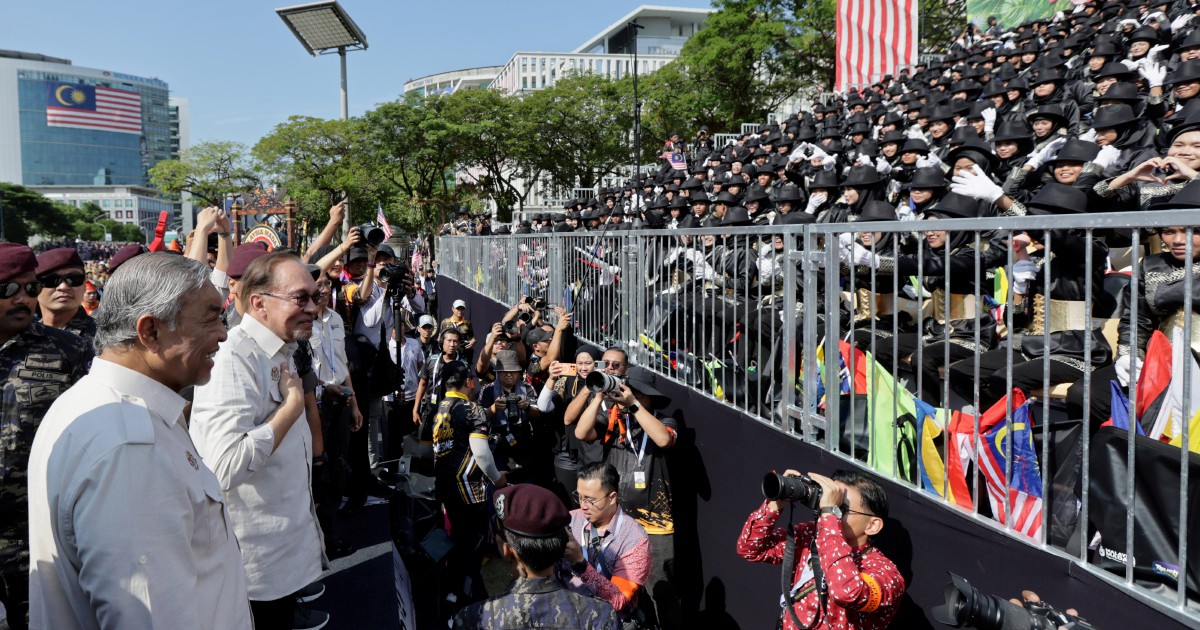
Prime Minister Datuk Seri Anwar Ibrahim seized the opportunity to build direct connections with members of the public during his walkabout at Dataran Putrajaya following the National Day parade festivities. The informal interactions demonstrated a deliberate effort to move beyond ceremonial protocols, with the Prime Minister pausing at several points to engage with onlookers and offer gestures of warmth towards children present at the venue.
The post-celebration engagement reflects an approach increasingly adopted by senior government figures across Southeast Asia, where direct public interaction serves both symbolic and practical purposes in contemporary politics. For Malaysia specifically, such moments carry particular significance given the nation's diverse demographic composition and the importance of fostering inclusive national identity during occasions that celebrate unity. The embrace of children particularly resonates as a gesture of hope and continuity, messaging that extends beyond the immediate moment into broader national consciousness.
Dataran Putrajaya, as the nation's administrative heart and designated venue for major state ceremonies, provides an especially prominent stage for such interactions. The choice of location underscores the deliberate nature of these exchanges, positioning them within the formal apparatus of state while simultaneously humanising the office of Prime Minister. The juxtaposition of ceremonial proceedings with spontaneous public contact creates a narrative layering that appeals across multiple audience segments—those attending in person and those consuming coverage through media channels.
National Day celebrations themselves carry profound symbolic weight within Malaysia's political calendar. The August observance commemorates the country's independence and serves as a focal point for national reflection and unity messaging. Prime ministerial attendance at such events is expected, yet the quality and nature of engagement during these occasions can shape public perception of leadership accessibility and genuine commitment to constituent concerns. Anwar's deliberate approach to extending interactions beyond formal protocols suggests an intention to reinforce messages of approachability during a significant national moment.
The generational dimension embedded in the interactions with children warrants particular attention. In many Southeast Asian political contexts, imagery involving young citizens carries amplified significance, often functioning as implicit commentary on leadership continuity and vision for the nation's future. The act of embracing children at a national celebration can be interpreted as symbolic endorsement of hope and investment in younger generations, messages that resonate particularly strongly during periods when nations are assessing their developmental trajectory and social cohesion.
Public walkabouts following major state events have become increasingly sophisticated as political communication tools across the region. What might appear as spontaneous engagement often reflects careful planning regarding timing, positioning, and accessibility. The effectiveness of such moments depends substantially on their perceived authenticity—any appearance of artificiality can undermine the intended messaging. The success of such initiatives therefore rests on calibration between structure and apparent spontaneity.
The timing of these interactions relative to broader political developments in Malaysia adds contextual depth. The nation continues navigating complex questions regarding economic management, social cohesion, and regional positioning. Leadership moments that emphasise direct connection with ordinary citizens can function as counterweights to more technical or distant aspects of governance, reinforcing narratives about government's human orientation. For a multicultural nation like Malaysia, such imagery also carries implicit messages about inclusive governance and recognition of diverse constituent groups.
Social media amplification has fundamentally altered how these moments reach audiences. Imagery and footage from such events circulate rapidly across platforms, often reaching far broader audiences than those physically present at Dataran Putrajaya. This expanded reach means that individual interactions with citizens can have outsized impact on public perception of leadership character and priorities. The documentation and sharing of these moments thus becomes integral to their political and social significance.
The broader Southeast Asian context reveals consistent patterns of political leadership engaging more directly with populations. Across the region, leaders have recognised that traditional top-down communication often fails to generate the public engagement necessary for effective governance. More interactive approaches, particularly those emphasising accessibility and personal connection, align with evolving expectations regarding how democratic leadership should present itself. Malaysia's position as a developed regional economy with sophisticated media infrastructure means such interactions are scrutinised with particular intensity.
For Malaysian observers, these moments offer insights into how the Prime Minister balances ceremonial responsibilities with constituent engagement. The willingness to step beyond formal protocols and interact genuinely with citizens—particularly younger members of society—can influence broader perceptions regarding government responsiveness and leadership authenticity. Such instances accumulate over time, shaping the narrative framework through which administrations are evaluated by the public.
The interactions at Dataran Putrajaya also merit consideration within Malaysia's specific political landscape, where public sentiment and perception significantly influence government legitimacy and policy effectiveness. National Day occasions provide particularly potent platforms for reinforcing messages of national unity and leadership commitment to all citizens. The Prime Minister's evident engagement during these celebrations thus serves multiple simultaneous functions: marking national significance, demonstrating accessibility, and implicitly addressing broader questions about the government's relationship with diverse segments of Malaysian society.

