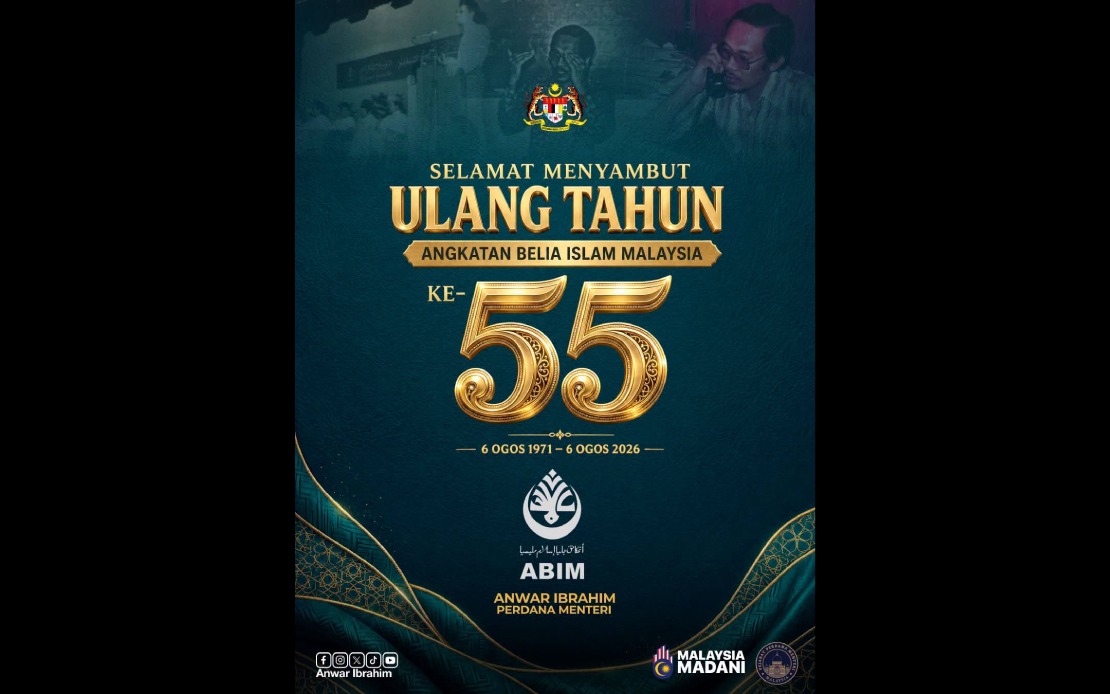
Prime Minister Datuk Seri Anwar Ibrahim has publicly lauded the Muslim Youth Movement of Malaysia (ABIM) as it marks five and a half decades of existence, recognising the organisation's pivotal role in advancing student activism and Islamic engagement across the country. Speaking through a Facebook post on August 6, Anwar underscored that ABIM's milestone anniversary signified far more than simply the passage of time—rather, it represented a substantial historical legacy constructed through dedication, ethical conduct, empathy, and religious conviction.
ABIM was formally established on August 6, 1971, making it one of Malaysia's oldest and most influential Muslim student organisations. The movement emerged during a transformative period in Malaysian history when student activism was reshaping civil discourse and young Muslims sought meaningful platforms for intellectual and spiritual engagement. Over the past 55 years, the organisation has evolved from a primarily student-focused entity into a comprehensive movement that extends its influence across multiple sectors of Malaysian society, touching the lives of generations through varied programmes and initiatives.
Anwar's endorsement carries particular weight given his own deep connection to the organisation. He served as ABIM's president, an experience that defined much of his formative years in political and social leadership. His public recognition of the movement reflects the respect accorded to ABIM within Malaysia's Islamic and political establishment, and signals continued governmental acknowledgement of the organisation's constructive contributions to nation-building. The Prime Minister's remarks suggest that despite occasional controversies surrounding certain Islamic organisations, ABIM continues to enjoy official validation for its moderate and community-focused approach.
The Prime Minister characterised ABIM's mission as extending substantially beyond religious sermons and spiritual guidance. Rather, he framed the organisation's activities as encompassing comprehensive community support, with specific emphasis on strengthening Muslim communities throughout Malaysia. This broader interpretation of Islamic outreach aligns with contemporary moderate Islamic thought that positions faith-based organisations as essential partners in social development and welfare provision, rather than merely as vehicles for religious instruction or theological discourse.
According to Anwar's assessment, ABIM has functioned as a crucial advocate for marginalised populations. The organisation has undertaken educational programmes aimed at successive generations of Malaysian youth, working to instil values of human dignity and ethical conduct. This social welfare dimension has helped establish ABIM as a trusted institution capable of mobilising youth participation around constructive community objectives, creating pathways through which young Muslims can contribute meaningfully to society while deepening their religious understanding.
The metaphorical language employed by Anwar in his statement—describing ABIM as "a tree firmly rooted in its values"—suggests organisational stability and resilience. The imagery of roots withstanding storms and branches providing shelter reflects Anwar's perception of ABIM as a durable institution capable of navigating Malaysia's complex political and social landscape while maintaining its foundational principles. This characterisation becomes particularly significant in the Malaysian context, where organisations working at the intersection of religion, youth mobilisation, and civil society occasionally face scrutiny from various quarters.
ABIM's five-decade trajectory has witnessed Malaysia's transformation from a post-independence nation establishing institutional frameworks into a middle-income economy grappling with modernisation, religious pluralism, and generational change. Throughout these decades, the organisation has maintained consistent focus on youth engagement, Islamic scholarship, and community welfare. Its longevity itself testifies to effective institutional management and sustained relevance to Malaysian Muslim communities across different socioeconomic backgrounds and educational levels.
The timing of Anwar's public commendation during his tenure as Prime Minister reflects governmental prioritisation of institutions that channel youth energy toward constructive social and religious purposes. Malaysian policymakers have long recognised that youth organisations serving Muslim populations occupy strategically important positions within the broader ecosystem of civic engagement. ABIM's demonstrated commitment to moderate Islamic perspectives and social inclusive participation aligns with Malaysia's broader national narrative emphasising religious harmony and multicultural coexistence.
For Malaysia's broader civil society landscape, ABIM's sustained operation and expansion represents continuity in institutional Islamic engagement at the grassroots and community levels. The organisation bridges formal government structures and informal community networks, functioning as a transmission mechanism for Islamic values, modern education, and progressive social thinking. This intermediary position has allowed ABIM to influence public discourse on Islamic matters among educated, younger demographics who might otherwise engage with more rigid ideological frameworks.
The acknowledgement of ABIM's contributions carries implications for how Malaysia positions itself within the global Muslim community and among international observers evaluating the country's approach to Islamic governance and youth development. By publicly endorsing an established Islamic youth organisation emphasising social responsibility and community service, Anwar reinforces Malaysia's image as a nation capable of fostering moderate, institutionalised Islamic activism that contributes positively to development objectives.
Looking forward, ABIM faces the ongoing challenge of maintaining relevance among generations shaped by digital connectivity, rapid social change, and evolving understandings of Islamic identity and practice. The organisation's continued emphasis on education, community support, and ethical leadership suggests responsiveness to contemporary concerns while maintaining foundational values. Anwar's public backing indicates governmental support for ABIM's continuing evolution and adaptation to emerging social circumstances.

