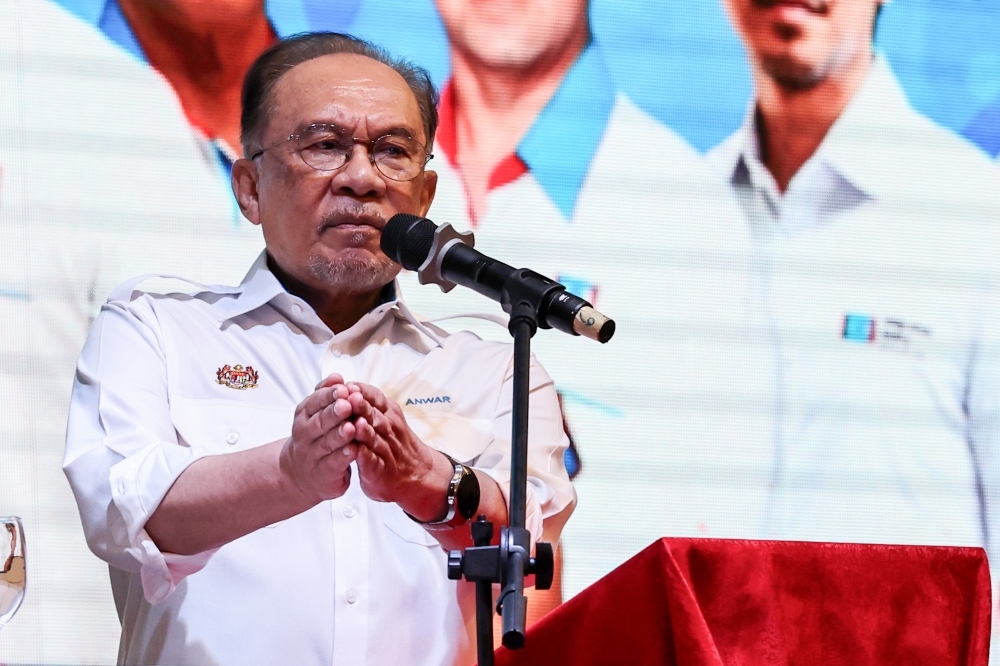
Prime Minister Datuk Seri Anwar Ibrahim delivered a forceful rebuke to those responsible for Tabung Haji's deteriorated financial position on Thursday in Melaka, characterizing the RM12 billion in unaccounted funds as an unmistakable case of institutional mismanagement. Speaking to journalists following a public engagement, Anwar employed the Malay term "sakau"—which colloquially describes the illicit siphoning of resources—to convey his exasperation at the magnitude of the shortfall uncovered by the Royal Commission of Inquiry.
The inquiry's conclusions have placed Tabung Haji, the Islamic pilgrimage savings scheme serving millions of Malaysian Muslims, at the centre of a governance crisis that demands immediate remedial steps. The RM12 billion gap represents a substantial portion of the fund's assets and raises serious questions about the adequacy of internal controls and oversight mechanisms that should have detected irregularities far earlier. Anwar's pointed language signals that his administration intends to pursue those found culpable with vigour, moving beyond symbolic gestures toward concrete enforcement.
Tabung Haji operates as one of Malaysia's most significant social institutions, with accumulated savings from nearly three decades of management contributing to millions of pilgrims' aspirations to undertake the hajj. The fund's erosion therefore carries profound implications not merely for individual account holders but for public confidence in state-managed financial bodies more broadly. When an organisation entrusted with religious savings suffers such comprehensive losses, the reputational damage extends beyond the institution itself to perceptions of governance quality across the public sector.
The RCI's findings have apparently documented patterns of misappropriation, poor asset allocation, and insufficient transparency in how the fund's resources were deployed and monitored. Such systemic failures do not emerge overnight but reflect extended periods during which accountability structures failed to function. Anwar's assertion that the losses constitute clear-cut "sakau" suggests the inquiry has identified conduct that falls squarely within criminal or quasi-criminal categories rather than mere administrative negligence or poor judgment.
For Malaysian investors and depositors in other government-linked schemes, the Tabung Haji revelations underscore the necessity of enhanced scrutiny of fund managers and governance frameworks. The RM12 billion loss serves as a cautionary reminder that scale and institutional prestige offer no protection against mismanagement when oversight remains inadequate. Several Malaysian pension funds, provident institutions, and savings schemes operate under comparable structures, raising systemic questions about whether similar vulnerabilities exist elsewhere.
Anwar's administration has signalled that accountability will extend to former board members, executives, and potentially external parties who facilitated improper transactions. The government has indicated its intention to pursue recovery of lost assets through legal channels, though the complexity and duration of such proceedings remain substantial. International precedents suggest that recovering misappropriated public funds typically requires years of litigation and cooperation from multiple jurisdictions, particularly where investments crossed borders.
The political dimensions of the Tabung Haji scandal cannot be divorced from Malaysia's broader reckoning with governance failures from preceding administrations. The losses accumulated over a period encompassing multiple political cycles, yet the extent of the deterioration only became apparent following comprehensive scrutiny. This reality has prompted broader calls for independent institutional audits and enhanced whistleblower protections across government-linked entities.
From a Southeast Asian perspective, Malaysia's handling of the Tabung Haji inquiry and subsequent corrective measures will be observed as an indicator of whether Malaysia maintains credible accountability mechanisms in the post-2018 reform era. Regional observers, particularly those from countries with similar Islamic financial institutions, will assess whether the RCI process represents genuine institutional learning or superficial political theatre. The transparency of investigations and the severity of consequences imposed will signal the strength of Malaysia's commitment to institutional integrity.
Anwar has articulated that recovering the financial position of Tabung Haji depends on multiple concurrent initiatives: identifying and prosecuting those responsible for losses, strengthening governance structures, improving transparency in fund operations, and restoring confidence among account holders. The RM12 billion figure he invoked likely represents accumulated deficiencies across multiple years, reflecting both active misappropriation and passive underperformance relative to reasonable market expectations.
For ordinary Malaysians holding Tabung Haji accounts—predominantly those from middle and lower-income backgrounds for whom the fund represents a crucial mechanism for financing their pilgrimage—the revelations have provoked anxiety regarding the safety of their accumulated savings. Government assurances that depositor balances will remain secure carry credibility only insofar as the administration demonstrates effective remedial action. Anwar's public emphasis on accountability serves partly to reconstruct institutional legitimacy with this vulnerable constituency.
The path forward involves not only legal proceedings against identified wrongdoers but institutional reform that prevents recurrence of similar lapses. This encompasses enhanced board independence, external auditing protocols, segregation of investment decision-making from day-to-day operations, and robust reporting mechanisms to relevant regulatory authorities. The RCI's recommendations will likely form the foundation for comprehensive restructuring of Tabung Haji's governance architecture.
As investigations proceed and prosecutions potentially commence, the symbolic importance of the Tabung Haji case transcends the institution itself. It represents a test of whether Malaysia's accountability institutions can function effectively when scrutinizing government-linked entities and holding senior officials to consequences. The RM12 billion loss that prompted Anwar's exasperated invocation of "sakau" has become emblematic of broader governance challenges requiring sustained political commitment to resolution.

