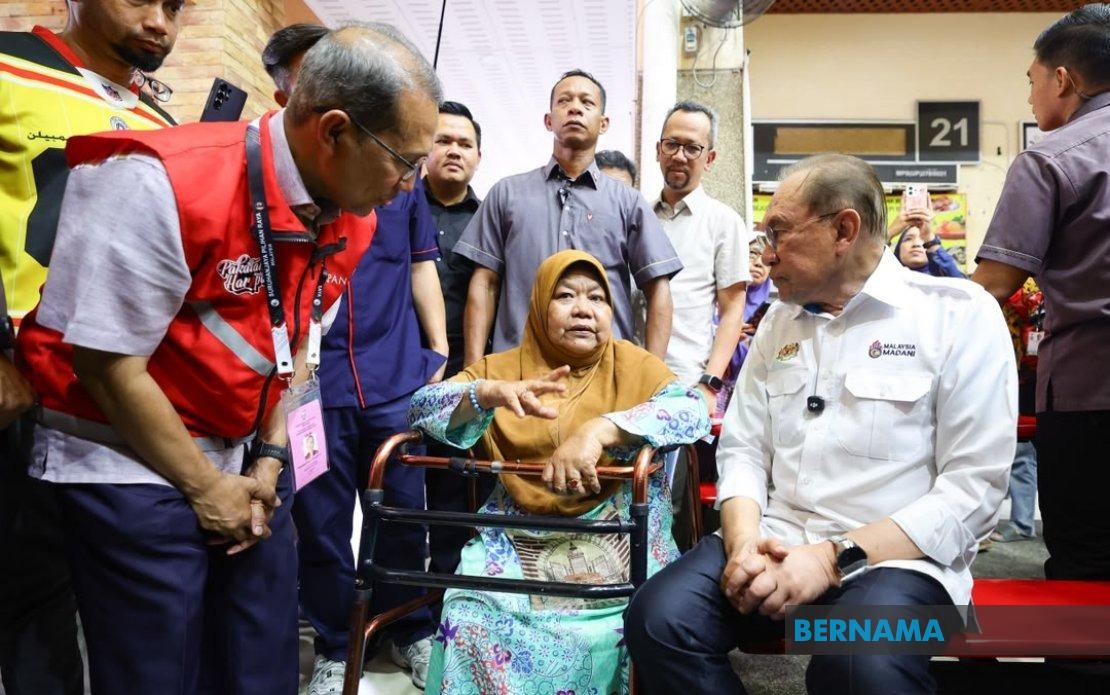
Prime Minister Datuk Seri Anwar Ibrahim visited Negeri Sembilan on Monday to champion the Pakatan Harapan-led state government's governance record, using concrete examples of infrastructure work to demonstrate how the coalition returns state resources directly to communities. Speaking at a gathering with residents in Ampangan, Anwar framed the coalition's approach to development as fundamentally different from previous administrations, emphasizing that projects must prioritize public welfare and operate with complete transparency. His remarks came as PH ramps up its campaign push ahead of the 16th Negeri Sembilan State Election, scheduled for August 1, with early voting on July 28.
At the heart of Anwar's message was the Ampangan river widening and deepening initiative, which he presented as a model for how development can simultaneously solve immediate practical problems while generating resources for ongoing maintenance. The project exemplifies what Anwar called a "reciprocal basis" approach—extracting sand from the riverbed improvement work and using the proceeds to finance further maintenance and infrastructure upgrades in the affected areas. This creates a self-sustaining cycle that keeps money circulating within the community rather than disappearing into state coffers or private contractors' pockets. By framing infrastructure not merely as construction but as a mechanism for transparent resource circulation, Anwar attempts to redefine what voters should expect from their government.
The flooding challenges that have plagued Ampangan and similar riverside communities across Negeri Sembilan represent a persistent grievance for residents. Rather than simply announcing a solution, Anwar positioned the flood mitigation work as evidence of a broader shift in how the state prioritizes citizen concerns. His emphasis on transparency regarding resource management addresses longstanding public skepticism about whether development spending actually benefits the communities supposedly served. By highlighting the concrete link between problem identification, project execution, and resource recycling, Anwar appeals to voters' desire for accountable governance where they can understand and see the direct benefits of state spending.
Integrity-based governance formed the philosophical cornerstone of Anwar's address, a theme he has consistently promoted since Pakatan Harapan's formation. He insisted that integrity must underpin all development initiatives at both state and national levels, positioning it not as an abstract moral principle but as the practical foundation for effective project delivery. This framing allows Anwar to connect voter frustrations about corruption and wasteful spending to a choice between competing visions of governance. In his view, communities that demand trustworthy leadership will inevitably see better outcomes because such leaders prioritize substance over grandstanding.
To illustrate his point, Anwar drew on his own experience with a hotel development project in Port Dickson, which he said incorporated considerations for the local fishing community's welfare. He specifically mentioned how the project addressed education and housing improvements for fishermen—concrete benefits that extended beyond the immediate development transaction. By invoking this example, Anwar suggests that PH-aligned leadership brings a development philosophy that sees communities holistically rather than viewing them merely as locations for profit extraction. The comparison implicitly contrasts his approach with potential alternatives, though he stops short of directly attacking opponents.
The Negeri Sembilan state election represents a significant test for Pakatan Harapan's continued political viability in the peninsula's heartland. The coalition is contesting all 36 available seats, with the distribution reflecting its internal power balance: PKR fields 16 candidates, DAP contributes 11, and Amanah provides nine. This composition itself carries meaning—it demonstrates how the three major PH partners divide electoral opportunities, with PKR's largest allocation reflecting Anwar's own party's position within the coalition hierarchy. For Negeri Sembilan voters, the slate represents continuity of the current state government structure, a fact that favors the incumbent administration if public sentiment remains broadly supportive.
Anwar's appeal to voters to "choose people who are trustworthy" reflects a broader PH strategy emphasizing character and integrity as differentiating factors. His explicit mention that "there are many good Malays, many good Indians and many good Chinese who have dignity" carries particular weight in Negeri Sembilan's multiethnic context. By highlighting the multiracial composition of trustworthy leadership options, Anwar frames PH's diversity not as a source of instability but as proof of the coalition's genuine commitment to inclusive governance. This appeal cuts against narratives that suggest Malays or Muslims lack genuine representation within PH, a persistent criticism the coalition must address.
The invocation of "insya-Allah, our future will be more secure" signals Anwar's effort to connect PH governance to broader values and aspirations that resonate across Malaysia's Muslim-majority population. Rather than positioning PH as a secular or non-Malay-friendly force, his framing embeds political choice within Islamic cultural and religious contexts. This rhetorical move attempts to defuse a recurring weakness for PH in Malay-Muslim constituencies, where Barisan Nasional and particularly UMNO have traditionally dominated by claiming to better represent Malay and Muslim interests.
The timing of Anwar's Negeri Sembilan visit reflects PH's strategic recognition that state-level elections offer opportunities to demonstrate governance competence on a manageable scale. Unlike federal elections, where outcomes depend on nationwide sentiment and complex coalition dynamics, state elections allow parties to showcase localized achievements and build momentum for future campaigns. A strong performance in Negeri Sembilan could provide psychological and organizational benefits for PH ahead of potential federal election contests, while also securing the state government's continuation as a platform for further policy implementation.
For Malaysian voters and political observers, Anwar's emphasis on reciprocal resource management and transparent development offers a concrete policy framework distinct from rhetorical promises. Whether voters find this vision compelling depends partly on their assessment of whether the current PH-led state government has genuinely delivered on such principles since assuming office. The Ampangan project and similar initiatives thus become more than routine infrastructure work—they function as evidence in a larger argument about what governance can and should accomplish when leaders prioritize community benefit over other considerations.
The broader significance of Anwar's campaign intervention extends beyond Negeri Sembilan itself. His personal engagement in state-level politics underscores how federal and state political dynamics increasingly interconnect, with prime ministerial credibility directly affecting the electoral prospects of coalition partners contesting state seats. Should PH perform well in Negeri Sembilan, Anwar's governance narrative gains validation; conversely, significant setbacks could undermine his claims about the coalition's ability to deliver tangible benefits. For Southeast Asian observers, Malaysia's experience demonstrates how political coalitions balance internal partnership dynamics while maintaining coherent messaging to voters across multiple electoral contests occurring simultaneously.

