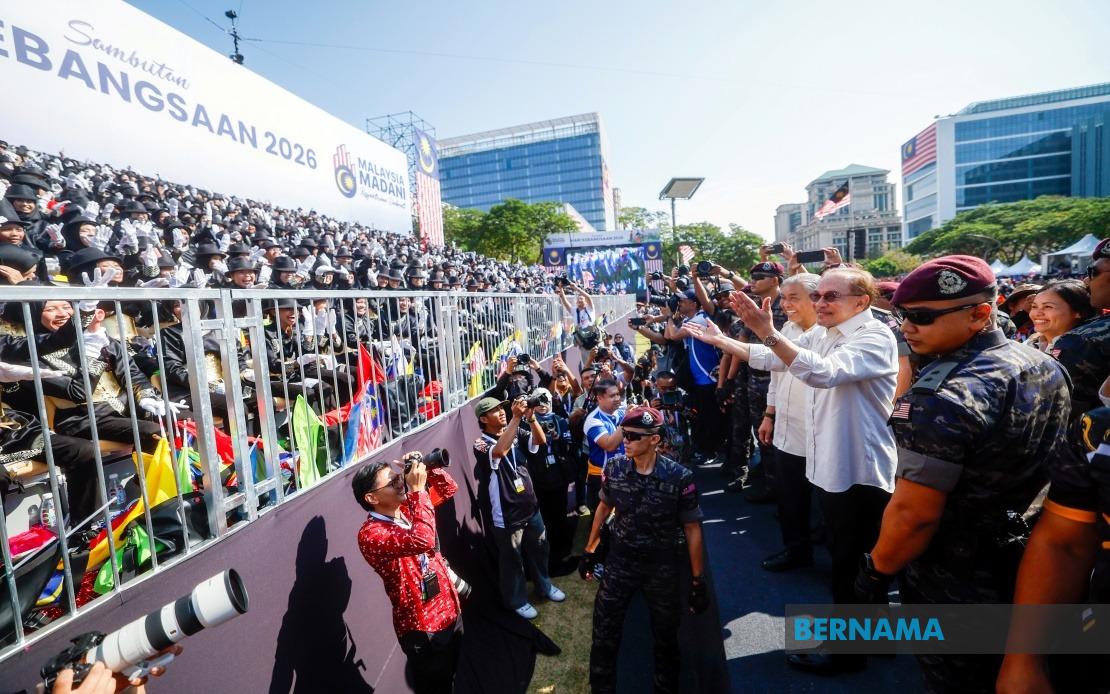
Prime Minister Datuk Seri Anwar Ibrahim commended the overwhelming display of national pride and enthusiasm demonstrated by Malaysians during the 69th National Day celebration held at Dataran Putrajaya on August 31. Addressing reporters following the impressive military parade and cultural festivities, Anwar expressed his gratitude to all stakeholders and the public who participated in the day-long commemoration, describing it simply as a "great, great show." The event, which attracted more than 100,000 spectators—many of whom had camped at the venue since the previous evening—underscored the enduring spirit of unity and patriotism that continues to define the nation's character.
The morning celebration commenced at 8 am with the dignified presence of His Majesty Sultan Ibrahim and Her Majesty Raja Zarith Sofiah, alongside their respective entourages. Anwar and his wife, Datuk Seri Dr Wan Azizah Wan Ismail, formally received Their Majesties upon arrival, while Communications Minister Datuk Seri Fahmi Fadzil, who chairs the 2026 National Day and Malaysia Day Main Committee, also attended the state proceedings. This high-level political representation reflected the significance the government places on the national commemoration and its role in fostering civic consciousness among the population.
Operationalised under the theme "Malaysia MADANI: Kesejahteraan Dinikmati" (Malaysia MADANI: Prosperity Enjoyed), the day's programme emphasised the government's commitment to prioritising citizens' well-being while celebrating the nation's diversity. The thematic focus aligned with the Malaysia MADANI framework that has become central to the current administration's policy direction, serving as a symbolic reminder of shared national values and collective aspirations. This messaging resonated particularly strongly with attendees, many of whom engaged directly with the Prime Minister following the official ceremonies.
The parade itself represented a logistical achievement of considerable magnitude. Nearly 10,819 participants were mobilised across 76 separate contingents, complemented by 22 marching bands that provided rhythmic accompaniment throughout the procession. The spectacle incorporated an eclectic mix of military hardware, civilian assets, and symbolic displays—including 328 land, sea, and air assets, 112 service animals, and notably, 22 electric vehicles that underscored the government's push toward sustainable transportation. The addition of elaborate human graphics performances staged on the terraces added visual dynamism and engaged the massive crowd throughout the several-hour event.
Anwar's post-parade walkabout through the crowds demonstrated the informal accessibility he sought to project to ordinary Malaysians. Walking more than 500 metres across Dataran Putrajaya while obliging photograph requests and engaging in impromptu conversations, the Prime Minister connected directly with constituents in a manner that transcended formal state protocol. One encounter particularly illustrated the real-world impact of government policy: a citizen spontaneously thanked Anwar for announcing the restoration of monthly fuel subsidies, a gesture that captured how policy announcements translate into tangible benefits for ordinary household budgets.
The fuel subsidy expansion announced during Anwar's National Day Address on August 30 represented the most concrete policy outcome of the commemorative period. The restoration of the BUDI MADANI RON95 (BUDI95) programme's monthly basic eligibility quota from 200 litres to 300 litres would benefit more than 16 million users of subsidised petrol, substantially expanding purchasing power for this significant segment of the population. For lower and middle-income Malaysians dependent on subsidised fuel, this increase translates directly into monthly savings—a contribution to household economics that resonates far beyond symbolic gestures.
Additionally, Anwar announced that eligible owners of diesel-powered pickup trucks and jeeps would receive up to 400 litres of BUDI Diesel monthly beginning September 1. This extension broadens the subsidy programme's scope to include commercial and agricultural users, recognising the economic dependency of rural and semi-rural communities on diesel-powered vehicles. Together, these announcements constitute a significant fiscal commitment by the government, reflecting a strategic emphasis on cost-of-living support even as the nation navigates broader economic challenges and international commodity price volatility.
The scale of public participation in the National Day celebration—with more than 100,000 attendees, many arriving well before dawn to secure vantage points—provides insight into the continued resonance of national commemorations within Malaysian society. Despite competing entertainment options and the distractions of contemporary digital media, Malaysians continue to demonstrate investment in shared civic moments. The diversity of participants visible in media coverage suggested cross-communal attendance, with the Malaysia MADANI thematic emphasis on diversity and inclusion appearing to strike a responsive chord among different demographic groups.
For Malaysian policymakers and the broader Southeast Asian region observing Malaysian political dynamics, the successful execution and popular reception of the National Day celebration carries several interpretive layers. It demonstrates the government's capacity to mobilise administrative resources and organise large-scale public events effectively. Simultaneously, it reflects—or at least projects—a restoration of public confidence in national institutions following periods of political turbulence. The direct engagement between the Prime Minister and crowd members, coupled with the announcement of tangible economic benefits, suggests a conscious political strategy to rebuild the connection between government and governed through both symbolic participation and material policy outcomes.
The celebration also provided a platform for reaffirming the Malaysia MADANI vision across multiple stakeholder groups simultaneously. Military personnel, cultural performers, youth organisations, and civil servants all featured prominently in the parade contingents, creating a visual representation of national mobilisation around shared governmental objectives. This coordinated presentation helps consolidate the narrative that Malaysia MADANI represents not merely an abstract policy framework but a concrete commitment to citizen welfare that transcends partisan considerations and unites the nation around common prosperity objectives.
Looking forward, the successful staging of the National Day celebration and the accompanying policy announcements position the government to leverage this moment of high civic engagement into sustained support for upcoming initiatives. The fuel subsidy expansion will require careful fiscal management given commodity price fluctuations and budgetary constraints, but the political goodwill generated through the announcement provides space for the government to manage future economic adjustments with greater public understanding. For Malaysian voters and regional observers alike, the August 31 commemoration underscores that despite Malaysia's persistent political complexities, the nation retains the capacity to unite around shared symbols and, critically, around government commitments to improve living standards across broad segments of the population.

