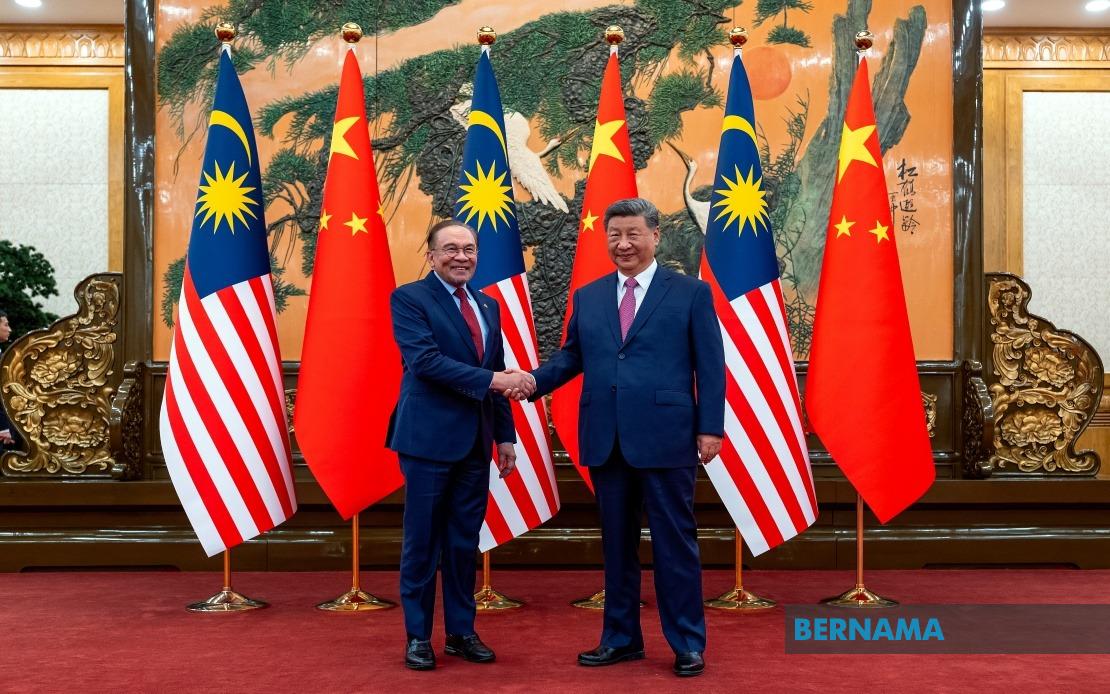
Prime Minister Datuk Seri Anwar Ibrahim has conveyed official congratulations to Chinese President Xi Jinping marking the 105th anniversary of the Chinese Communist Party, signalling the continued warmth of Malaysia-China relations at the highest political level. The gesture, communicated through a formal letter delivered on behalf of the Malaysian government and people, underscores the enduring diplomatic partnership between Kuala Lumpur and Beijing that has evolved over more than five decades into one of Southeast Asia's most consequential bilateral relationships.
In announcing the missive via a Facebook statement, Anwar emphasised his recognition of the Chinese ruling party's transformative role in shaping modern China's trajectory as a global power. The Prime Minister acknowledged the institutional strength drawn from the party's deep historical roots, civilisational legacy, and the accumulated values that have guided China's development across generations. This framing reflects a diplomatic approach that honours Beijing's self-conception while positioning Malaysia as a partner attuned to China's internal narratives of progress and continuity.
Central to Anwar's message was a deliberate evocation of Malaysia's pioneering recognition of the People's Republic of China on May 31, 1974, a landmark decision that preceded the establishment of formal ties by many nations in the region. By anchoring contemporary bilateral relations to this historic milestone, the Prime Minister underscored Malaysia's early strategic foresight and its unique standing as the first non-socialist state in Southeast Asia to accord diplomatic recognition to the PRC. This distinction carries symbolic weight, positioning Malaysia as a bridge state capable of maintaining cordial ties across ideological divides at a time of intensifying geopolitical competition in Asia.
The foundation laid in 1974 has indeed proven durable and multifaceted. Over the ensuing five decades, Malaysia-China relations have expanded far beyond diplomatic niceties to encompass substantial economic integration, infrastructure investment, and cultural exchange. Chinese capital has flowed into Malaysian megaprojects, trade volumes have surged to record heights, and people-to-people connections have deepened through tourism, education, and diaspora networks. The messaging in Anwar's letter implicitly celebrates this evolution, framing it as a natural outgrowth of mutual respect and shared pragmatism.
Anwar's reiteration of Malaysia's commitment to deepening strategic cooperation with China signals continuity in foreign policy orientation despite domestic political transitions and shifting regional dynamics. The invocation of respect, trust, and mutual benefit as guiding principles reflects the diplomatic vocabulary increasingly favoured in Southeast Asian capitals when articulating their China strategies. These terms deliberately sidestep contentious issues—such as the South China Sea disputes or technology competition—while affirming the underlying commitment to engagement and partnership.
The timing of this anniversary gesture merits consideration within the broader context of Malaysia's regional balancing act. As a middle power with deep economic ties to China, Malaysia simultaneously maintains strategic partnerships with the United States, Japan, and India, along with close ties to fellow ASEAN members. Commemorating the Chinese Communist Party's founding anniversary is a routine diplomatic practice, yet it also signals to Beijing that Kuala Lumpur views the relationship as sufficiently important to mark formally at the highest level. For Malaysian audiences, such gestures demonstrate the government's pragmatic engagement with all major powers without ideological reservation.
Regional peace, stability, and prosperity—the trio of objectives cited in Anwar's statement—represent the official Malaysian framework for evaluating its international partnerships. These concepts carry particular resonance in Southeast Asia, where decades of rapid economic growth and declining military conflict have been attributed partly to the regional architecture of multilateral engagement and economic interdependence. By linking Malaysia-China cooperation to these broader regional goods, Anwar positions bilateral ties as contributing to collective Southeast Asian interests rather than serving narrow bilateral advantage.
The letter's emphasis on the Communist Party's historical journey and civilisational inheritance reflects a diplomatic courtesy extended by numerous nations on similar occasions. However, for Malaysia—a Muslim-majority democracy with a constitutional monarchy—the gesture carries additional significance as a demonstration of the government's secular pragmatism and its capacity to engage substantively with Beijing regardless of differences in political systems, governance models, or ideological orientation. This non-interference stance has become a defining feature of Malaysia's foreign policy under successive administrations.
Looking forward, Anwar's message suggests that Malaysia intends to maintain and expand the multifaceted partnership with China across economic, cultural, and strategic domains. The emphasis on shared benefits indicates a desire for cooperation that generates tangible returns for Malaysian interests, whether through infrastructure development, trade opportunities, or regional influence. This transactional element, clothed in the diplomatic language of mutual respect, reflects the hardheaded calculus underlying Malaysia's China policy: engagement yields concrete advantages that contribute to national development and regional standing.
The anniversary congratulations also arrive at a moment when China faces mounting international pressure and scrutiny over various policy domains, from technology and trade to governance and human rights. Malaysia's reaffirmation of commitment to China underscores the country's independent foreign policy stance and its resistance to pressure from Western capitals to adopt more adversarial postures. This consistency has become an increasingly valued aspect of Malaysia's international brand, offering Beijing assurance of a reliable partner in a region where geopolitical competition is intensifying.

