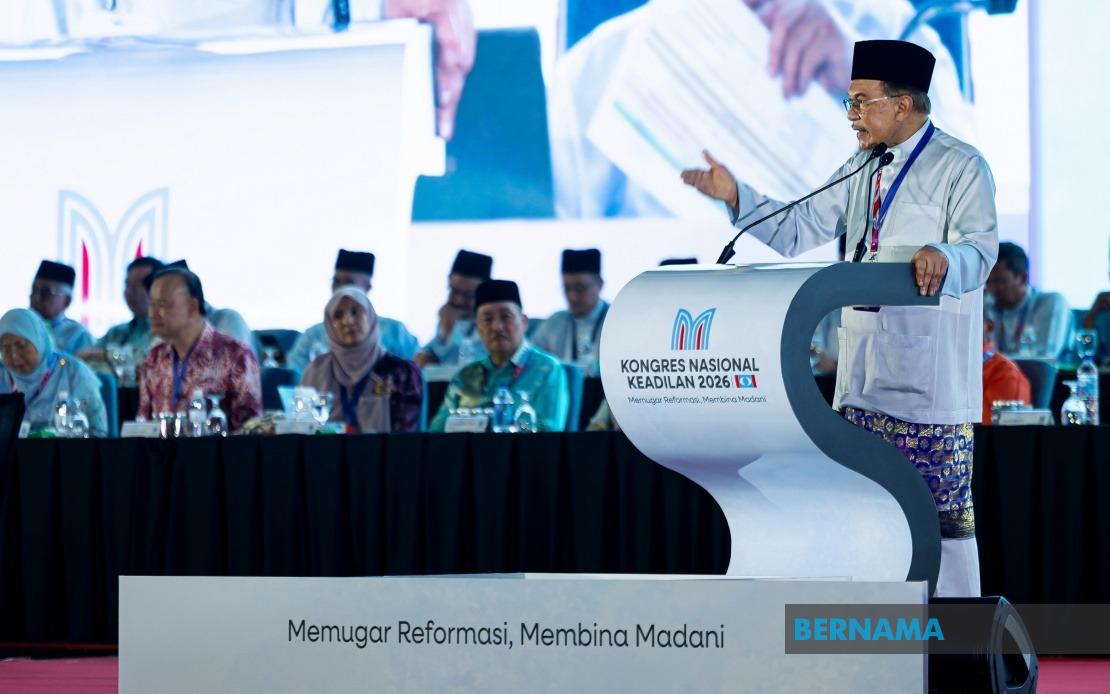
Prime Minister Datuk Seri Anwar Ibrahim moved swiftly on Thursday to dispel suggestions that tensions have emerged between himself and Deputy Prime Minister Datuk Seri Dr Ahmad Zahid Hamidi, characterising such claims as stemming from a fundamentally different worldview. Speaking at the 2026 PKR National Congress in Melaka, Anwar stressed that his working relationship with the deputy premier remains robust, and he sought to reframe the narrative around governance within Malaysia's coalition administration.
Anwar's remarks were a direct response to former UMNO Youth leader Khairy Jamaluddin's assertion the previous day that trust between the Prime Minister and Ahmad Zahid had hit its lowest point since the Unity Government took office following the 2022 general election. Khairy had suggested that deepening friction between Barisan Nasional and Pakatan Harapan—particularly stemming from BN's decision to partner with Perikatan Nasional in the recent Negeri Sembilan state elections—had damaged the foundation of their partnership. However, Anwar dismissed this interpretation as reflective of Khairy's personal tendency to view political dynamics through a lens of conflict rather than cooperation.
The Prime Minister articulated a philosophical distinction that he positioned as central to his approach to governance. He explained that while observers like Khairy habitually examine political relationships for signs of rupture and competition, he himself adopts a framework centred on maintaining harmony and working through disagreements via dialogue. This divergence in perspective, Anwar suggested, explains why critics perceive cracks in the coalition where the leadership sees merely the normal friction inherent in managing a multi-party government. The distinction underscores a broader debate within Malaysian politics about whether the Unity Government remains viable long-term or whether centrifugal forces will eventually pull it apart.
During his presidential address at the Melaka International Trade Centre, Anwar made a strategic choice to publicly acknowledge Ahmad Zahid's contribution to establishing the current administration. By expressing formal appreciation for the BN chairman's instrumental role in facilitating the formation of the Unity Government in its initial phase, Anwar was signalling that despite occasional policy disagreements, the foundational partnership between PKR and UMNO remains intact and valued. This gesture carried symbolic weight beyond mere protocol, functioning as a deliberate reinforcement of coalition unity at a moment when external observers questioned its stability.
The context surrounding these statements reveals the delicate balancing act that characterises Malaysian coalition politics. Since its formation after the 15th General Election, the Unity Government has operated as an unprecedented arrangement bringing together ideological competitors who previously spent years in opposition to one another. For Anwar's PKR and Anwar Zahid's UMNO to function effectively within this framework requires sustained commitment to dialogue over confrontation, precisely the philosophy Anwar was articulating. However, the divergent strategic choices made by BN in recent state elections—most notably its willingness to cooperate with PN—has created friction that cannot be entirely dismissed as mere perception.
The Negeri Sembilan state election mentioned by Khairy serves as a concrete illustration of the fault lines within the broader coalition. When BN opted to partner with PN rather than standing alongside PH candidates, it signalled that component parties within the Unity Government maintain independent strategic calculations that may not always align. For PKR and PH, such moves appear as reversions to pre-Unity Government alignments and suggest that BN's commitment to the federal coalition is conditional rather than absolute. These decisions inevitably create tension with PH leadership, even if those tensions remain officially managed.
Anwar's characterisation of disagreements as resolvable through discussion and peaceful approaches reflects a pragmatic assessment that conflict within the coalition is manageable if both sides maintain commitment to engagement. He appeared to be suggesting that differences of opinion—whether between individual parties or within the broader framework of the Unity Government—represent normal features of democratic governance rather than signals of imminent collapse. This framing attempts to lower the political temperature and direct public attention away from narratives of instability that could undermine investor confidence and governmental effectiveness.
For Malaysian observers, the significance of this exchange extends beyond personal dynamics between Anwar and Ahmad Zahid. The stability of the Unity Government carries substantial implications for Malaysia's economic trajectory, investor confidence, and the country's capacity to implement medium-to-long-term policy reforms. If the coalition fractures, the resulting political uncertainty could disrupt implementation of important initiatives and potentially trigger another cycle of electoral competition that many Malaysians have found exhausting. Conversely, if the coalition holds firm despite periodic tensions, it could establish a precedent for managed political competition that strengthens democratic institutions.
Khairy's intervention in this debate introduces an additional layer of complexity, as his status as a prominent UMNO figure sidelined from the highest echelons of government lends his observations a particular credibility among certain segments of the party base. His willingness to publicly articulate concerns about deteriorating trust between coalition partners suggests that anxieties about the arrangement's durability circulate genuinely within UMNO ranks. Whether Khairy was speaking in a personal capacity or reflecting broader sentiment within the party machinery remains unclear, but his comments appear calibrated to maintain pressure on both Anwar and Ahmad Zahid to demonstrate their continued commitment to collaboration.
The road ahead for the Unity Government will likely depend on whether both BN and PH can develop mechanisms to manage their competing electoral and strategic interests without allowing those differences to cascade into public displays of dysfunction. Anwar's language of peaceful resolution and dialogue suggests he believes such accommodation is possible. However, the fundamental question of whether two political formations with substantially different ideological roots and party bases can maintain a durable partnership remains partially unresolved, particularly as Malaysia approaches the next cycle of state and federal elections where electoral competition between PH and BN becomes inevitable.

