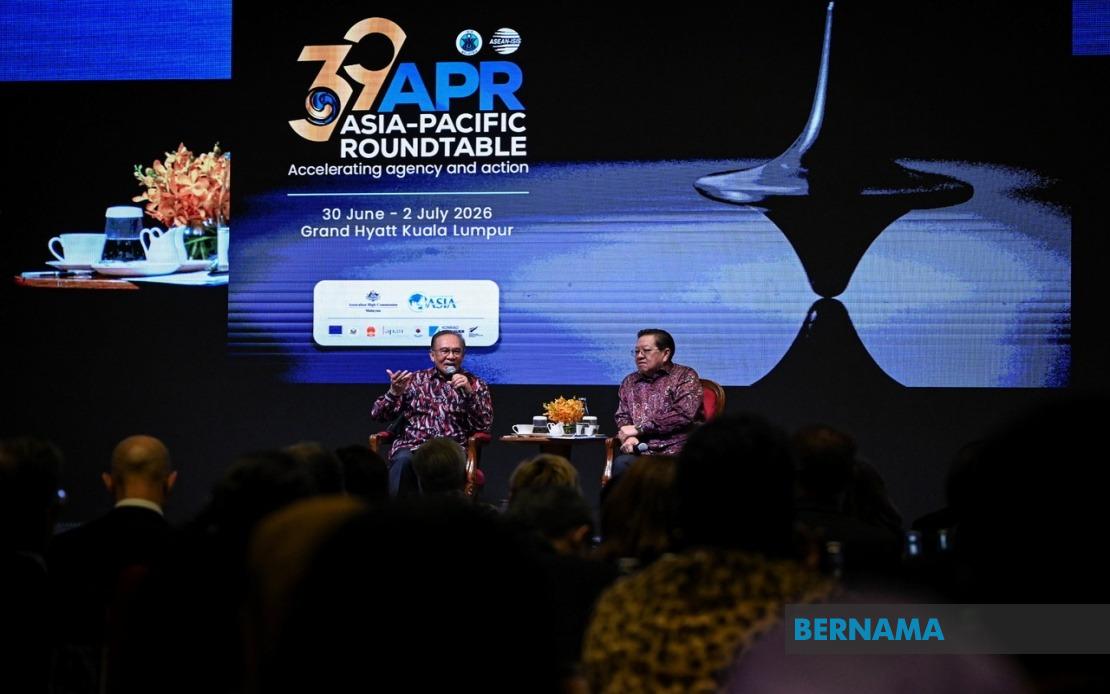
Prime Minister Datuk Seri Anwar Ibrahim has moved to counter what he characterises as alarmist narratives surrounding the South China Sea, instead advocating a framework built on diplomatic engagement and adherence to international maritime conventions. Speaking at the 39th Asia-Pacific Roundtable in Kuala Lumpur on Thursday, the Malaysian leader rejected deterministic predictions of conflict in the contested waterway, positioning Malaysia as a model for managing territorial sensitivities through sustained dialogue rather than confrontation.
Anwar's intervention comes as regional tensions around the South China Sea continue to generate international concern, particularly involving competing maritime claims and military presence in strategic waters. His comments, delivered during a public question-and-answer session, appear designed to calm anxieties among Malaysia's trading partners and ASEAN neighbours while simultaneously signalling Malaysia's pragmatic approach to managing relations with China despite unresolved disputes over maritime boundaries and resource access.
The Prime Minister emphasised the quality of Malaysia's bilateral relationship with Beijing, citing direct communications with Chinese President Xi Jinping and Premier Li Qiang as evidence of substantive engagement without fundamental acrimony. By characterising these interactions as genuinely productive rather than merely ceremonial, Anwar seeks to demonstrate that territorial disagreements need not poison broader diplomatic and economic relationships, a particularly important message given Malaysia's significant trade interdependencies with China.
Crucially, Anwar pointed to China's stated support for the United Nations Convention on the Law of the Sea (UNCLOS) as grounds for optimism regarding dispute resolution frameworks. The continuing negotiations on the ASEAN-China Code of Conduct in the South China Sea represent, in his view, a constructive mechanism through which regional actors can establish behavioural norms and reduce misunderstandings. This focus on rules-based frameworks appeals to Malaysia's interest in having territorial claims adjudicated according to international legal principles rather than raw power dynamics.
The Prime Minister explicitly distanced himself from what he termed a "phobia" regarding South China Sea conflict, a rhetorical move that acknowledges widespread concerns while attempting to reframe them as excessive pessimism rather than prudent caution. By suggesting that apprehensive narratives themselves may become self-fulfilling prophecies, Anwar implicitly argues that measured diplomatic language contributes to stability, whereas inflammatory discourse raises tensions and narrows negotiating space.
Anwar's argument rests significantly on ASEAN's historical track record in maintaining peace through mechanisms of quiet diplomacy and regular leadership engagement. He highlighted how close personal relationships among regional leaders, facilitated through consistent direct communication channels, have enabled the bloc to resolve or manage differences before they escalate into public crises. This emphasis on behind-the-scenes relationship-building reflects ASEAN's foundational commitment to non-interference and consensus-seeking rather than formal institutional mechanisms with binding enforcement mechanisms.
Beyond South China Sea specifics, the Prime Minister broadened his remarks to advocate for comprehensive reform of global multilateral institutions, including the United Nations and the World Trade Organisation. This positioning suggests that Malaysian concerns about regional stability connect to broader frustrations with the international order, where smaller and middle powers worry that their interests are inadequately represented in institutions designed during a different geopolitical era. Anwar's call for institutional reform reflects Malaysian preferences for a more equitable international architecture rather than acceptance of existing power hierarchies.
Anwar also addressed the Cambodia-Thailand border dispute as a parallel case study supporting his thesis that longstanding territorial disagreements, often rooted in colonial-era boundary demarcations, can be addressed through patient negotiation. His acknowledgement that both countries remain committed to ongoing talks, despite decades of sporadic tensions, illustrates his conviction that sustained engagement eventually produces movement toward settlement, even when progress appears glacial to outside observers.
For Malaysian policymakers and business stakeholders, Anwar's messaging carries significant implications regarding investment confidence and trade stability in the region. By projecting Malaysian-Chinese relations as fundamentally sound despite maritime complications, the government aims to reassure investors and trading partners that South China Sea disputes, while real, need not derail commercial or diplomatic cooperation. This balancing act proves essential for Malaysia, which depends on access to both Chinese markets and Western security partnerships.
The Prime Minister's statements also position Malaysia as a potential mediator or stabilising force within ASEAN, a role that carries both diplomatic influence and reputational benefits. By articulating a vision of managed coexistence that neither capitulates to larger powers nor militarises regional competition, Malaysia presents itself as a pragmatic actor interested in preserving the conditions for multilateral cooperation and economic interdependence.
Anwar's rejection of conflict inevitability ultimately reflects a strategic calculation that Malaysia's interests are better served by emphasising cooperation mechanisms, international legal frameworks, and leadership-level relationships than by amplifying conflict narratives. Whether this approach proves sufficient to navigate increasingly complex strategic competition between major powers in the region remains a defining question for Malaysian foreign policy in coming years.

