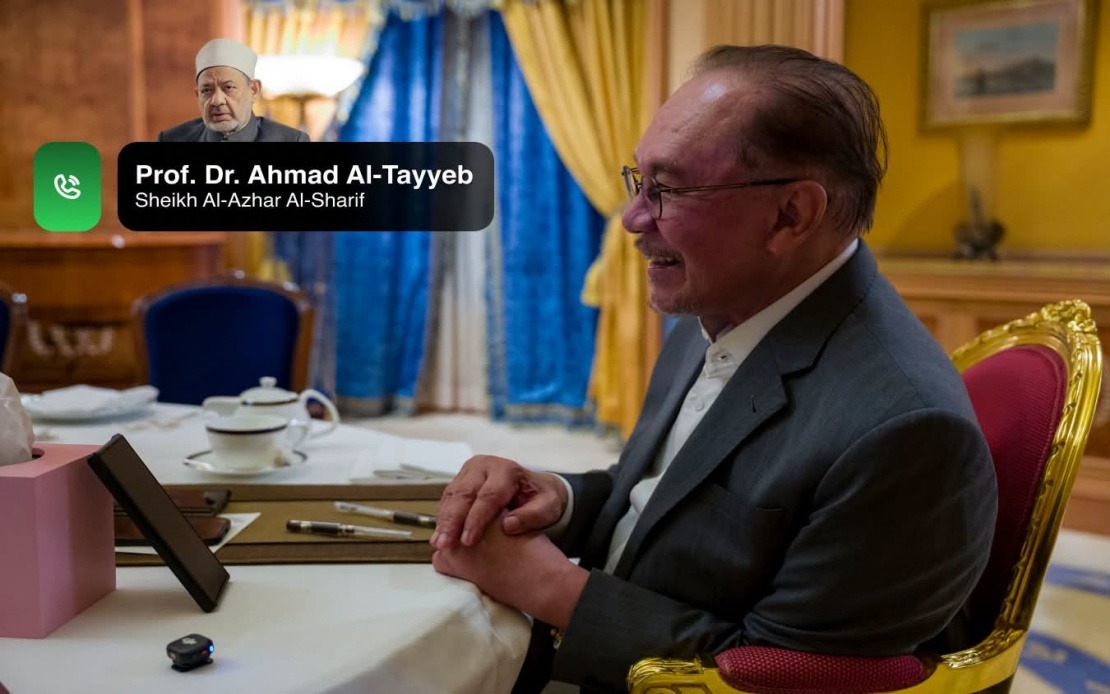
Prime Minister Datuk Seri Anwar Ibrahim has engaged in substantive discussions with one of Islam's most respected institutional voices, Sheikh al-Azhar al-Sharif Prof Dr Ahmad al-Tayyeb, focusing on collaborative efforts to deepen Islamic knowledge and understanding across communities. The conversation, initiated by the prominent cleric, occurred after Anwar's recent surgical recovery, with the Sheikh extending personal prayers and well-wishes to the Malaysian leader.
Through a Facebook post, Anwar articulated appreciation for the gesture and confirmed his successful surgical experience, noting that his recuperation is progressing positively. Beyond personal courtesies, the pair turned their attention to substantive matters concerning the broader dissemination of Islamic learning and dakwah—the Islamic concept of spreading faith and knowledge. The Prime Minister characterised their discussion as focusing on "the continuation of dakwah and study efforts in expanding the understanding of Islam," suggesting a coordinated vision for religious education that extends beyond Malaysia's borders.
Anwar emphasised the significance he places on al-Tayyeb's counsel, describing the Sheikh's perspectives as essential guidance for maintaining rigorous Islamic scholarship and ensuring that religious knowledge benefits the entire Malaysian community. Al-Azhar's institutional authority in Islamic jurisprudence and theology carries considerable weight across the Muslim world, making his engagement with Malaysian leadership a noteworthy development in regional religious dialogue. The Prime Minister's reference to the Sheikh's earlier visit to Malaysia indicates that this connection has already yielded impressions that resonated with the local Muslim population, suggesting a foundation of mutual respect and shared theological concerns.
Looking forward, Anwar expressed hope for future meetings in either Cairo, home to al-Azhar University, or Kuala Lumpur, to sustain collaborative dakwah initiatives and expand Islamic knowledge dissemination for community benefit. This bilateral interest in continued engagement signals potential institutional partnerships that could strengthen Malaysia's standing in global Islamic intellectual circles while potentially enhancing the country's role in fostering moderate, scholarly interpretations of Islam across Southeast Asia. The practical implications of such cooperation could include academic exchanges, theological seminars, or coordinated educational programmes.
Parallel to the al-Tayyeb conversation, Anwar also connected with Mohamed Abdelsalam, Secretary-General of the Council of Muslim Elders (Majlis Hukama Muslimin), during which both leaders extended personal health inquiries. Anwar's concern for Abdelsalam's wife, currently hospitalised, demonstrated the personal dimension underlying these professional exchanges and reflected the Malaysian leader's commitment to maintaining warm diplomatic relations with key Islamic figures. These multilayered conversations illustrate how religious leadership at the highest levels operates simultaneously across personal, institutional, and theological domains.
Abdelsalam's position as Secretary-General of the Council of Muslim Elders places him at the intersection of Islamic scholarship and geopolitical influence, making his alignment with Malaysia's leadership potentially consequential for the nation's religious diplomacy. The discussions extended to Abdelsalam's support for al-Tayyeb's proposed return to Malaysia, indicating coordinated enthusiasm among Islamic leaders for deepening Malaysia's institutional religious partnerships. The explicit mention of al-Azhar's desire to strengthen ties with Malaysia suggests recognition of the country's strategic importance in Southeast Asian Islam and its potential role in promoting what Anwar termed "a simple, free and authoritative Islam."
The phrase "simple, free and authoritative Islam" carries particular weight in Malaysian context, where navigating between diverse Islamic interpretations and maintaining social cohesion has proven consistently challenging. By invoking this formulation alongside international Islamic figures, Anwar positions Malaysia as committed to Islam rooted in scholarly rigour while remaining accessible and avoiding extremist rigidity. This framing responds implicitly to longstanding debates in Malaysia about Islamic education, the role of state institutions in religious affairs, and the country's capacity to model moderate Islamic governance.
Anwar's public acknowledgement of his wife Datuk Seri Dr Wan Azizah Wan Ismail's steadfastness and sacrifice throughout his political journey adds a personal narrative dimension to the leadership narrative. The invocation of spousal support in the context of international religious diplomacy reflects both traditional Malaysian political communication styles and Anwar's effort to integrate his personal resilience with national religious vision. This rhetorical connection between private commitment and public religious leadership messaging serves to humanise the Prime Minister's international engagements while reinforcing themes of loyalty and perseverance that resonate in Malaysian political discourse.
The timing of these conversations—following Anwar's surgery—carries symbolic significance beyond immediate health concerns. His recovery and rapid return to engaging international religious figures signals physical and political vitality, particularly relevant given Malaysia's ongoing political complexities and the Prime Minister's previous health challenges. The willingness of prominent global Islamic leaders to initiate contact and demonstrate support during convalescence strengthens Anwar's positioning within international Islamic circles and demonstrates the diplomatic capital he has accumulated.
These exchanges reflect Malaysia's broader aspirations within Islamic governance networks at a moment when Muslim-majority nations are navigating theological pluralism, moderate modernisation, and geopolitical repositioning. By cultivating deep connections with institutions like al-Azhar, Malaysia aims to position itself as a thought leader in contemporary Islamic intellectual discourse rather than merely a receptor of religious authority. The emphasis on dakwah and Islamic knowledge expansion as collaborative frameworks suggests potential for joint projects that could influence Islamic education methodologies across the region.
Future collaboration between Malaysian leadership and al-Azhar could yield practical outcomes including academic cooperation, student exchange programmes, or coordinated theological research addressing contemporary Islamic challenges. The Council of Muslim Elders' involvement adds another institutional layer capable of facilitating these initiatives across multiple Muslim nations. For Malaysia specifically, such partnerships offer opportunities to strengthen national religious institutions, enhance the country's reputation for Islamic scholarship, and potentially export Malaysian models of moderate Islamic governance to other Southeast Asian contexts where Islamic reform and modernisation remain contested issues.

