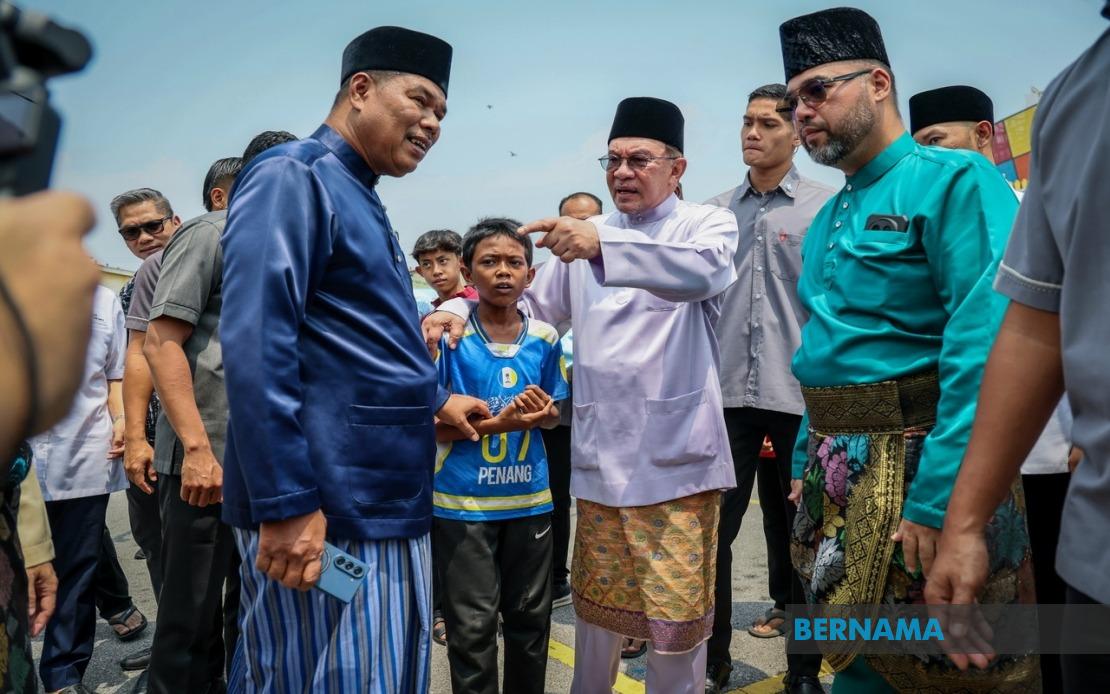
Prime Minister Datuk Seri Anwar Ibrahim has drawn a clear line between political leadership and judicial process by declaring that the corruption investigation surrounding former Human Resources Minister Datuk Seri M. Saravanan rests entirely with law enforcement and prosecutorial bodies. Speaking at Masjid Sembilang in Butterworth following Friday prayers on August 28, Anwar emphasised that once allegations enter the domain of investigative agencies such as the Malaysian Anti-Corruption Commission (MACC) and the Attorney-General's Chambers (AGC), the matter ceases to be a concern of his office.
The Prime Minister's remarks came in response to a letter Saravanan had submitted to him regarding his legal situation. The correspondence had prompted media scrutiny about whether Anwar might exercise any form of political discretion in the case. Anwar moved swiftly to dispel such speculation, asserting that his role does not extend to the examination or oversight of cases once they have progressed to formal investigation or prosecution stages. This pronouncement underscores a principle of governance that separates executive authority from investigative and prosecutorial independence, a distinction increasingly important in Malaysia's ongoing efforts to rebuild public confidence in institutional integrity.
Saravanan himself clarified that his letter to the Prime Minister carried no request for intervention or case dismissal, but rather sought to articulate his position on matters he believes have been misunderstood. The former minister's clarification suggests awareness of the sensitivity surrounding any appearance of political influence on a high-profile corruption case. His decision to reach out to Anwar, coupled with his subsequent public statement, indicates an effort to maintain legitimacy while navigating a serious legal challenge without appearing to seek improper political assistance.
The substantive allegations against Saravanan are substantial and carry significant implications. At the Kuala Lumpur Sessions Court on the same day, the Tapah MP entered a not guilty plea to three counts of corruption involving RM1.097 million. These charges are connected to his alleged approval of foreign worker quotas during his tenure as Human Resources Minister. The scale of the alleged misconduct and the specific nature of the charges—involving discretionary approvals of labour quotas that carry considerable economic weight—touch upon governance issues that resonate throughout Malaysia's business and labour sectors.
For Malaysian observers, Anwar's deliberate detachment from the case reflects a calculated approach to governance that seeks to insulate the executive from perceptions of selective justice or political favouritism. The handling of high-profile corruption cases involving senior political figures has historically been a flashpoint for allegations of partisan manipulation. By explicitly stating that investigative and prosecutorial decisions fall outside his purview, Anwar appears intent on establishing protocols that demonstrate institutional separation and reduce opportunities for claims that outcomes reflect political considerations rather than evidence and law.
The case also illuminates broader questions about accountability within Malaysia's public sector, particularly regarding the allocation of foreign worker quotas. This mechanism directly affects labour market dynamics, business operations, and the welfare of migrant workers throughout the country. When such discretionary powers become subjects of corruption investigations, they underscore the vulnerability of administrative systems to abuse and the importance of robust oversight mechanisms independent of political pressure.
Anwar's statement carries additional weight given his own historical experience with the Malaysian judiciary and investigations. As someone who has previously navigated complex legal proceedings, his explicit commitment to respecting the independence of prosecutorial and investigative bodies may be read as an affirmation of institutional principles he has championed as part of his reform agenda. This approach suggests a deliberate effort to distinguish the current administration's governance style from patterns that critics have associated with previous administrations.
The timing of the case also merits consideration within the context of Malaysia's broader political landscape. Saravanan's tenure as Human Resources Minister concluded following the 2022 general election and the subsequent formation of Anwar's administration. The case thus involves decisions made under a previous political dispensation, which may facilitate the appearance of impartial handling. Nevertheless, the government's management of such cases remains subject to public scrutiny regarding whether enforcement is genuinely impartial or selectively applied.
For Southeast Asian observers, Malaysia's handling of high-profile corruption cases offers instructive lessons about the challenges facing democracies in maintaining institutional credibility. The region grapples with endemic corruption and struggles to balance public demands for accountability with concerns about politically motivated prosecutions. Malaysia's approach—emphasising the role of constitutionally independent bodies such as the MACC and AGC—reflects broader regional efforts to establish institutional frameworks that can manage such tensions.
Moving forward, the Saravanan case will likely proceed through normal judicial channels. The proceedings at the Sessions Court will determine culpability based on evidence, legal argument, and judicial application of law. Anwar's pre-emptive stance regarding non-involvement may serve multiple purposes: it demonstrates commitment to institutional independence, provides political insulation if the case reaches conclusions that might otherwise provoke accusations of political interference, and signals to other potential defendants and accused officials that judicial processes will not be subject to executive manipulation. This positioning reflects an understanding that institutional credibility—perceived as well as actual—constitutes a valuable asset for any administration navigating the complexities of governing a diverse, sophisticated economy such as Malaysia's.

