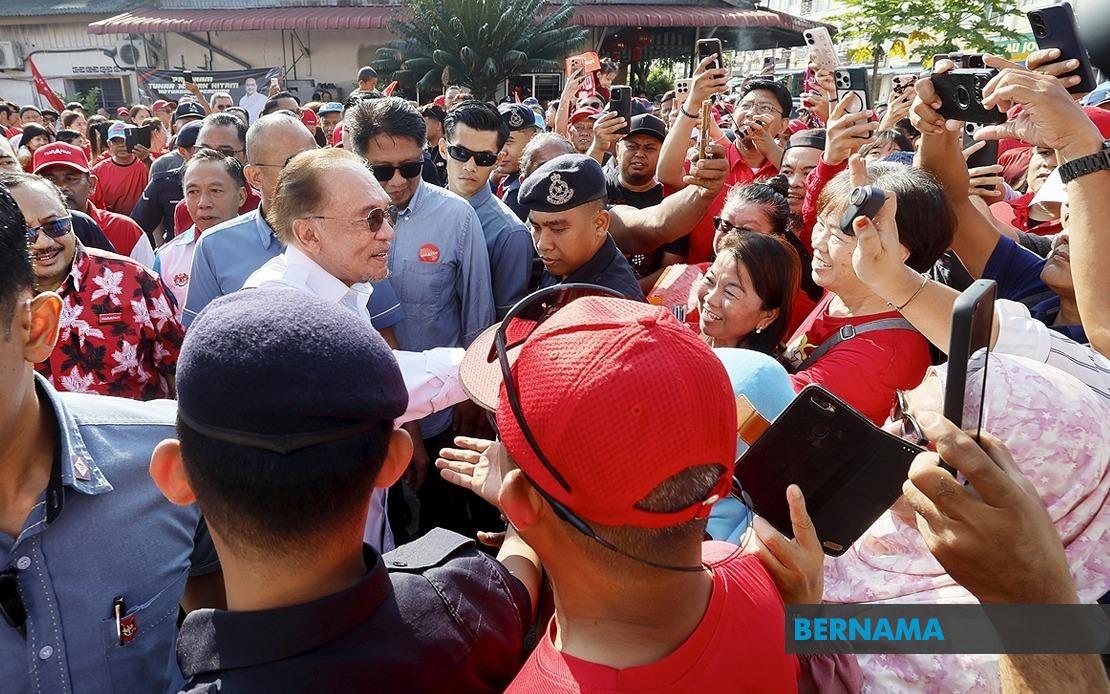
Prime Minister Datuk Seri Anwar Ibrahim moved to counter perceptions of political favouritism on Monday, asserting that his federal administration dispenses development assistance and welfare support on merit rather than partisan calculation. Speaking during a campaign event in Batu Pahat ahead of Johor's state election, the Pakatan Harapan chairman sought to distinguish his government's approach from previous administrations, emphasising that resource allocation follows genuine policy priorities.
Anwar's remarks carry particular weight given Malaysia's long history of centre-state tensions and accusations that federal funding flows preferentially to politically aligned states. By explicitly stating that his government has "never sidelined any state or community based on political affiliation," Anwar positioned his administration as a departure from such practices. This messaging proves especially significant in Johor, where the federal government's relationship with the state administration has historically carried considerable political weight given the state's economic importance and large population.
The Prime Minister cited concrete examples to substantiate his position. He pointed to the Johor-Singapore Special Economic Zone (JS-SEZ) as evidence of federal commitment to Johor's development trajectory, a project representing one of the largest regional economic initiatives involving Malaysia in recent years. Additionally, he highlighted federal approvals worth billions of ringgit directed toward flood mitigation infrastructure in Segamat and Muar, communities that have repeatedly experienced devastating monsoon inundation. These references suggest federal decision-making based on geographic need and economic potential rather than electoral calculations.
Beyond Johor, Anwar extended his argument to include states controlled by opposition parties. His mention of development initiatives in Kelantan and Kedah carries strategic importance, as these states have been governed by parties outside the Pakatan Harapan coalition. Kelantan has long been a stronghold of the opposition, while Kedah shifted hands between political coalitions in recent elections. By invoking these examples, Anwar attempted to demonstrate that federal resource allocation transcends coalition boundaries—a positioning intended to appeal to voters across the political spectrum.
The distinction Anwar drew between electioneering and governing proves analytically significant. He explicitly rejected what he characterised as the practice of promising assistance merely during campaign seasons, instead framing his government's approach as sustained, long-term commitment to nationwide development. This rhetoric attempts to shift voter attention from immediate campaign pledges toward perceived administrative track records. For Malaysian voters accustomed to cyclical political promises that evaporate between elections, such framing challenges a deeply embedded pattern of political behaviour.
The Senggarang campaign event itself demonstrated the coalition's mobilisation strategy heading into the Johor state election. The presence of Communications Minister Datuk Fahmi Fadzil underscored the event's significance to federal-level messaging, while local candidates Onn Abu Bakar, Mohd Khuzzan Abu Bakar and Felicia Poh Rui Ling represented Pakatan Harapan's slate in three closely watched constituencies. The choreography suggests coordination between federal leadership and state-level electoral efforts, typical of modern Malaysian political campaigns where local races increasingly receive central party attention.
Johor's electoral significance extends beyond its 56 state assembly seats. As Malaysia's second-most populous state and an economic engine comparable to some countries in the region, Johor's political complexion influences national stability. Federal-state relations in Johor therefore carry implications for governance efficiency, infrastructure development, and resource distribution affecting millions of Malaysians. Anwar's emphasis on equitable treatment directly addresses voter concerns about whether development resources will flow fairly if they choose a particular party.
The concept of meritocratic distribution versus partisan allocation has long vexed Malaysian governance. Previous administrations faced persistent criticism over allegedly directing federal funds toward politically sympathetic states while constraining resources to opposition-held territories. These practices, whether real or perceived, created regional development disparities that compounded political grievances. Anwar's positioning attempts to break this cycle by establishing federal neutrality as a governing principle, though such claims require extended implementation to gain credibility.
The timing of these remarks—during active state election campaigning—reflects political calculation within Malaysian electoral contexts. Voters in opposition-held or swing constituencies might view equitable federal treatment as particularly valuable. By emphasising fair resource distribution before the election, Anwar attempts to neutralise a common opposition argument that federal governments punish states led by opposition parties. This preemptive messaging aims to remove a potential obstacle to Pakatan Harapan's electoral prospects in Johor.
The broader context matters too. Malaysia's federal system delegates significant authority to state governments in areas like land management, Islamic affairs, and local economic development. However, revenue generation and major infrastructure financing remain concentrated at federal level. This structural arrangement creates inherent dependency of state governments on federal resource allocation, making equitable distribution a tangible governance issue affecting daily administration rather than mere political rhetoric.
For Southeast Asian observers, Anwar's remarks reflect broader regional governance challenges. Nations throughout the region grapple with tension between federal principles and partisan political interests, between resource distribution based on need versus political alignment. Malaysia's approach to resolving these tensions carries implications for federalism's viability as an organising principle across Southeast Asia's diverse political landscape.
The litmus test for Anwar's assertions will emerge through multi-year implementation patterns. Current campaign rhetoric holds limited value without sustained demonstration through budgetary allocation, project implementation timelines, and measurable development outcomes across states of all political colours. Malaysian voters, particularly those in opposition-held territories, possess legitimate grounds for scepticism based on historical experience. Whether this federal government achieves the stated principle of political neutrality in resource distribution will substantially influence not only Johor's electoral outcome but also broader patterns of federal-state relations throughout Malaysia's political future.

