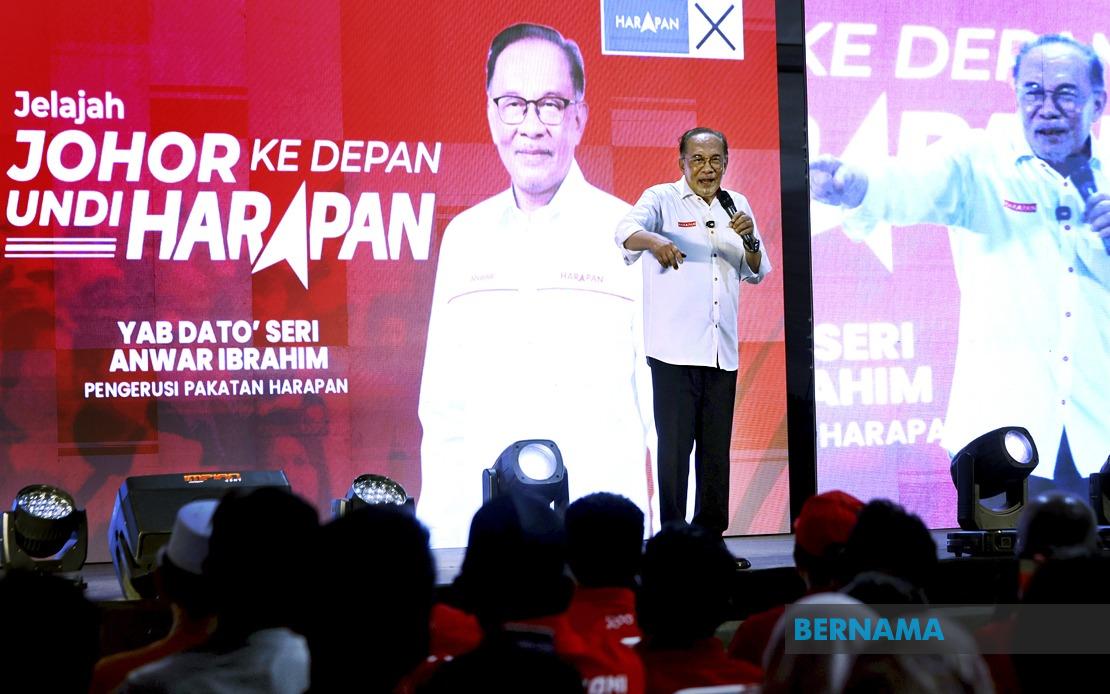
Prime Minister Datuk Seri Anwar Ibrahim has drawn a clear line in the sand regarding governance standards, declaring that Malaysia's days of systemic corruption and patronage networks are finished. Speaking at a campaign rally in Sungai Mati, Muar, the MADANI Government leader positioned the administration's anti-corruption stance as fundamental to national progress and international credibility, signalling that the institutional culture permitting officials to accumulate wealth through their positions has no place in his vision for the country.
The Prime Minister's remarks carried particular weight given their timing, coinciding with the campaign for the Johor State Election scheduled for July 11, where 56 state seats are contested by 172 candidates. Anwar's emphasis on integrity as a non-negotiable leadership criterion reflects an attempt to recalibrate political discourse away from divisive communal appeals and towards shared standards of public accountability. By articulating that he welcomes competent and honest leaders across all ethnic communities—Malays, Chinese, and others—he appears to be challenging opposition narratives that attempt to weaponise identity politics.
Central to Anwar's message is his assertion that the government will maintain strict institutional barriers against graft. He specifically rejected the previous era's normalised practices of officeholders leveraging their positions to enrich themselves, their families, and political associates through government contracts and resource allocation. The reference to using state power to "make my children rich or award contracts to my wife" pointed unmistakably at patterns observed during earlier administrations, framing anti-corruption efforts not merely as legal enforcement but as fundamental cultural reform.
For Malaysian investors and international observers, Anwar's reiteration of zero-tolerance policies carries economic implications. Nations and multinational corporations increasingly factor governance quality and corruption risk into investment decisions. By reinforcing that his administration will not shield officials from accountability, the Prime Minister attempted to strengthen Malaysia's position as a transparent investment destination relative to regional competitors facing similar governance challenges.
The campaign context is significant for understanding these statements' political dimensions. Anwar, leading the Pakatan Harapan coalition, faces opposition parties he characterises as motivated primarily by desires to recapture federal power rather than substantive policy disagreements. By framing the election through the lens of integrity versus self-serving leadership, he sought to redirect voter attention towards what his coalition presents as core differences in governance philosophy and administrative conduct.
Public concerns about corruption remain substantial across Malaysian society, with periodic scandals involving misappropriated development funds, inflated procurement contracts, and patronage appointments continuing to erode confidence in state institutions. Anwar's repeated public commitments to eradication may be partly calculated to address this persistent anxiety, though the gap between rhetorical commitment and enforcement across the sprawling federal bureaucracy remains a critical challenge. Implementation requires sustained will across multiple agencies, from the Malaysian Anti-Corruption Commission to the Auditor General's office.
The presence of Penang Chief Minister Chow Kon Yeow and Ledang MP Syed Ibrahim Syed Noh at the Johor event underscored efforts to present the Pakatan Harapan coalition as unified around these governance standards. Chow's administration in Penang has cultivated a reputation for relative transparency in state-level procurement and appointments, lending credibility to the broader coalition message, though implementation disparities across states governed by PH components remain evident.
Anwar's invitation for Johor voters to judge leaders on honesty and integrity rather than "political rhetoric aimed at concealing past abuses" constituted a direct challenge to opposition messaging strategies that he apparently views as reliant on misdirection. This framing implicitly acknowledged that opposition parties likely command sympathetic audiences in portions of Johor's electorate and sought to shift the evaluative criteria applied by undecided voters.
The intensity of Anwar's campaign effort in Johor—completing 15 engagements over two days and eight on the day of the Sungai Mati event—reflected the state's electoral significance to federal political dynamics. Johor, traditionally a Barisan Nasional stronghold, represents contested territory where Pakatan Harapan seeks to consolidate support following its 2022 federal election gains. Strong performance in state elections provides momentum for federal politics and validates coalition governance messages.
Economic dimensions of corruption directly affect Johor's development prospects. State government contracts and federal fund allocations flow through systems vulnerable to diversion if anti-corruption protocols remain weak. Public infrastructure, education facilities, and healthcare improvements depend partly on ensuring allocated resources reach intended purposes rather than enriching officials and their networks. Voters' assessments of whether leaders truly prioritise public welfare over personal enrichment thus carry tangible consequences for service delivery in their constituencies.
The election itself will test whether Anwar's anti-corruption messaging resonates sufficiently to shift voter preferences in a state where communal and historical loyalties have conventionally predominated. The outcome may provide indicators regarding whether governance quality and institutional integrity rank high enough on voter priority lists to counterbalance other electoral motivations across Malaysia more broadly.
Moving forward, the test of these commitments extends beyond rhetorical emphasis to sustained investigative pressure, prosecutorial follow-through, and institutional reform. International transparency organisations and domestic civil society groups will likely scrutinise whether administrations dominated by Pakatan Harapan parties actually prosecute high-profile corruption cases without regard to political affiliation, and whether systemic vulnerabilities enabling graft receive structural attention alongside individual accountability measures.

