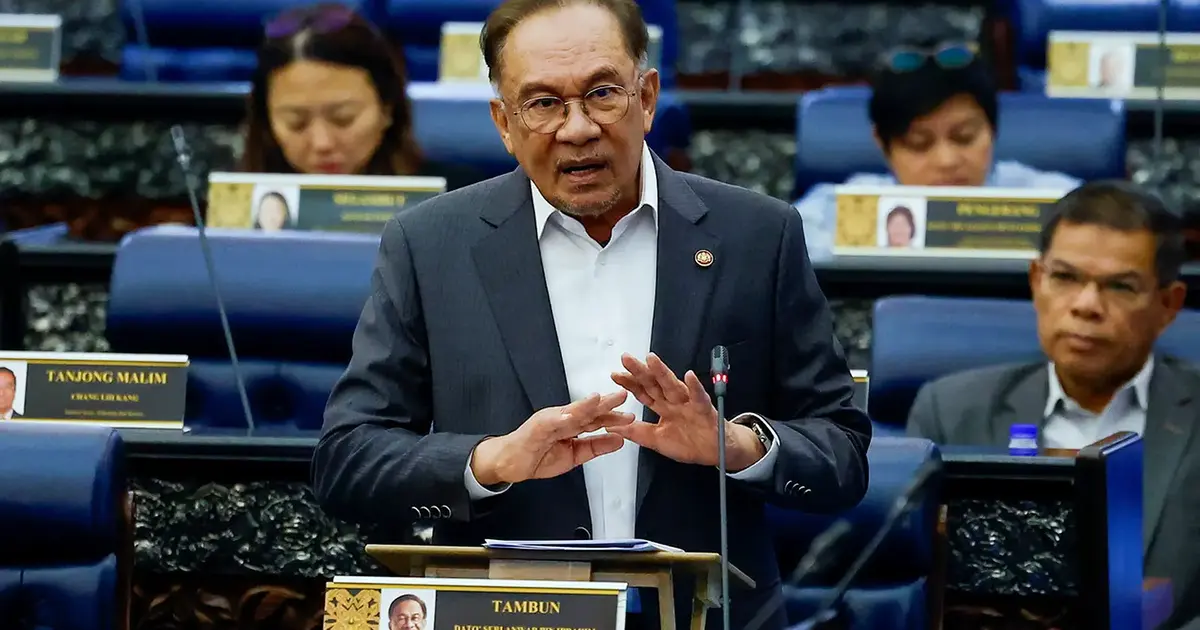
Prime Minister Anwar Ibrahim has clarified that the framework governing Sabah's special grant allocations was not a new arrangement introduced under the current administration, but rather a commitment that the preceding Warisan-led state government had already ratified. The disclosure addresses ongoing discussions about federal financial support mechanisms for the East Malaysian state, establishing a continuity in policy approach across successive administrations.
According to Anwar, the escalating grant structure was formally endorsed by the state government led by Warisan, with allocations beginning at RM53.4 million in the 2020 and 2021 financial years. This initial baseline represented a significant commitment of federal resources toward addressing specific development priorities and administrative needs identified within Sabah's governance framework. The figure reflected contemporary assessments of the state's financial requirements and the federal government's capacity to provide targeted assistance beyond standard revenue-sharing arrangements.
The trajectory of these special grants demonstrates a consistent pattern of increases across the ensuing period. By 2024, the allocation had expanded substantially to RM106.8 million, effectively doubling the initial amount committed during the earlier years. This progressive elevation indicates either a reassessment of Sabah's needs, an adjustment for inflation and economic factors, or a deliberate policy decision to incrementally enhance support as circumstances permitted. The doubling represents a notable expansion in federal commitment to the state's development agenda.
Anwar's statement carries particular significance in the Malaysian federal context, where East Malaysian states—Sabah and Sarawak—occupy a constitutionally distinct position. These territories maintain separate jurisdictions in critical areas including land, taxation, and immigration, necessitating negotiated arrangements for federal support rather than uniform nationwide policies. Special grants have historically served as mechanisms through which the federal government addresses gaps between state revenues and expenditure requirements, particularly for infrastructure and service delivery in less urbanised regions.
The confirmation that the previous administration had sanctioned these grant rates provides political cover for the current government's continuation of the arrangement. It demonstrates that the federal government is honouring commitments made across different administrations, rather than unilaterally imposing new terms. This consistency builds confidence among state-level stakeholders and suggests a measure of political consensus on Sabah's developmental priorities, regardless of which coalition controls federal power.
For Sabah's population and governance apparatus, these grants represent crucial funding for operations and development projects that state revenues alone cannot sustain. Given the state's economic structure, which has historically relied on commodity exports including timber and palm oil alongside tourism, diversification and infrastructure development require substantial capital infusion. The grants provide flexibility in state budget allocations, allowing administrations to invest in healthcare, education, and physical infrastructure without necessarily depleting reserves or incurring excessive debt.
The doubling of allocations over four years reflects the federal government's recognition that Sabah's fiscal challenges require escalating intervention. Whether driven by actual cost increases, population growth, or policy prioritisation, the trajectory suggests that Malaysian authorities view Sabah as a development priority warranting enhanced resource transfer. This aligns with broader national objectives to reduce regional disparities and ensure that East Malaysian states participate equitably in national development gains.
For Southeast Asian observers, the arrangement illustrates how federal systems navigate the tension between centralised monetary policy and regionally differentiated spending priorities. Malaysia's special grant mechanism for Sabah parallels arrangements in other federalised economies where constituent states require asymmetric support. The transparent acknowledgment of historical commitments strengthens the institutional credibility of such arrangements, which depend on predictability and political continuity to function effectively.
Anwar's statement also addresses potential criticism that the current administration had inflated Sabah's funding without proper justification. By anchoring the 2024 allocation to a framework agreed under a different government, the Prime Minister positioned these grants as a legacy of sound bilateral planning rather than a partisan initiative. This framing matters significantly in Malaysian politics, where state governments controlled by opposition coalitions may scrutinise federal spending patterns for evidence of political bias or reward mechanisms.
The continuing enhancement of these grants reflects demographic and infrastructural realities in Sabah. The state's population of approximately 3.9 million requires expanding service capacity across health, education, and transport networks. Urban centres including Kota Kinabalu and Sandakan experience growth pressures that demand infrastructure investment, while rural areas require connectivity and utility improvements. Special grants provide dedicated financing for such projects without competing directly with federal allocations designated for other regions or purposes.
Moving forward, the precedent established through Warisan's prior agreement and the subsequent doubling of allocations may set expectations for continued increases. State administrations—whether currently controlled by Warisan or other coalitions—may anticipate that grant amounts will continue expanding, particularly if economic conditions and demographic trends warrant such increases. This creates an ongoing negotiation point between federal and state authorities regarding resource adequacy and financial sustainability.
The broader implications extend to Malaysian federalism and centre-state relations. Special grants represent one tool through which the federal government balances constitutional distribution of powers with practical needs for intergovernmental transfers. As Sabah's economy evolves and development priorities shift, these grant mechanisms will likely require periodic recalibration. The acknowledgment that previous administrations established the framework demonstrates that such recalibration functions most effectively through continuity and bipartisan consensus rather than abrupt policy reversals.

