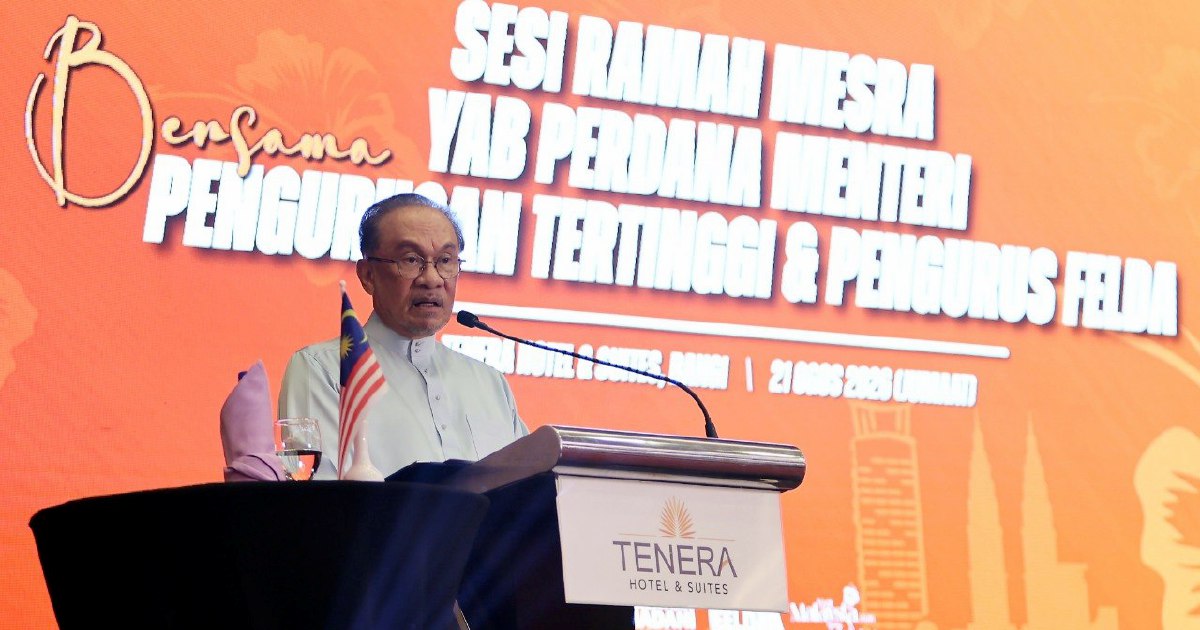
Prime Minister Datuk Seri Anwar Ibrahim confirmed in Bangi today that a specially constituted task force has commenced its investigation into various matters concerning the Federal Land Development Authority, signalling the government's commitment to examining long-standing issues at the organisation. The establishment of this task force represents a significant development in addressing concerns that have accumulated around Felda's operations and governance structures. Anwar indicated that comprehensive findings from the inquiry would be made public only after the investigative work reaches completion, suggesting a thorough and methodical approach rather than preliminary statements.
Felda, which has been a cornerstone of Malaysia's agricultural and rural development policy since its establishment in 1956, has faced mounting scrutiny over its financial performance and operational effectiveness in recent years. The scheme, which settled hundreds of thousands of landless families across multiple generations, has become increasingly complex as it navigates contemporary market pressures, ageing infrastructure, and demographic shifts in its settler communities. Understanding the scope of the task force's mandate is essential for appreciating the significance of this announcement, particularly for the estimated 400,000 settler families and their descendants who depend on the organisation's viability.
The creation of a dedicated task force underscores mounting pressure on the government to comprehensively address structural and procedural concerns that have long troubled Felda's stakeholders. These issues extend beyond simple operational inefficiencies to encompass governance challenges, questions about asset management, and broader concerns regarding the scheme's contemporary relevance in Malaysia's evolving agricultural landscape. The task force's independence and composition will likely determine public confidence in the findings and the likelihood of meaningful reform emerging from the investigation.
Anwar's statement carries particular weight given his administration's broader emphasis on transparency and institutional accountability. The explicit mention that findings will be released only upon completion suggests the government is prioritising comprehensive investigation over rapid political positioning. This approach contrasts with previous handling of controversial state-linked organisations, where public pressure sometimes accelerated disclosure timelines before investigations were fully concluded. For Malaysian observers accustomed to more opaque governance processes, the commitment to completing work before announcement represents a shift in institutional culture.
Felda settlers, who represent a significant rural constituency and voting bloc, have watched these developments with considerable interest. Many have experienced declining incomes, inadequate support services, and inconsistent returns from land holdings. The task force's investigation offers potential pathways to understanding whether these challenges stem from systemic failures, resource constraints, management decisions, or market conditions beyond the organisation's control. The findings could inform policy adjustments affecting hundreds of thousands of rural households across Peninsular Malaysia, Sabah, and Sarawak.
The timing of this announcement reflects broader efforts to restore institutional credibility across Malaysia's public sector. Felda has weathered previous controversies, including questions about land acquisition, settler welfare, and financial transparency. A comprehensive task force examination provides opportunity for the government to identify root causes of dysfunction and propose evidence-based solutions rather than ad-hoc interventions. This methodical approach, though slower than some expect, potentially yields more durable reforms.
Regional dynamics also merit consideration. Throughout Southeast Asia, government-sponsored agricultural settlement schemes face similar pressures—demographic change, global commodity price volatility, environmental sustainability requirements, and competition from commercial agriculture. Felda's experience and the findings from this investigation could offer instructive lessons for other nations managing large-scale settler populations dependent on primary commodity production. Malaysia's approach to examining and reforming such institutions may establish useful precedents for the region.
The commitment to releasing findings upon completion represents a significant accountability mechanism. Public announcement of the task force's conclusions will enable scrutiny from settler representatives, opposition parliamentarians, civil society organisations, and agricultural economists. This transparency requirement creates pressure on the task force to produce rigorous, well-documented findings that can withstand external examination. The announcement has thus established a framework through which Malaysians can meaningfully evaluate government responses to institutional challenges.
For stakeholders across the supply chains dependent on Felda's operations—commodity traders, agricultural service providers, rural cooperatives, and export firms—the investigation's conclusions will carry direct business implications. Potential reforms could affect land-use patterns, production systems, market access arrangements, and capital investment requirements. The task force's findings may therefore influence not only Felda settlers' circumstances but also broader agricultural sector dynamics across Malaysia's rural economy.
Anwar's announcement also signals that institutional examination and potential reform represent ongoing government priorities despite competing pressures. While the task force's work proceeds without predetermined timeline, the government has explicitly committed to public disclosure of results. This represents a middle position between demands for immediate action and complete administrative silence. For Malaysian stakeholders monitoring Felda's future, the task force's eventual findings will likely prove more consequential than today's announcement of its commencement.

