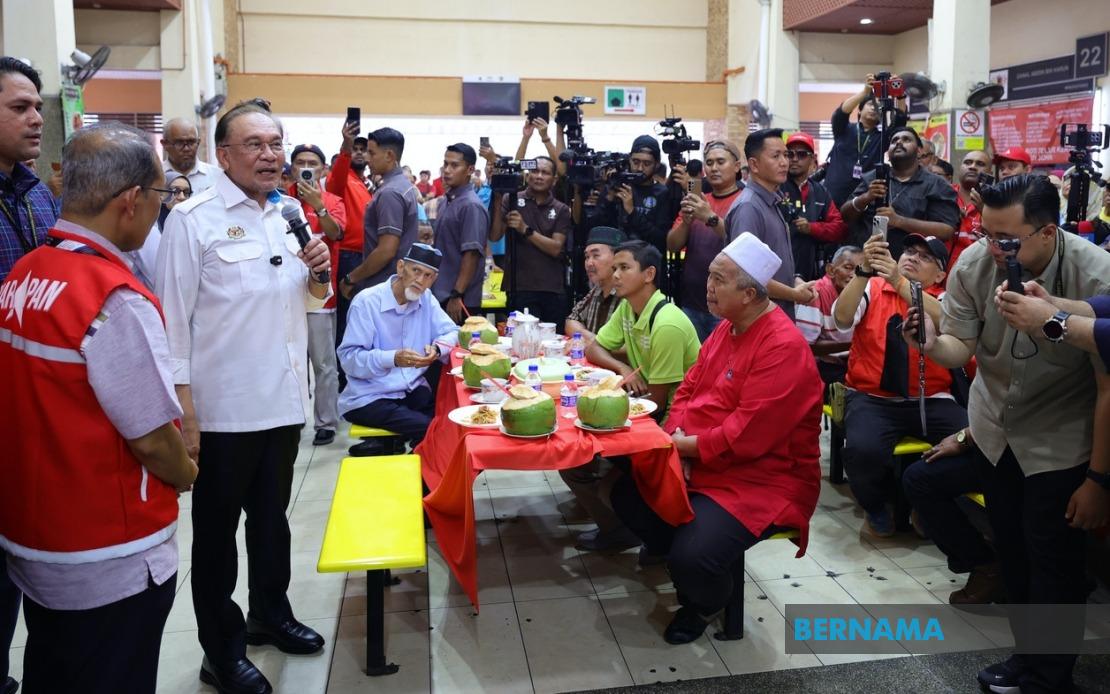
Prime Minister Datuk Seri Anwar Ibrahim has made a direct appeal to Negeri Sembilan voters to maintain their confidence in Pakatan Harapan, framing the upcoming state election as a referendum on political stability and coordinated governance. Speaking in Seremban on July 22, Anwar stressed that securing a renewed mandate for the coalition is essential to preserving the political equilibrium that has characterised the state over the past three years, while enabling seamless collaboration between state and federal authorities on development and welfare initiatives.
The appeal reflects PH's strategy of positioning itself as a stabilising force rather than advocating for transformative change. Anwar, who holds the dual roles of Prime Minister and PH chairman, emphasised that consistent governance arrangements allow for more efficient implementation of public programmes and infrastructure projects. This messaging suggests the coalition views electoral contests through the lens of administrative continuity rather than ideological contestation, a shift from PH's earlier positioning as a reform-oriented alternative to long-established political structures.
Anwar specifically acknowledged the stewardship of Menteri Besar Datuk Seri Aminuddin Harun, crediting him with maintaining stability in Negeri Sembilan over three years through collaborative relationships with coalition partners. The invocation of Aminuddin's record represents a calculated effort to localise PH's national narrative, suggesting that federal and state leadership operate as integrated parts of a coherent governance framework. For voters accustomed to viewing state and federal politics as separate contests with distinct stakes, this framing attempts to link electoral choices at the state level directly to broader governance outcomes.
However, Anwar's acknowledgment that PH's policies remain imperfect introduces an element of candour often absent from campaign rhetoric. By conceding that no administration achieves flawlessness, he attempts to preempt criticism while inviting voters to view an electoral endorsement as provisional consent contingent on demonstrated improvement. This formulation—requesting voter patience in exchange for the promise of responsiveness—positions PH as willing to accept feedback and iterate on its approaches, a rhetorical stance designed to appeal to constituencies that may harbour reservations about specific policies while remaining open to continued PH governance.
The composition of PH's slate for the Negeri Sembilan contest reflects internal power dynamics within the coalition. The distribution across three partners—16 seats for PKR, 11 for DAP, and nine for Amanah—allocates the largest share to PKR, the party chaired by Anwar himself, while providing meaningful representation to both DAP and Amanah. This arrangement suggests that coalition negotiations have been sufficiently settled to prevent public friction, though questions remain about whether the allocation reflects genuine inter-party equilibrium or represents internal compromises that may generate future tensions.
The timing of Anwar's campaign presence in Negeri Sembilan carries symbolic weight in Malaysian politics. Direct involvement by the Prime Minister in state-level contests signals that PH views the election as consequential to its national political standing, despite the formal distinction between state and federal authority. For voters considering their ballots, the appearance of the country's top political leader serves as tacit acknowledgment that state electoral outcomes carry implications beyond local governance—a reality that may mobilise voters concerned with national political trajectories as much as parochial state interests.
The Election Commission's scheduling of polling day for August 1, with early voting commencing July 28, provides a compressed campaign window spanning approximately one week from Anwar's remarks. This timetable suggests that decisive elements of voter preference may already be crystallised, with campaign activity serving primarily to mobilise existing support rather than convert undecided voters. The early voting provision enables certain categories of voters—public sector employees, security personnel, and those unable to vote on polling day—to participate before the main election, a mechanism that historically has benefited PH in Negeri Sembilan, where federal government employment remains relatively concentrated.
For Malaysian observers tracking broader coalition dynamics, the Negeri Sembilan contest offers diagnostic value regarding PH's internal cohesion and electoral appeal. Negeri Sembilan, a state with a relatively compact population and mixed rural-urban characteristics, presents electoral terrain distinct from Selangor or Penang, where PH has demonstrated robust support, or from Kelantan and Terengganu, where PAS has achieved dominance. The state's results will illuminate whether the coalition's apparent stability at the federal level translates into sustained voter support at the subnational tier, where governance performance becomes tangible through the delivery of services and management of local issues.
The substantive policy dimensions of Anwar's campaign remarks remain notably abstract. Rather than advancing specific development agendas or distinguishing PH's Negeri Sembilan platform from opposition alternatives, his messaging emphasises continuity, cooperation, and responsiveness. This approach contrasts sharply with earlier Malaysian election campaigns characterised by polarised positions on constitutional, religious, or economic fundamentals. Whether such an orientation signals voter appetite for stability-focused governance or reflects PH's strategic calculation that polarisation serves opposition interests remains unclear until ballots are counted and voter preferences revealed.
The Prime Minister's presence and framing of the election around stability and federal-state coordination underscores how Malaysian electoral contests increasingly revolve around questions of administrative competence and alliance management rather than programmatic alternatives. For Southeast Asian observers comparing governance dynamics across the region, Malaysia's evolution toward elections contested on grounds of bureaucratic continuity rather than substantive policy alternatives or ideological distinction represents a significant departure from earlier patterns of democratisation-era competition.

