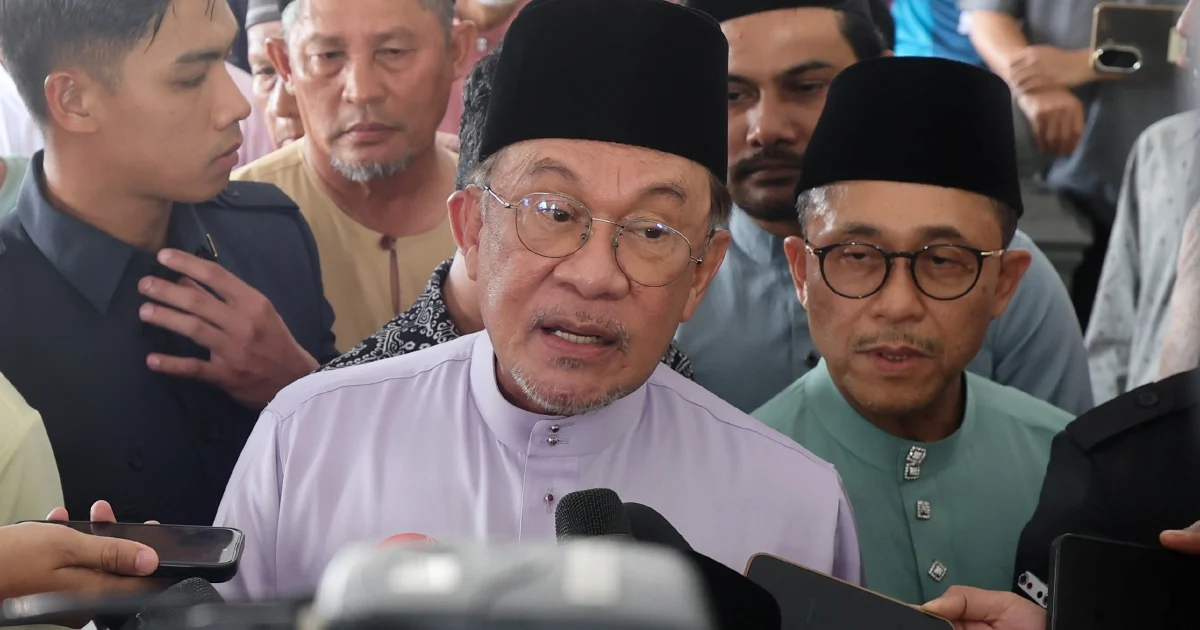
Prime Minister Datuk Seri Anwar Ibrahim has moved to reassure Malaysia's non-Muslim communities that the government's plans to strengthen the Syariah court framework will not encroach upon their fundamental right to freely observe their respective faiths. Speaking from Putrajaya, the Prime Minister stressed that institutional reforms designed to elevate the Syariah court system should be understood as an effort to improve judicial efficiency within the Islamic legal sphere rather than as a step toward broadening its jurisdiction beyond Muslim personal law matters.
The clarification comes at a time when discussions surrounding the constitutional position and operational scope of Syariah courts have attracted considerable attention from both religious scholars and civil society observers across Malaysia. The government's positioning reflects a balancing act increasingly familiar in Malaysia's plural democracy, where the dual legal system must accommodate both Islamic jurisprudence for Muslim citizens and secular constitutional protections for non-Muslims. Anwar's statement represents an explicit acknowledgement that such institutional strengthening initiatives can generate anxiety among minority communities, particularly when details remain limited or when previous court decisions have appeared to test jurisdictional boundaries.
The Prime Minister's emphasis on protecting non-Muslim religious liberty reflects Malaysia's constitutional framework, which guarantees Article 11 freedoms—the constitutional bedrock ensuring all citizens can profess, practise, and propagate their chosen religion. This constitutional arrangement, formalized in the Federation of Malaya Agreement and carried forward into the Malaysian Constitution, remains a foundational principle despite ongoing debates about its interpretation and application. The government's message seeks to reinforce that constitutional certainty while advancing internal reforms within the Islamic justice system, a distinction that requires careful political communication in a country where interfaith relations command significant public attention.
The focus on Syariah court institutional development reflects broader governance priorities within the current administration. Strengthening these courts could encompass improvements in case management systems, judicial training programmes, court infrastructure, or efficiency measures designed to reduce case backlogs and improve service delivery for Muslim litigants engaging with family law, inheritance, and religious matters handled within this distinct legal framework. Such administrative and procedural enhancements differ fundamentally from attempts to expand Syariah jurisdictional reach into spheres traditionally governed by secular civil law, a distinction the Prime Minister's remarks underscore.
For Malaysia's non-Muslim population—comprising approximately 40 percent of the country's over 33 million residents, including Buddhist, Christian, Hindu, and Sikh communities alongside smaller faith groups—concerns about Syariah court expansion occasionally resurface during periods of institutional reform. These anxieties, though often rooted in historical awareness of jurisdictional disputes in other Muslim-majority countries, reflect legitimate vigilance regarding the balance between religious accommodation and secular constitutional governance. The Prime Minister's public assurance directly addresses such concerns and signals government intent to proceed with reform while maintaining the established constitutional division between religious and civil law domains.
The timing of this clarification also reflects Malaysia's position within a broader Southeast Asian context where religious pluralism and constitutional secularism coexist with varying degrees of tension. Unlike some regional neighbours where one faith predominates and shapes legal frameworks entirely, Malaysia has constructed a system explicitly recognizing religious diversity while simultaneously accommodating Islam's special constitutional position. This distinctive arrangement requires constant articulation and reaffirmation, particularly when institutional modifications occur. Anwar's statement positions Malaysia as a nation capable of strengthening religious institutions while honouring constitutional commitments to minority protection.
Within Malaysia's governance structure, the federal government shares responsibility for Islamic affairs with state governments, which exercise considerable authority over Syariah court administration and Islamic law implementation. This constitutional division means that Syariah court strengthening initiatives may unfold at multiple administrative levels, potentially creating coordination challenges or variation in approach across different states. The Prime Minister's nationwide assurance therefore serves to establish consistent federal messaging even as implementation may involve multiple stakeholders with different institutional interests and policy emphases.
The statement also reflects awareness that civil society organizations and religious minorities actively monitor developments affecting religious freedoms and constitutional rights. Malaysian civil society maintains robust networks for advocacy and information-sharing, ensuring that government initiatives receive scrutiny and that minority concerns find platforms for expression. By proactively addressing potential anxieties, the Prime Minister's office demonstrates engagement with these constituencies and commitment to transparency regarding government intentions. This approach contrasts with alternatives involving unilateral action followed by defensive explanation of actual impacts.
Moving forward, the substance of Syariah court strengthening measures will determine whether Anwar's assurances receive validation through implementation. Specific reforms that maintain transparent jurisdictional boundaries, respect established constitutional frameworks, and avoid incremental expansion into civil law spheres will reinforce the credibility of government assurances. Conversely, any initiatives perceived as extending Syariah court authority beyond traditional personal law domains would undermine the clarity established through the Prime Minister's remarks and potentially reignite community tensions surrounding religious governance.
The government's articulated commitment to non-Muslim religious freedoms while advancing Syariah institutional development reflects recognition that Malaysia's stability and progress depend upon maintaining constitutional balance. As institutional reforms proceed, continued explicit affirmation of constitutional protections for religious minorities will remain essential to maintaining the delicate equilibrium that characterizes Malaysia's unique approach to religious pluralism within an Islamic-majority democracy.

