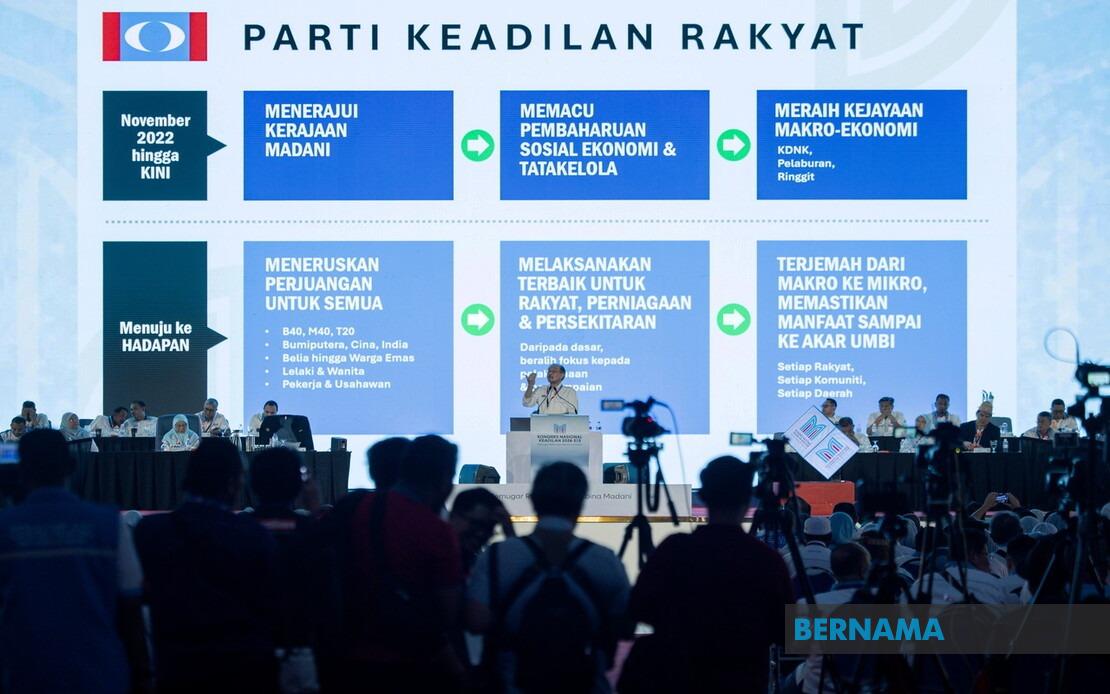
Prime Minister Datuk Seri Anwar Ibrahim has handed a full mandate to Home Minister Datuk Seri Saifuddin Nasution Ismail to assume the duties of PKR deputy president, filling a gap created by the temporary absence of Nurul Izzah Anwar. Speaking at the PKR National Congress 2026 held at the Melaka International Trade Centre on August 16, Anwar framed the appointment as a necessary consolidation of leadership within the party machinery, emphasising Saifuddin Nasution's long-standing loyalty and understanding of the president's working style.
The interim arrangement follows a decision made by the PKR Central Leadership Council on August 6, which approved the temporary leave for Nurul Izzah and Saifuddin Nasution's assumption of deputy presidential duties. This move represents a significant recalibration of responsibilities within PKR's upper echelon, particularly as the party navigates recent electoral setbacks. Anwar's public declaration of confidence in his veteran lieutenant signals stability at a moment when questions about party direction have begun to surface, particularly following disappointing results in recent state-level contests.
Saifuddin Nasution's elevation to interim deputy president comes as he simultaneously maintains his portfolio as Home Minister, a dual responsibility that underscores his importance to both the party and the government. The appointment acknowledges his experience in managing complex administrative machinery and his alignment with Anwar's strategic vision. In his address to party delegates, Anwar stressed that the entire PKR organisation should extend its unequivocal backing to Saifuddin Nasution as he takes on these expanded duties, effectively calling for party unity behind the transitional arrangement.
Concurrently, Anwar announced complementary structural changes designed to optimise PKR's operational effectiveness heading into the medium term. Datuk Seri Amirudin Shari, another vice-president, has been appointed as the party's election director, positioning him centrally in electoral strategy and campaign coordination. Separately, Tengku Datuk Seri Zafrul Tengku Abdul Aziz has been assigned the role of coordinator in the Prime Minister's Office, facilitating closer alignment between party apparatus and government machinery. These appointments reflect a deliberate effort to concentrate key operational functions among trusted lieutenants.
A notable complication emerged in Anwar's handling of the Negeri Sembilan situation, where PKR's performance in the recent state election on August 1 has prompted grassroots demands for change. Six PKR division chiefs in the state called for a review of Datuk Seri Aminuddin Harun's position as chairman of the Negeri Sembilan PKR State Leadership Council, signalling internal dissatisfaction with the party's strategic direction at state level. Rather than immediately acceding to these calls, Anwar has redirected Aminuddin to concentrate exclusively on his role as vice-president, specifically overseeing the development and training of emerging PKR cadres.
Anwar's rationale for defending Aminuddin, despite the electoral loss, rested on a principle of collective responsibility rather than individual culpability. The Prime Minister argued that the defeat in Negeri Sembilan should not be attributed solely to Aminuddin, but instead should be viewed as a shared setback requiring collective reflection and corrective action. This framing suggests Anwar is seeking to preserve the position of a valued ally while simultaneously signalling that PKR must improve its performance across the board. However, the public nature of the divisional chiefs' concerns indicates underlying tensions that may not be entirely resolved by Anwar's intervention.
For Malaysian political observers, these internal PKR adjustments carry implications beyond party machinery. As the ruling coalition partner, PKR's organisational health and morale directly affect the stability of the Anwar government. The recent electoral disappointments in Negeri Sembilan, combined with earlier setbacks, have fuelled questions about whether PKR can maintain electoral momentum as the government approaches its mid-term review. Leadership appointments and crisis management at this juncture carry symbolic weight, signalling either strength or vulnerability to both supporters and critics.
The appointment of Saifuddin Nasution as interim deputy president also reflects broader patterns within PKR's evolution under Anwar's stewardship. The party has increasingly gravitated toward a model in which Anwar himself serves as the dominant decision-making centre, with senior positions distributed among figures perceived as loyal and competent rather than as a means of rotating power or elevating potential successors. Saifuddin Nasution's appointment strengthens this model by placing a long-serving administrator in a crucial coordinating role without necessarily signalling a shift toward succession planning.
The structural changes announced at the congress suggest PKR is attempting to tighten internal discipline and improve electoral coordination ahead of anticipated challenges. Amirudin Shari's appointment as election director responds directly to the need for more systematic campaign organisation, while Tengku Zafrul's role in the Prime Minister's Office creates institutional linkages that can facilitate faster decision-making and resource mobilisation. These moves indicate an organisation alert to its shortcomings but attempting to address them through structural adjustment rather than more fundamental strategic reassessment.
For PKR members and aligned observers, Anwar's emphasis on unity and collective effort represents a call for patience and solidarity during a difficult period. The demand for party members to extend full support and loyalty to Saifuddin Nasution, explicitly mentioned in Anwar's speech, underscores that internal dissent—whether directed at Aminuddin in Negeri Sembilan or at other party figures—must be subordinated to broader organisational objectives. This message carries weight in the context of ongoing coalition pressures and the wider political environment in which PKR operates.
Looking forward, the success of these appointments will likely depend on whether PKR can reverse its recent electoral trajectory and rebuild confidence among members and voters. Saifuddin Nasution's interim tenure as deputy president will be measured not merely by his administrative competence but by whether PKR can demonstrate renewed vigour in its campaigns and policy advocacy. Similarly, the fate of Aminuddin Harun and his redefined role in cadre training will be shaped by how effectively PKR can develop and mobilise a new generation of party activists to address grassroots concerns and electoral challenges across the peninsula.

